
By Gareth Vaughan
Two key arguments used by the Reserve Bank and Prime Minister against the introduction of deposit insurance are disputed by international deposit insurance expert and University of Auckland Professor David Mayes.
Mayes told interest.co.nz there's limited evidence to support the Reserve Bank's argument that a deposit insurance scheme would increase moral hazard, and make banks more susceptible to failure. And he's even more dismissive of John Key's view that deposit insurance would prove too costly for consumers because banks would pass on the cost of any deposit insurance levy to consumers.
"The costs of deposit insurance are trivial," said Mayes. "In particular if deposits are not insured banks have to pay more for them so in many respects it (deposit insurance) pays for itself."
And in terms of the moral hazard argument; "There is only limited evidence of such moral hazard. On the whole deposit insurance systems cope outside major financial crises. They are designed for the occasional failure not the wholesale collapse of the financial system."
Mayes is Professor of Banking and Financial Institutions at the Auckland University Business School. He has been an advisor to the Bank of Finland's board, and Professor of Economics at London's South Bank University. He has also worked as chief economist at the Reserve Bank of New Zealand. His comments came after interest.co.nz contacted the International Association of Deposit Insurers (IADI), with questions about the Reserve Bank and Key's comments. Carlos Isoard, IADI's Secretary General, replied that it was IADI's policy not to comment on domestic matters, but Mayes, a member of the IADI Advisory Panel, had offered to respond.
The IADI represents 67 deposit insurers from 66 jurisdictions. It's based at the Bank for International Settlements in Basel, Switzerland.
In a speech last week, Toby Fiennes, the Reserve Bank's head of prudential supervision said New Zealand was the only OECD country without explicit deposit insurance for reasons mainly to do with moral hazard and the sheer difficulties of defining boundaries and pricing. The Reserve Bank believed it better to keep risk of failure very low, including through a strong regulatory regime, than to build structures that could distort incentives and behaviour, said Fiennes.
'Big banks don't expect to be allowed to fail'
Fiennes also went on to say that deposit insurance isn't always effective in preventing bank runs by retail depositors, noting Britain's Northern Rock suffered a "classic retail run" in 2007, despite there being a deposit insurance scheme in place.
However, Mayes said it's not clear that there is much distortion except in developing countries or emerging markets.
"The main (New Zealand) banks do not expect to fail (and) neither do they expect to be allowed to fail," said Mayes. "I doubt if they believe OBR (the Reserve Bank's Open Bank Resolution policy) will be applied."
"Northern Rock experienced a run because the insurance was partial. After the first £2,000 the depositor took a haircut of 10% and the upper limit was £35,000, well below present limits (which are £85,000). No one now believes co-insurance of this form works and almost everybody except the British didn’t believe it worked then," Mayes added.
"In any case this is a very strange example as it illustrates the problems from not having deposit insurance rather than having a well designed scheme."
Fiennes also said deposit insurance is hard to price accurately and fairly, and comes with difficult boundary issues. He questioned whether it should just be for banks, or whether the net should be spread wider to include finance companies, building societies and credit unions.
But Mayes said everybody faces this problem and they make judgements about how to scale risk weighted contributions.
"No doubt the balance is not right but it applies the right sort of incentives to become less risky. To my mind all deposit taking institutions should be properly supervised and hence eligible for insurance. We (New Zealand) are in a small minority in thinking otherwise," said Mayes.
"Those who don’t fail always contribute more than those who do - this is the nature of insurance. It is normally only the small who fail outside the global financial crisis of course. Large banks get a considerable subsidy as it is so this only rights the balance a little."
'OBR needs deposit insurance'
An important issue, Mayes added, is that deposit insurance is not an alternative to OBR. One of the arguments the IADI makes for deposit insurance is that ordinary small depositors can't be expected to monitor, or indeed be able to monitor, the banks with whom they have deposits.
"OBR is a sensible idea as it resolves the problems in the large banks swiftly with minimum recourse to the taxpayer. But it only makes sense with deposit insurance. Then there will be no run if people hear a rumour about a bank being in trouble. As it is you will get the Northern Rock problem," Mayes said.
Both Labour and the Greens have pledged to re-introduce deposit insurance should they get into government. Labour's finance spokesman David Parker says a Labour-led government would ensure the first NZ$30,000 of all bank deposits were protected and not subject to a haircut in the event of a bank failure. And Greens co-leader Russel Norman says NZ$100,000 is a "fair level" of protection for New Zealand savers. In his speech Fiennes did say deposit insurance could "easily" be accommodated within the central bank's toolkit.
New Zealand had deposit insurance through the Crown retail deposit guarantee scheme, which ran for 38 months from October 2008 until the end of 2011 and cost taxpayers' around NZ$1 billion largely due to the demise of South Canterbury Finance.
Meanwhile, New Zealand's registered banks are required to pre-position their systems by June 30 this year so the OBR process can operate, if it's ever activated. It's touted as an alternative the Government could use in the event of a bank failure to a liquidation or taxpayer funded bailout. The Reserve Bank says OBR's primary purpose is to ensure the financial system continued to function as smoothly as possible by keeping payment systems open so people and businesses could transact with each another.
The de minimis
Under OBR a troubled bank would be placed into statutory management. The statutory manager would freeze the bank’s liabilities including deposits. The idea is to release customers' transaction accounts as soon as possible. So instead of their accounts being frozen for a lengthy period as they would under a conventional liquidation, a proportion of their money would be unfrozen and released for the start of the next business day, with a government guarantee to prevent further runs on the bank. The frozen funds would then be released in whole or in part as possible.
Under OBR shareholders would be the first to lose their investment. Once shareholder funds were gone, subordinated creditors would be next to wear losses, followed by all other unsecured creditors.
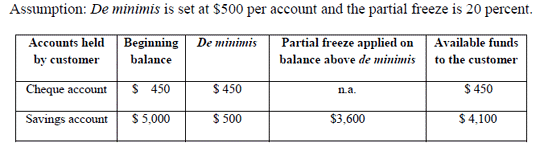
There is, however, scope for a “de minimis”, potential insurance of sorts. This would be a nominal dollar amount in relevant customer liability accounts protected from haircuts and fully available to account holders when the bank reopens the next business day after the appointment of a statutory manager. The purpose of this de minimis is to help customers with limited resources fund everyday expenses. The Minister of Finance would decide whether to set a de minimis amount, and determine what this amount is if one is set.
The table below, from a Reserve Bank consultation document, demonstrates how the de minimis would work.
*Note, the video interview was recorded after this story was written, so although the material covered is largely the same, David Mayes' quotes in the story don't match his comments on the video identically.
This article was first published in our email for paid subscribers. See here for more details and to subscribe.
We welcome your comments below. If you are not already registered, please register to comment
Remember we welcome robust, respectful and insightful debate. We don't welcome abusive or defamatory comments and will de-register those repeatedly making such comments. Our current comment policy is here.