
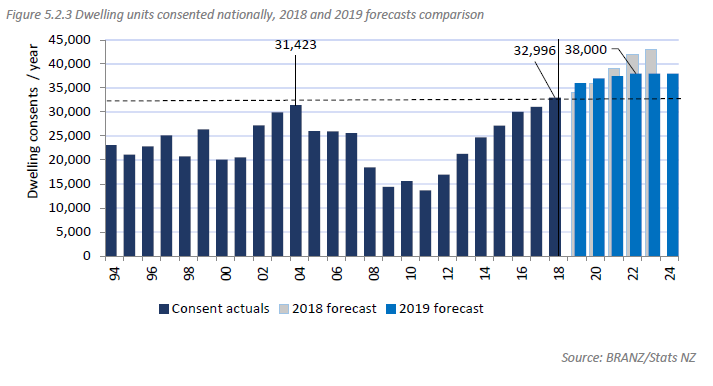
The latest MBIE National Construction Pipeline report now sees nationwide house building peaking at levels around 5,000 fewer than earlier forecast.
However, the Auckland market is now predicted to run stronger for longer, with 96,000 dwelling units to be consented in the six years to 2024, with the peak levels of annual building hitting around 17,000.
The Auckland peak levels are around the same as forecast a year ago - but the peak is now forecast to be sustained for longer.
This is the seventh annual construction pipeline report for the Ministry of Business, Innovation and Employment. It is based on building and construction forecasting by the Building Research Association of New Zealand (BRANZ), and data from building economics consultancy Pacifecon NZ Ltd on known non-residential building and infrastructure intentions.
The 2018 report had included references to the Government's KiwiBuild programme. This year there are no references to the now 'reset' programme.
The 2018 report had forecast 3% dwelling consent growth for 2018 nationally while actual consent growth was double that at 6%. The 2019 forecast is for year-on-year growth to 2022.
"Compared to the 2018 forecast, this is higher short-term dwelling growth followed by maintenance to 2024. Over the next four years, the number of dwelling units consented is forecast to increase by 15% to a high of 38,000 dwelling units in 2022," the report says.
While the report doesn't explicitly spell it out, this growth is substantially weaker than the same report forecast a year ago.
Then, the (2018) report said: "Over the next six years the number of dwelling units consented is forecast to increase by 39% to a forecast high of 43,000 dwelling units in 2023."
The 2019 report does, however, include a graph highlighting the differences in forecasts from last year to this.
The weaker than earlier predicted residential construction activity is pretty much spread around the country, although the activity forecasts for Waikato/Bay of Plenty are notably down on those a year ago. But the forecasts for Canterbury, Wellington and the rest of New Zealand are all lower.
However, the forecasts for Auckland this year show a stronger for longer trend.
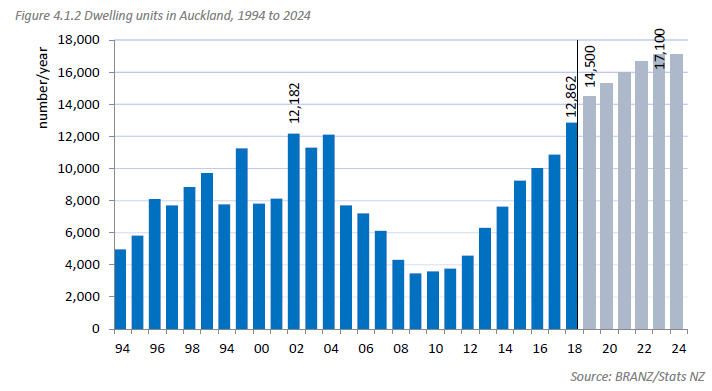
The 2019 report says the number of dwelling units consented in Auckland grew by 18% to nearly 13,000 in 2018 exceeding the previous peak in 2002 by 6%.
"Consistent growth is expected throughout the forecast period resulting in a 33% increase in dwelling unit consents from current levels to a high of over 17,000 in 2023. This is a similar forecast to last year’s resulting in over 96,000 dwelling units expected to be consented in the six years from 2019 to 2024."
The report says dwelling growth in Auckland continues to be driven by multi-unit consents.
"In 2018 (as in 2017), the number of multi-units consented exceeded the number of detached consents contributing just over 50% of the 12,862 dwellings consented. In 2016, multi-units represented 44%. This trend is expected to become more apparent over the forecast period with 58% of the more than 96,000 dwellings to be consented by 2024 being multi-unit."
We welcome your comments below. If you are not already registered, please register to comment
Remember we welcome robust, respectful and insightful debate. We don't welcome abusive or defamatory comments and will de-register those repeatedly making such comments. Our current comment policy is here.