

By Greg Ninness
The urgent need for the Government to rein in rampant house prices has been reinforced by interest.co.nz’s latest Home Loan Affordability figures.
These show the Real Estate Institute of New Zealand’s national lower quartile selling price increased by $40,000 (+7.6%) during February, rising from $525,000 in January to a record $565,000.
Over the 12 months to the end of February the national lower quartile price increased by $106,500, up 23.2% for the year.
In the Auckland region the lower quartile selling price increased by $122,000 in the 12 months to February. But the biggest increase of $160,000 for the year was in Hawke’s Bay, followed by Wellington +$151,000, Bay of Plenty +$110,000 and Waikato +109,000.
The smallest increases were in Canterbury +$66,000 and Northland +$70,000.
Those extraordinary rises mean lower quartile selling prices around New Zealand have increased by an average of $2048 a week over the last 12 months.
The lower quartile selling price is the price point at which 25% of sales are below and 75% are above, representing the lower end of the property market that is most within reach for typical first home buyers.
However price increases of the magnitude of those over the last 12 months will have almost certainly kept the goal of home ownership out of reach of most first home buyers on average incomes, because the amount required for a deposit has likely increased faster than their ability to save it.
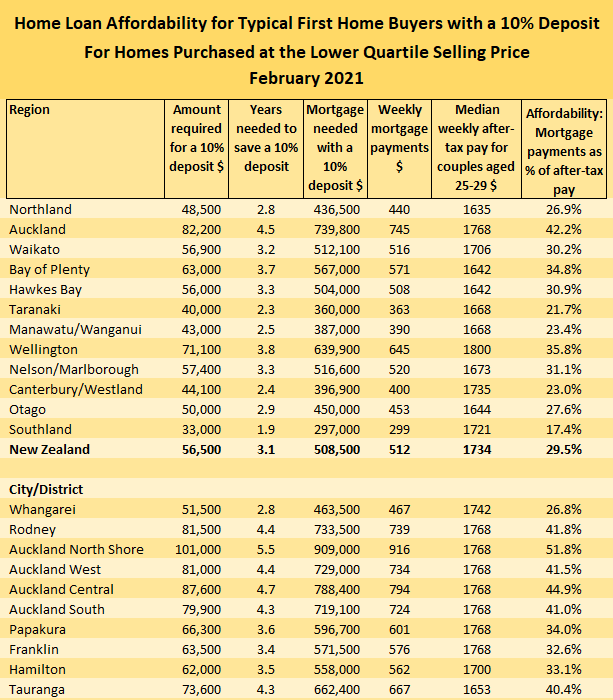
Even the amount needed for just a 10% deposit on a home at the national lower quartile price would have increased by $10,650 over the last 12 months, rising from $45,850 in February last year to $56,500 in February this year.
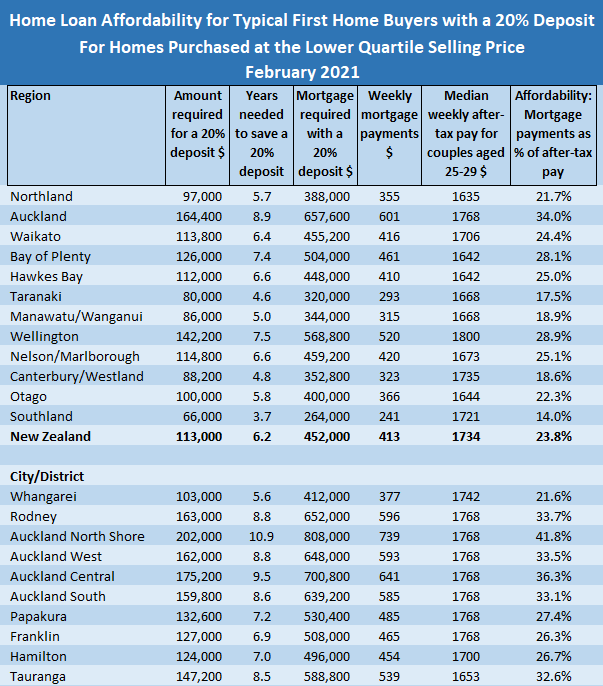
In Auckland, the country’s most expensive housing region, the amount needed for a 10% deposit on a lower quartile-priced home increased by $12,200 over the same period, from $70,000 in February last year to $82,200 in February this year. You can double those numbers for a standard 20% deposit.
Unfortunately the bad news for first home buyers doesn’t end there.
Mortgage interest rates continue to hit record lows, with the average of the two year fixed rates offered by the major banks sinking to 2.53% in February, down from 3.52% in February last year and 4.26% in February 2019.
You would think that a slide in mortgage interest rates would have benefited aspiring first home buyers but that’s not the case, because house prices have risen faster than interest rates have fallen.
The amount of money needed for the mortgage payments on a home purchased at the national lower quartile price with a 10% deposit hit a record high in February. Think about that for a moment. Mortgage interest rates are at a record low, but the mortgage payments for a home at the bottom end of the market are at a record high.
In Auckland the situation is even worse. Not only are mortgage payments on a lower quartile-priced Auckland home at a record high, they have been pushed squarely into unaffordable territory.
Interest.co.nz’s Home Loan Affordability Reports have long considered that mortgage payments start to become unaffordable when they chew up more than 40% of the homeowner’s after-tax income. The median after-tax pay for couples aged 25-29 in Auckland, if they both work full time, is $1768 a week.
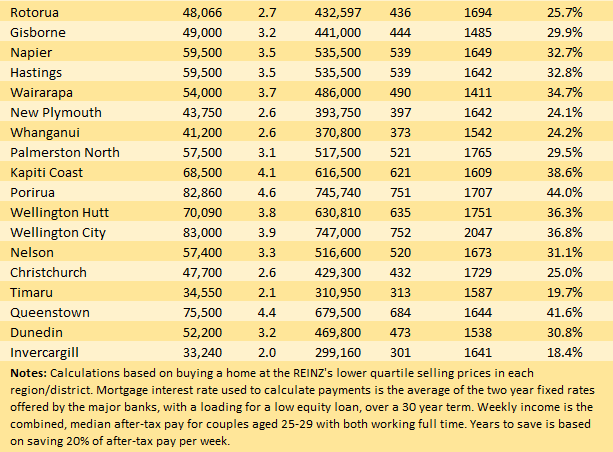
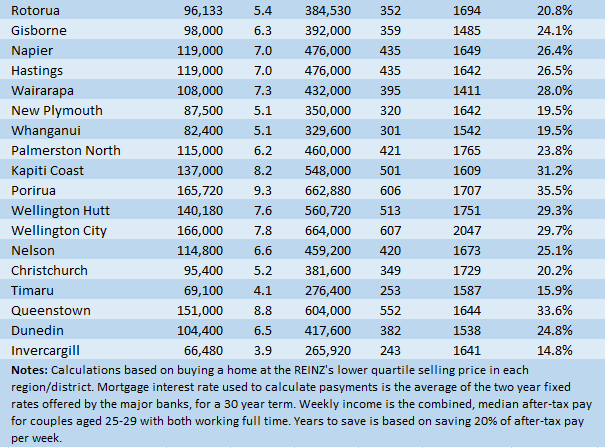
The mortgage payments on an Auckland home purchased with a 10% deposit at February’s lower quartile price of $822,000 would be around $745 a week, or just over 42% of the median take home pay for couples aged 25-29 (the monthly breakdown of affordability figures with both 10% and 20% deposits in all of the main housing districts, is set out in the tables below).
That means they would likely already be finding things tight while interest rates are at record lows. But if they suffered a drop in income or if interest rates started to rise, they could find themselves in financial doo-doo.
If both of those things happened at once, the doo-doo could get very deep indeed and that could have implications not just for affected homeowners but for the legacy of Prime Minister Jacinda Ardern. Almost certainly, the greatest achievements of her terms in office so far have been steering the country successfully through the COVID pandemic and avoiding the worst of its potential health and economic impacts.
But a consequence of that has been the debt fuelled, speculative housing bubble, which is now so serious that it risks the PM and her Government being remembered as major contributors to a new class system based on property ownership, and for burdening the economy with a growing mortgage debt millstone.
This week’s housing policy announcements by the Government showed that it is prepared to act decisively to address those problems. The changes made to the way residential investment property will be taxed are probably the most significant changes to impact the property market in a lifetime.
Although it will be several years for them to be fully implemented, they will likely have an immediate cooling effect on the market. And with that will come hope for aspiring first home buyers. The changes should put a stop to prices spiralling out of control and put the dream of home ownership more within their grasp, turning their mood from hopeless to hopeful.
The comment stream on this story is now closed.
*This article was first published in our email for paying subscribers. See here for more details and how to subscribe.
We welcome your comments below. If you are not already registered, please register to comment
Remember we welcome robust, respectful and insightful debate. We don't welcome abusive or defamatory comments and will de-register those repeatedly making such comments. Our current comment policy is here.