

It has been a tumultuous 12 months for first home buyers since house prices peaked in November last year, with soaring interest rates, plunging property prices, a cooling housing market and economic uncertainties at every turn.
So how have aspiring first home buyers fared over the 12 months to November, is it easier or more difficult for them to get into a home of their own now than it was at last year's market peak?
According to interest.co.nz's Home Loan Affordability Report, the two biggest drivers of changes in affordability are mortgage interest rates and house prices, and to a lesser extent household incomes.
In November last year, mortgage rates were already rising and the average of the two year fixed rates charged by the major banks had increased from its record low of 2.52% in May 2021, to 4.08% in November.
By November this year that had increased to 6.09%.
The low interest rate environment of 2020/21 had seen spectacular house price increases with the Real Estate Institute of New Zealand's national lower quartile dwelling price peaking at $670,000 in November last year.
But it was downhill from there. And by November this year the national lower quartile price had shed $69,000 and was sitting at $601,000.
The lower quartile is the price point at which 75% of sales are above and 25% are below each month, representing the bottom end of the market where first home buyers are likely to be most active.
Some regions, most notably Auckland and Wellington had even bigger falls in lower quartile prices over that period.
In Auckland it dropped from $966,000 in November last year to $829,000 in November this year. In Wellington it dropped from $775,000 to $655,101.
There were three regions - Taranaki, Canterbury and Southland - where lower quartile prices were higher in November this year than November last year. But for everyone else, it was cheaper to buy a lower quartile-priced home in November this year than it was a year ago. And in places like Auckland and Wellington it was considerably cheaper.
The immediate implication for first home buyers is they would need a smaller deposit and would need to borrow less to buy a home at the lower quartile price.
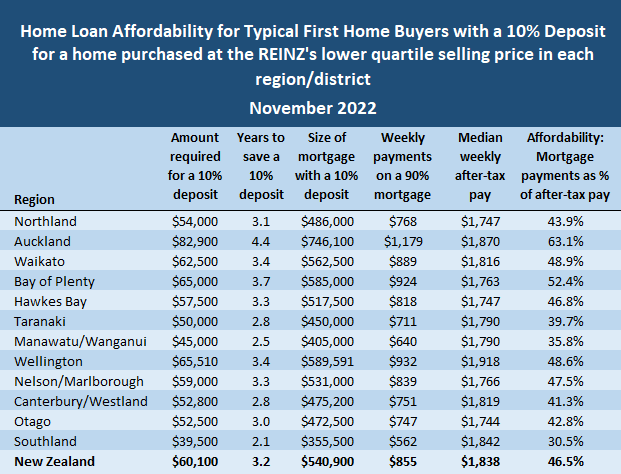
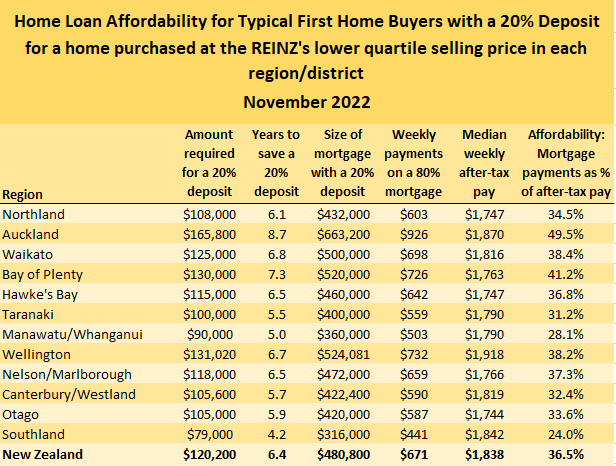
With the national lower quartile price dropping from $670,000 to $601,000 over the year to November, the amount needed for a 10% deposit dropped from $67,000 to $60,100. A 20% deposit dropped from $134,000 to $120,200.
The Home Loan Affordability Report also tracks how long it would take a couple earning median rates of pay for 25-29 year olds, to save a deposit if they put aside 20% of their after-tax pay each week.
That dropped from 3.7 years to 3.2 years for a 10% deposit, and from 7.3 years to 6.4 years for a 20% deposit.
And of course the size of the mortgage they would be taking on was also reduced, dropping from $603,000 for a home purchased at the national lower quartile price with a 10% deposit in November last year, to $540,900 in November this year.
If the home buyer had a 20% deposit the size of the mortgage would have reduced from $536,000 to $480,800.
So there were three ways in which aspiring first home buyers looking to buy a lower quartile-priced home were better off in November this year than they were in November last year; they would need a smaller deposit, it would take less time to save a deposit and they would need a smaller mortgage.
But of course not everything has gone their way, with rising mortgage rates spoiling the party.
Although first home buyers would need to borrow less to purchase a home at the national lower quartile price in November this year than they would if they had purchased in November last year, rising interest rates mean their mortgage payments would have gone up.
If they had a 10% deposit, the amount they would need to set aside each week for mortgage payments would have increased from $770 a week in November last year to $855 in November this year, up an extra $85 a week.
If they had a 20% deposit those amounts would have increased from $596 a week to $671 a week, up an extra $75 a week.
The pain of finding that extra money each week would have been eased slightly by the fact that incomes have been rising at a reasonable clip this year.
The Home Loan Affordability Report estimates the combined, after-tax pay of couples aged 25-29, at the median rate of pay if both were working full time, would have increased from $1801 a week in November last year to $1838 in November this year, giving them an extra $37 a week.
Mortgage payments are considered unaffordable if they eat up more than 40% of after-tax household income. In the examples above, the mortgage payments for a first home buyer with a 10% deposit would have eaten up 43% of after-tax pay in November last year. That would've risen to 47% in November this year, putting it squarely into unaffordable territory for couples on average wages.
If they had a 20% deposit, the amount of their household income they would need to set aside for mortgage payments would have increased from 33% to 37%.
While that's still considered affordable, interest rates wouldn't need to rise much further to push mortgage payments into unaffordable territory.
So overall, while there has been some good news for first home buyers since the housing market has come back from its peak, the financial obstacles they face remain so high that most will still struggle to get into a home of their own and in places like Auckland, Waikato, Bay of Plenty and Wellington. Home ownership is probably still out of reach for those on average wages.
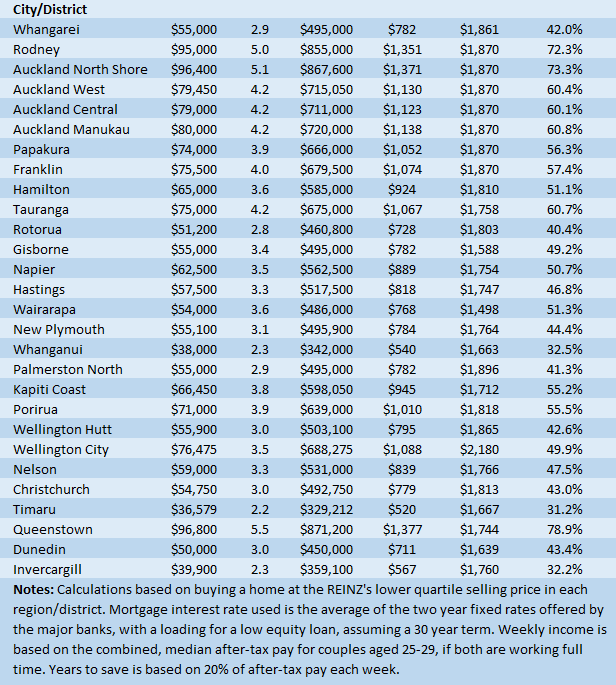
The tables below give the main home loan affordability measures with either a 10% or 20% deposit, in all main urban districts throughout the country.
The comment stream on this article is now closed.
*This article was first published in our email for paying subscribers. See here for more details and how to subscribe.
We welcome your comments below. If you are not already registered, please register to comment
Remember we welcome robust, respectful and insightful debate. We don't welcome abusive or defamatory comments and will de-register those repeatedly making such comments. Our current comment policy is here.