

House building activity slumped in the fourth quarter of last year - but non-residential building work increased quite strongly.
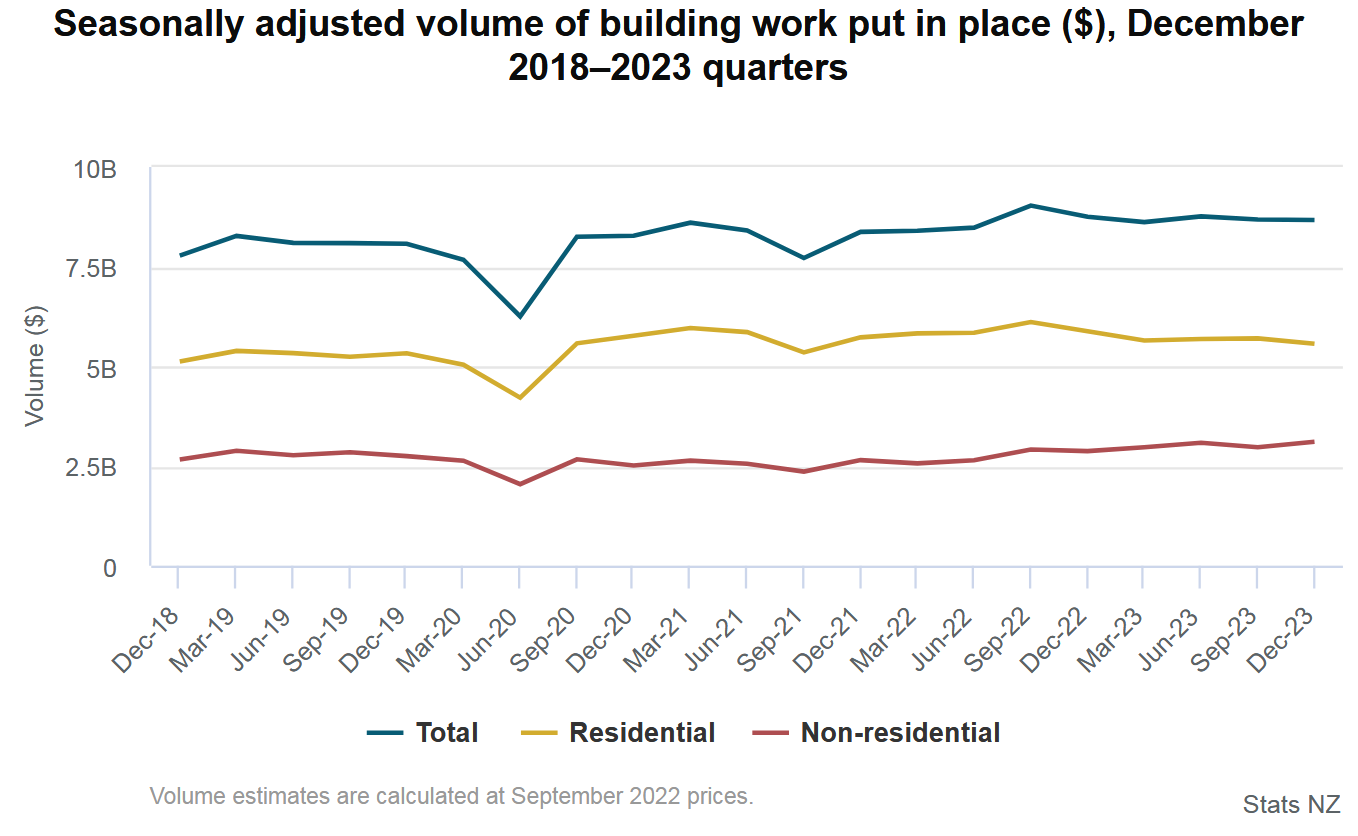
Statistics NZ says the seasonally adjusted volume of residential building work put in place was $5.6 billion, which was down 2.4% on the previous quarter.
Compared with the December quarter in 2022 the figure was down by some 5.6%.
However, the value of non-residential work was $3.1 billion in the December 2023 quarter, up 4.6% compared with the September 2023 quarter.
“The rise in non-residential building work offset a decrease in residential building work, which led to total building activity being flat for the December 2023 quarter,” Stats NZ's construction and statistics manager Michael Heslop said.
The total volume of building activity in New Zealand was $8.7 billion in the December 2023 quarter, down 0.1% compared with the September 2023 quarter.
Seasonally adjusted volume estimates remove the effects of price changes and typical seasonal patterns. These figures also measure the amount of work actually carried out - as opposed to the building consent figures that measure approvals for building work. The consent figures have also been dropping sharply for residential developments.
Westpac senior economist Satish Ranchhod said trends "were mixed" across sectors.
"Weakness has been centred on the residential sector. The level of residential building fell 2.4% in the December quarter and is now down 9% on the levels we saw last year."
Ranchhod said the overall results for the quarter were in line with his expectations.
"Building activity is slowing, especially in the residential sector. However, that slowdown has been from an elevated level – even with the softening over the past year, we’re still building a large number of new homes each quarter.
"Over the coming year, we expect that residential building activity will continue to soften. With high interest rates and a subdued housing market, fewer new projects are coming to market (residential consent numbers have fallen nearly 30% over the past year). However, with many firms still working through existing pipelines of projects, that downturn is expected to be gradual.
"Non-residential construction activity is continuing to track at high levels. However, softening economic conditions are putting the brakes on the number of new projects coming to market, and we expect a downturn over 2024," Ranchhod said.
Stats NZ said the total value of building work was $37 billion in the year ended December 2023, up 7.1% from the year ended December 2022.
Value estimates of building work put in place, in contrast to volume estimates, include changes to building costs over time (such as material and labour costs).
In the past 12 months, the capital goods price index recorded a 5.7% increase in non-residential construction prices and a 4.3% increase in residential construction prices. Included in those overall calculations were the facts that residential construction prices rose 0.8% in the December 2023 quarter, while non-residential prices rose 1.0%.
By region, the value of total building work in the year ended December 2023 compared with the year ended December 2022, was:
- $15 billion in Auckland (up 9.0%)
- $3.6 billion in Waikato (up 4.9%)
- $3.2 billion in Wellington (down 0.6%)
- $5.8 billion in the rest of the North Island (up 1.6%)
- $5.5 billion in Canterbury (up 15%)
- $3.8 billion in the rest of the South Island (up 6.9%).
By region, the actual value of total building work in the December 2023 quarter compared with the December 2022 quarter, was:
- $3.9 billion in Auckland (up 6.5%)
- $886 million in Waikato (down 4.8%)
- $805 million in Wellington (down 4.0%)
- $1.5 billion in the rest of the North Island (up 4.1%)
- $1.4 billion in Canterbury (up 9.6%)
- $978 million in the rest of the South Island (up 0.5%).
15 Comments
Still lots going on.. Activity every where... Roads.. houses.. Warehouses
Lets see in a few months, as a whole lot of projects in train are completed
Yes.
I know a couple of businesses that are regretting decisions made a way back to build new offices.
It means they now have reduced revenues, idle staff, falling order books and somehow have to pay ongoing building costs for a shiny new office.
Sadly it will result in more heads needing to be cut and an emptier new office with older furniture.
I can’t speak for other cities, but it looks like a lot of Auckland’s larger residential construction projects are either nearly completed or have been recently finished. I can think of a few examples, such as the Safari building in Ellerslie, the Conrad project in Mt Albert (around 120 units), the green apartment building in Ponsonby (around 100 units I think), Sylvia Park Apartments (300 units), and various medium sized suburban projects throughout the city.
Very few such projects in the early stages of construction on the other hand. Basically nothing in the CBD besides the long delayed tower on Customs St.
This is bad news - especially given NZ's chronic shortage of dwellings......
A bit down the track we will be paying for reduced building activity in higher house prices and higher rents.
TTP
Lol.
Better start buying up those houses, you first :)
- Be Qwuak!
I think higher rents will depend largely on if immigration continues at its current high numbers (Once jobs become less available, it’s likely to cause a reduction in the number of people coming to NZ).
Prices themselves will be largely influenced by interest rates, which will likely begin declining once the Fed starts cutting later this year. Supply also plays a part, but the supply of new houses will probably be absorbed quite quickly once rates begin coming down
Trades gouging heads towards its end. A good time to spool up state house building program to stop another generation of young tradie's heading to Aussie. Or not...
Doubt we can afford that coz Labour carefully spent all our excess money during the boom times...... but we have a lot of things to show for it like lots of extra names for places and government departments, plans for never-to-be-built entities (waters and Mhealth) and harbour crossings, cheap EVs, half finished billion dollar ferries... to name but a few.
Money well spent I say 🤪
Ps. Luckily rbnz took a more cautious approach. 😅
Pps. Amaxing labour had all that lolly to spend and still the prime ministers house and plane are broked.
PM doesn’t need his own plane. Should be flying premium economy
The airforce uses those planes for more than just VIP transport.. Or they would if they could ever be trusted to work more days than a dole bludger..
Exactly. Once they go construction capacity becomes severely limited for a long time, seeding the next disastrous boom/bust cycle. Government needs to recognise this and ramp up housing construction projects. They’ll get better value than usual also
Not sure if building 'enough' houses would have the desired impact on the values of the property portfolios of 7-house-luxon and his merry band of property-investor MPs
I suspect (from watching previous NZ governments) the trick is to look like you are trying really really hard to enable the building of zillions of houses, but fail.. then look really sad as you announce that you only managed to build a row of sheds in the back end of nowhere (blaming labour, rbnz and the rest of the world for stuff they did 50 years ago).. before eventually losing an election and retiring on the income from your overpriced rentals and a chairperson salary at our biggest bank.
i would be delighted to be proven wrong - and in a parallel universe i am sure MrLuxon converts to socialism and hires all of Australiasians builders to knock up houses for the poor, forgoing a senior banking position at a bank on retirement and giving away all his money as a role model for others :)
Sales off the plans cratered a year ago, if not more. This is the most telegraphed collapse in industry history.
So much for there can't be a downturn in building with rising interest rates because there is so much demand as espoused by so called construction experts.
The drop will be gradual, until suddenly it isn't and residential house building really falls off a cliff. Only question is will it be as bad as the GFC? If rates stay where they are for another 12 months or go higher it will be or worse.
Looks like the best tradies will be off to Oz, if they haven't already and we'll have another winter with a lot more people living in their cars since there's a shortage of rentals and the government 'is going to do something about emergency housing' which translates to closing down the motels, stopping building state houses and ignoring the crowded car parks again.
We welcome your comments below. If you are not already registered, please register to comment
Remember we welcome robust, respectful and insightful debate. We don't welcome abusive or defamatory comments and will de-register those repeatedly making such comments. Our current comment policy is here.