

New Zealand's house prices will rise by a "modest" 4% over the coming year and by 6% in 2026, independent global economic researchers Capital Economics (CE) predict.
CE's Head of Asia-Pacific Marcel Thieliant says the recovery of the NZ housing market will be "muted" even though CE's expecting the Reserve Bank will slash the Official Cash Rate (OCR) all the way down to 2.25% in 2025. It's currently at 4.75%.
"While we expect the RBNZ to cut interest rates by the most since the GFC over the coming year, housing affordability was never as stretched at the start of an easing cycle as it was at the start of the current one," Thieliant said.
"Accordingly, we only expect house prices to rise by a modest 4% over the coming year and by 6% in 2026. A housing market rebound will boost consumer spending and dwellings investment and put some upward pressure on inflation. However, that won’t prevent the RBNZ from slashing rates."
Thieliant said New Zealand’s house prices "have been on a rollercoaster ride" as they surged by nearly 50% between end-2019 and their peak in 2021 and then plunged by nearly 20% as the RBNZ lifted the OCR to 5.5%.
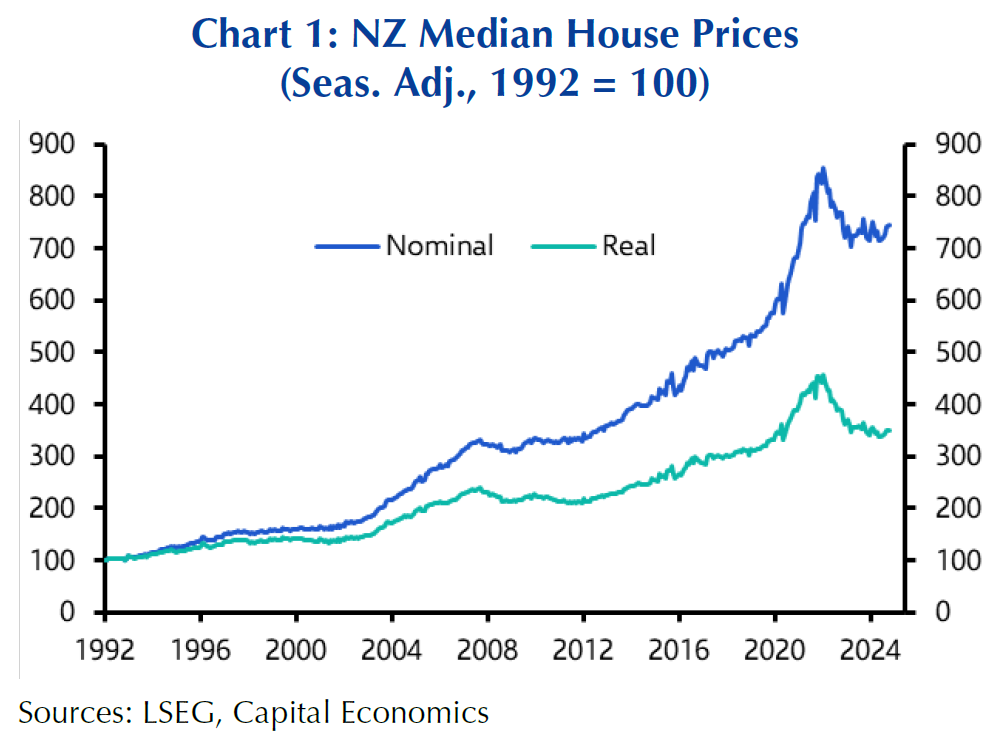
"Since early-2023, house prices have moved sideways even as home sales have rebounded a bit and mortgage rates have already fallen by more than 1%-pt," he said.
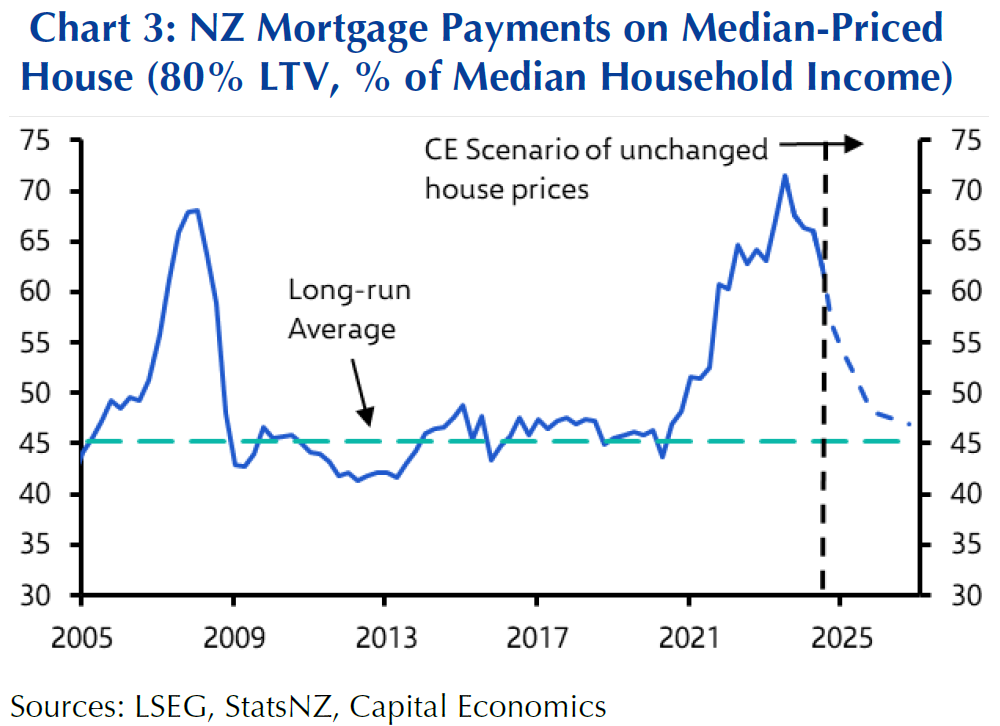
"If we’re right that the RBNZ will slash the OCR by 325bp [basis points] from its peak, housing affordability should improve dramatically.
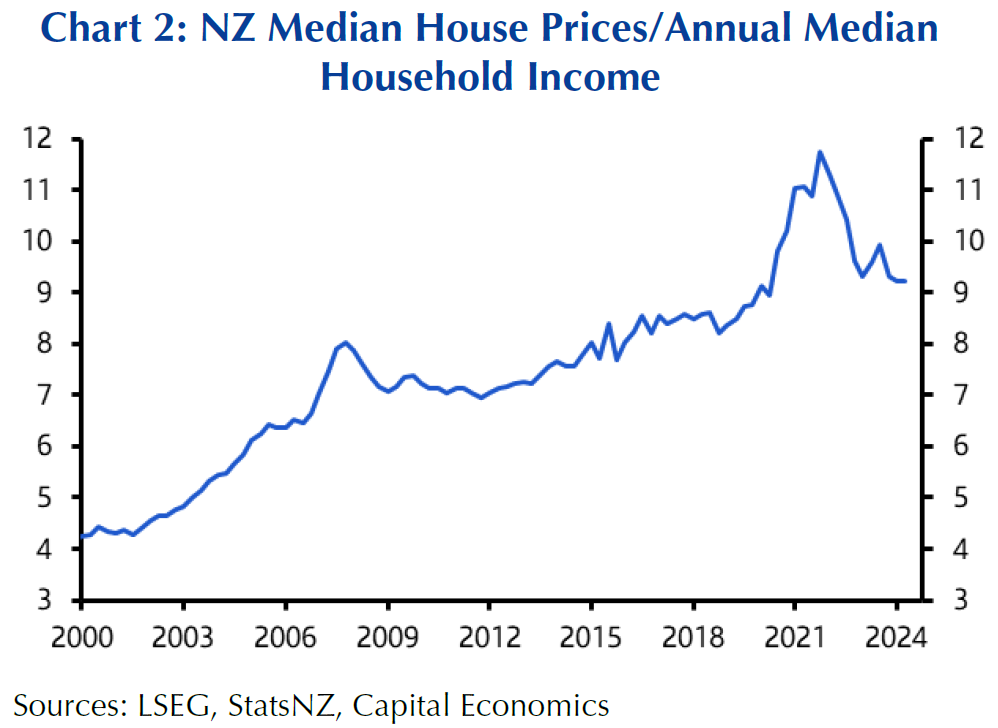
"However, arguably the best indicator of the strength of any housing rebound during a monetary easing cycle is housing affordability at the onset of that cycle. Unfortunately, mortgage payments relative to household incomes were never higher at the start of an easing cycle as they were at the start of the current one."
Thieliant said another headwind to the housing market is the sharp slowdown in net migration, which has fallen below pre-pandemic levels in recent months.
"With the unemployment rate set to remain higher than in neighbouring Australia for the foreseeable future and the government having tightened immigration rules, population growth will probably remain muted."
He said the Coalition Government had "admittedly" made it more attractive for investors to purchase rental property.
"But investors only account for one-fifth of total home purchases and the available data suggest that any boost to investor demand resulting from the policy changes has already happened."
Thieliant said the "bigger picture" is that the longer house prices remain flat, the more attractive housing valuations will become.
"We expect disposable income per employee to rise by around 4.5% this year. If that pace of income growth is sustained next year and in 2026 and house prices remain unchanged, the house price to income ratio would return to its 2019 average by late-2026.
"What’s more, our view that the RBNZ will slash the OCR from 4.75% now to 2.25% by the end of next year means that affordability should improve dramatically, too. This is illustrated by the dashed blue line in Chart 3, which illustrates a scenario in which interest rates and household incomes evolve in line with our forecasts and house prices don’t rise any further. In that case, housing affordability would have almost returned to its long-run average by the end of 2026, too."
We welcome your comments below. If you are not already registered, please register to comment
Remember we welcome robust, respectful and insightful debate. We don't welcome abusive or defamatory comments and will de-register those repeatedly making such comments. Our current comment policy is here.