
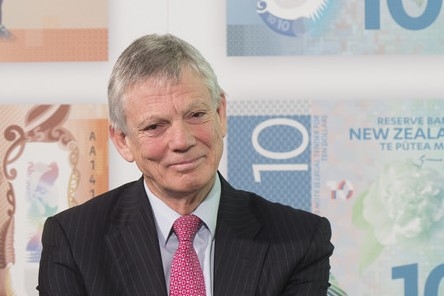
And then there was just one.
There’s now just one living Reserve Bank Governor yet to criticise current Governor Adrian Orr. That's current Infrastructure Commission Chair Alan Bollard, who was Governor for two terms from 2002 to 2012 under both Labour-led and National-led Governments.
This morning previous one-term Governor Graeme Wheeler launched a lengthy attack on the record of central banks broadly in recent years, including that of current Reserve Bank Governor Adrian Orr.
Wheeler joins former Governors Don Brash and Grant Spencer, former Chair Arthur Grimes and former Chief Economist John McDermott in criticising Orr for being too loose with policy and not concentrating enough on keeping inflation down.
Bollard effectively also reports to Orr’s effective boss, Finance Minister Grant Robertson.
The pro-markets think-tank, The New Zealand Initiative, published an 18-page paper this morning titled: ‘How Central Bank Mistakes After 2019 led to Inflation’.
It was authored by former Reserve Bank Governor Graeme Wheeler, NZ Initiative Senior Research Fellow Bryce Wilkinson and included a foreword by William White, the former Deputy Governor of the Bank of Canada.
They concluded:
“Central bankers need to reflect deeply on the management of monetary policy over the past two years and review their models and the assumptions and judgments they made. They must ensure that they have first rate financial market expertise on their monetary policy committees and Boards.
“Trite responses about 'having no regrets', 'would not do anything differently', and 'there is no alternative' are irresponsible and further damage a central bank’s credibility. Central bankers need to learn from their misjudgements because the social, economic, and political consequences of major mistakes run deep and the trust and confidence that the public have in them can be readily depleted.
“Just as President Bush acknowledged US responsibility for the global financial crisis, central banks could acknowledge what they believe they got wrong and what steps they are taking to rebuild public confidence.”
The line about having 'no regrets' is clearly aimed at Orr’s view that that there was no alternative.
Wheeler was quoted personally in the news release for the paper saying: “To begin restoring their damaged credibility, central banks must assess and acknowledge why their models and judgements were so inaccurate and inform the public on what steps they are taking to rebuild public confidence.”
White was harsher in his foreword: "Humility rather than hubris should have conditioned monetary policy right from the start."
'Errors of judgement'
Wheeler and Wilkinson said the main cause of inflationary pressures was in the errors of judgment made by central banks in conducting monetary policy during the Covid pandemic.
"While Russia’s invasion of Ukraine accentuated the rise in inflationary pressures, commodity prices were already high because of the rapid global expansion in liquidity and debt," the said.
"The scale of these programs was enormous. In the US, the size of the Federal Reserve’s asset portfolio increased from USD $4 trillion in early 2020 to almost USD $9 trillion in early 2022-equivalent to around 23% of pre-Covid GDP. (In three rounds of quantitative easing in the six years following the global financial crisis the Federal Reserve’s asset portfolio increased by USD $3 trillion). New Zealand also had a large program of quantitative easing with $53.5 billion of asset purchases - equivalent to 17 % of pre-covid GDP."
Excessive monetary stimulus also pushed up commodity and equity prices, as well as in housing markets.
"Central banks overdid interest rate cuts and the scale of their quantitative easing, and many continued large asset purchase programs when it was clear from the tightness of the labour market and rise in bond yields from late 2020 that their economies were stronger than forecast and that inflation pressures were starting to build," they said.
"It was inevitable that the combination of extremely low and often unprecedented interest rates, readily available liquidity, and central bank pressuring of commercial banks to rapidly expand their lending would fuel house price inflation, especially as the size of the housing stock changes very slowly. Between the December quarter 2019 and December quarter 2021 real house prices in the OECD median country increased by 13% - in New Zealand they rose by 33%, second only to Turkey."
'Huge mark-to-market losses'
Wheeler and Wilkinson also pointed to huge 'mark-to-market' losses now being incurred as banks increased interest rates.
"The RBNZ’s balance sheet puts the claim in June 2022 at $8.8 billion, over $4,000 per household. At the same time, the higher policy rates see central banks paying commercial banks much more interest on the massive excess reserves the latter have at the central bank," they said
"Banking system settlement balances at the RBNZ are currently $45 billion. Each 2% rise in the RBNZ’s overnight cash rate adds $900 million a year to the cost to taxpayers."
'Too confident in output gap models'
Wheeler and Wilkinson said central banks became over-confident in their inflation targeting frameworks and their use of output gap measurements.
"They believed that when Covid restrictions were eased inflation expectations would remain anchored and that the growth in productivity would help restrain inflationary pressures," they said.
"They also believed that they could ‘game’ inflation expectations by having policy interest rates close to zero (or negative) while also operating massive programs of quantitative easing. They believed that the credibility they had built through years of maintaining low and stable inflation would ensure that levels of core inflation and inflation expectations would remain well-anchored at levels consistent with price stability.
"This assumption proved to be wildly incorrect."
'They took their eye off the ball'
Wilkinson and Wheeler also accused central banks of taking their eyes off their core responsibility of keeping inflation low. They pointed in particular to the Reserve Bank of New Zealand.
"Confident in their ability to maintain low inflation, central banks in recent years began diverting resources to other topics such as climate change and inequality (and in the case of the RBNZ also embracing New Zealand’s indigenous history and culture and adopting a Māori world view in the operations of the central bank)," they said.
"Such issues bear little if any relationship to the reasons why central banks exist -- ensuring price stability and financial stability. Current monetary excesses and fiscal imbalances are undoubtedly much more pressing risks.
"Where goals in addition to price stability are assigned, governments in advanced economies have nearly always given primacy to price stability as the overriding objective. Two exceptions are the US and New Zealand. In addition to price stability, the Federal Reserve is required to 'promote maximum employment and moderate long term interest rates'.
"The assignment of clear policy goals for central banks is extremely important. Multiple policy goals such as achieving price stability and maximizing employment can come into serious conflict when inflation is higher than desirable and employment is falling or growing only slowly. In such situations the central bank needs to decide whether to raise interest rates to lower inflationary pressures, or lower interest rates to stimulate employment growth. This issue becomes increasingly problematic when an economy experiences stagflation-a situation now facing many countries."
Update - Reserve Bank responds to report
Late on Tuesday, Reserve Bank Governor Adrian Orr issued a statement saying the Reserve Bank, in addition to its five-yearly statutory review, "we are also reviewing our recent performance in conducting monetary policy, including the use of additional monetary policy tools."
"This monetary policy review will assess inflation and employment outcomes relative to the targets outlined in the Remit, and the decisions taken at various times based on the information available at the time, relative to other central banks, and relative to likely alternative economic outcomes if these decisions had not been taken," Orr said.
"The decisions of the Monetary Policy Committee are always made with the information at hand at the time. This information and the assumptions made at each decision point are outlined for all to view in our Monetary Policy Statements," he said.
Orr also rejected suggestions that climate change, Te Ao Māori, and financial inclusion, distracted the bank from monetary policty.
"I regret that the Committee – and society at large – has been confronted with the COVID-19 pandemic, and other recent events that have caused food and energy price spikes. We are a learning institution, and through the open process of the Remit review and the monetary policy review, we will be very clear on our lessons learnt as we forever seek to do a world class job for the people of New Zealand."

We welcome your comments below. If you are not already registered, please register to comment
Remember we welcome robust, respectful and insightful debate. We don't welcome abusive or defamatory comments and will de-register those repeatedly making such comments. Our current comment policy is here.