

Commerce Minister David Clark and Prime Minister Jacinda Ardern jointly announced plans Wednesday afternoon to legislate to create a regulatory backstop to force Foodstuffs (Pak'n'Save, New World and Four Square) and Woolworths (Countdown) to open their wholesale arms to competitors on fair terms, if they don't move first voluntarily to open access to others for goods at wholesale prices.
In an unusual move for what is usually a dry regulatory announcement, Ardern took the lead at the Beehive Theaterette lecturn, announcing the planned legislation as an inflation-fighting intervention that could see consumers and suppliers share some of the $1 million a day in excess profits estimated by the Commerce Commission.
"If today's announcements is a demonstration, it is of how difficult we as a government found it to swallow the Commerce Commission's report that a million dollars a day in excess profit was being taken directly out of these pockets. We could not accept that. And that is why we have taken the steps in our demonstration that we absolutely have the backs of New Zealand consumers," Ardern said.
Clark and Ardern were confident the supermarkets duopoly would move voluntarily to avoid the ultimate potential for a yet-to-be-appointed Grocery Commissioner working from within the Commerce Commission to set prices and terms of supply, similar to the way it currently sets prices for electricity lines companies and regulates prices for copper telecommunications cables.
Still another two years before D-Day
However, the legislation is yet to pass and is unlikely to until well into next year. The documents issued today show supermarkets would then have another year to comply.
"This work will improve competition and competition will improve prices," Clark said.
"I expect major grocery retailers to develop wholesale offerings that include a comprehensive range of products at a fair price," he said.
"And to the duopoly's credit, I acknowledge there has been some progress in this area. But today, I can announce the government is creating a toolkit of additional regulatory powers for the grocery commissioner and the government to draw on if these wholesale arrangements do not meet the thresholds of expectation.
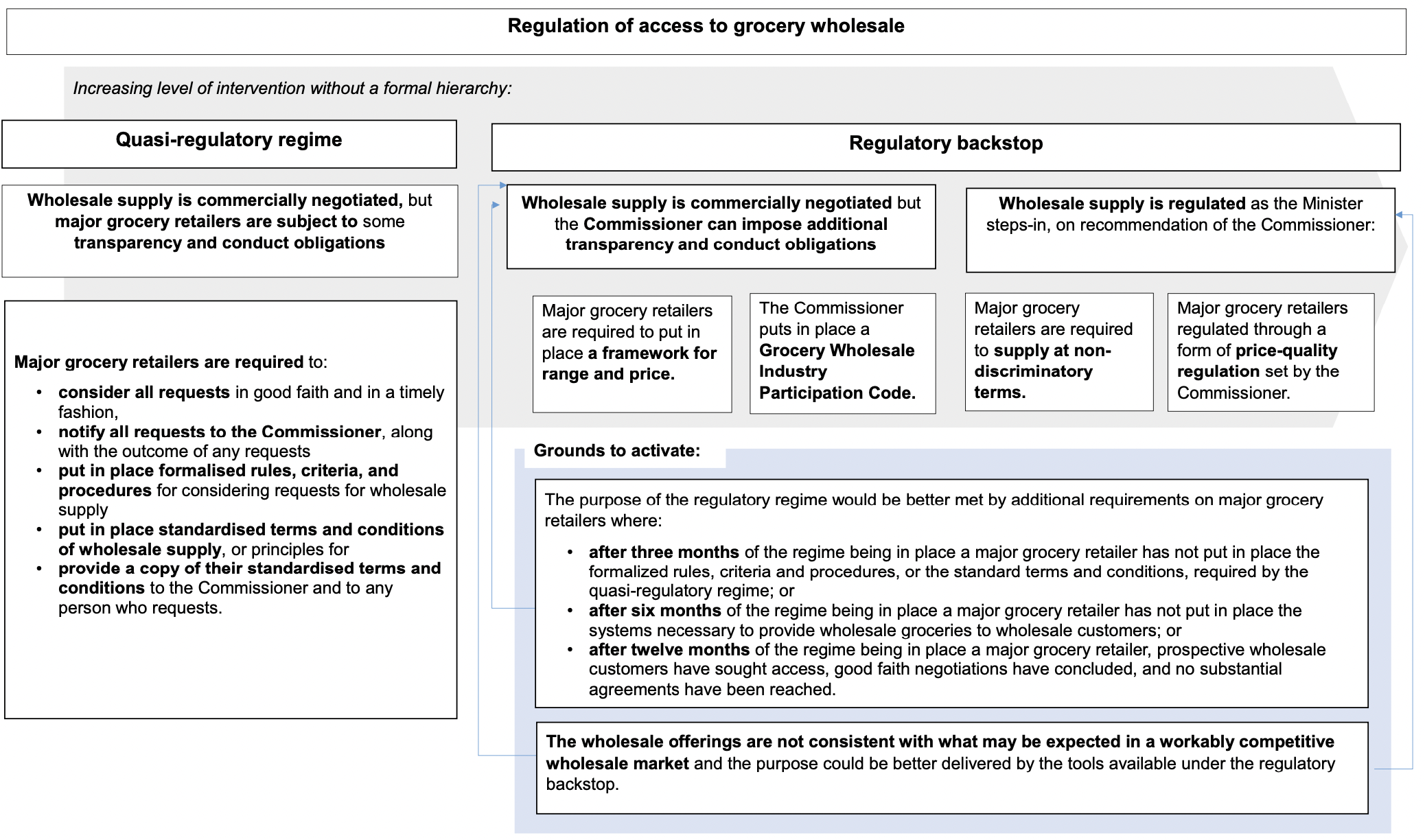
"These powers will allow the commissioner to improve transparency in conduct of the major grocery retailers by putting in place a grocery wholesale industry participation code, or requiring major retailers to establish a framework for range and price.
"We are also including new powers for government to step in and demand retailers provide wholesale supply at certain times, including price and range. However, there's nothing needless to say to stop supermarkets acting to open access today. They've said they're going to do it and this legislation proceeds with that understanding."
Clark said the Government had ultimately chosen to take stronger action than the voluntary scheme the Commerce Commission recommended in its final report from its market study, although an earlier draft report did suggest a full regulatory separation, similar to that seen with Chorus and Spark created from the body of Telecom NZ.
“Alongside their retail stores, supermarkets have behind the scenes wholesale operations. The changes announced today will ultimately require the duopoly to open these up to would-be competitors," Clark said.
“Our plan will give a leg up to the likes of smaller retailers and new market entrants. It means other retailers will now be able to source and sell a wider range of groceries at better prices. Under these changes the existing duopoly will be required to negotiate wholesale offerings to their competitors on commercial terms."
'Do it yourselves, before we do it for you'
Describing the voluntary first-step as quasi regulation, Clark said a new Grocery Commissioner would be able to impose additional regulation to force fairer prices.
“Ultimately if these interventions don’t deliver a fair deal new regulations can be utilised to require the major retailers to provide wholesale supply at certain terms, including price and range. The new system will incentivise the major supermarkets to play fair. But if they don’t the Commission will be able to use powerful new tools to make them do so," Clark said.
“Supermarkets are well advised to lock in good-faith wholesale arrangements on their own terms, or we will have no problem stepping in to make it happen. The grocery sector needs to change, so that competing retailers – whether they are independent dairies, smaller chains, or a new entrant – can offer a wider selection of products at competitive prices.
Collective bargaining for suppliers too
Clark said grocery suppliers would also be given flexibility to join together to collectively bargain with the duopoly.
Consumer NZ and the Food and Grocery Council, which represents suppliers, welcomed the announcement
“New Zealand consumers are fed up with excessive profits in the supermarket sector – they deserve better," said Consumer NZ CEO Jon Duffy.
"Without a genuine regulatory threat from the Government, the status quo will continue. Today’s announcement sends a clear message to the duopoly: The party is over and now it’s time to start playing fair," Duffy said.
Research commissioned by Consumer found trust in supermarkets had slumped in the last year, with 40% saying in June they did not trust the supermarkets, up from 17% a year earlier.
Food and Grocery Council CEO Katherine Rich said the backstop, together with earlier announcements of a Grocery Code of Conduct, a Grocery Commissioner, and legislation to end anti-competitive land wars blocking competitors, would help fix the grocery market.
“It’s great the Government has accepted the wholesale market is broken. Shoppers can see that every day when they see small retailers lining up at supermarkets to get groceries for their store. They do that because they have nowhere else to buy wholesale goods at reasonable prices," Rich said.
“That’s the very reason dairies and retailers such as Night ‘n Day and Supie are not competitive on pricing because what they’re paying for their goods is the same as shoppers at supermarkets pay. In the past, the big supermarkets have declined requests from some independent retailers seeking wholesale supply."
We welcome your comments below. If you are not already registered, please register to comment
Remember we welcome robust, respectful and insightful debate. We don't welcome abusive or defamatory comments and will de-register those repeatedly making such comments. Our current comment policy is here.