
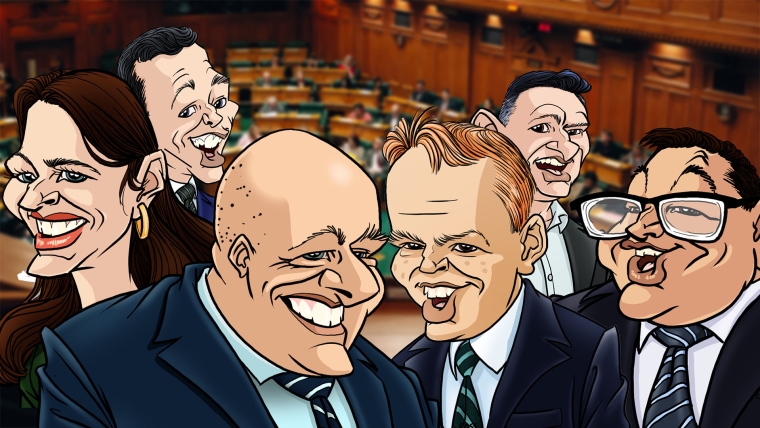
The third week of election campaigning kicked off with ACT’s would-be moment of high drama turning into low farce.
It happened at the party’s official campaign launch. The event began with the leader David Seymour materializing out of a cloud of dry ice – apparently unconcerned at CO2 emissions being too high already.
But the real hot air of the launch came from a one-man disruption machine, Karl Mokaraka, of the fringe party, Vision NZ.
For 10 minutes he berated the ACT leader until being hustled out of the meeting by ACT supporters. In the middle of this melee, the media became collateral damage, with a Newshub camera operator being not just punched, but hit on the head with a placard.
Mind you, this event might have turned ACT’s image from relentless libertarian to something centrist and normal, like a kindly grandpa cuddling his mokopuna on the sofa. After all, it is hard to compete with the Messianic fervour of Vision NZ, which wants to “empower traditional male roles” and to declare that women have “a womb, not a tomb”.
Anyway, ACT recovered from its collapsed scrum to spend the rest of the week attacking its usual targets: co-governance, bureaucratic red tape, soft-on-criminals governments and undisciplined state spending.
While this was going on, the New Zealand First leader Winston Peters was playing an unusual role - if only briefly – of thoughtful, discerning observer, like an unusually restrained accountant.
Both Labour and National, he said, should reconsider their tax policies because of the grim financial news revealed at Treasury's Pre-election Economic and Fiscal Update (PREFU). At this time, Peters said, prudence was essential.
But after that short interlude, Peters was back to attacking his usual targets: The vaccine mandates, co-governance, “men” in women’s bathrooms, Australia’s “Ned Kelly” banks, and the appalling, even “corrupt” media, who were “gaslighting” him, except when they weren't. On those occasions, they were "boycotting" him completely.
Tragically, though, someone forgot to tell Google News.
Meanwhile, Labour and the Greens were quarreling over solar energy systems. Not that they don't like them, they can't agree on who likes them more. Labour offered a total of $4000 to help people set up solar panels at their homes. But the Greens replied they had already offered $6000, augmented by an interest-free loan of up to $30,000, which was a far better deal.
The group that knows most about this subject is the Sustainable Energy Association of New Zealand (SEANZ) which welcomed help for its industry. But it said a lot more was needed to meet the 68% increase in electricity demand by 2050, as forecast by Transpower to decarbonise New Zealand’s economy. And little things could help, such as common connection systems between competing providers.
Meanwhile, a yawning chasm emerged on just who is paying good money to whom to fund the election campaign. The Labour leader Chris Hipkins agreed that hardly any rich business people were giving him a single red cent, which was fine by him.
"We get our support our support in much smaller amounts from a much larger group of individuals, who see the interests of working people are much better served by the Labour Party," he told RNZ.
By contrast, New Zealand's richest man, Graeme Hart, gave a reported $700,000 to parties on the right in the past two years.
On the subject of wealth, the Green Party dipped into its proposed wealth tax once more to fund an expanded programme of school lunches. It earlier relied on the same source to fund its offer of free dental care for all. So far, the party has not said the ranks of the rich should swell, or more people should win lotto, to fund these promises. But it might have to.
The week's campaigning was also notable for the first big debate of the election so far - between the leaders, Chris Hipkins and Christopher Luxon.
Many observers declared the two men emerged as equals, which was bad news for Labour, who can't afford to "draw" a battle when they are losing a war.
Luxon said he would run the country better because of his business experience, which was focused on "outcomes", in contrast with Hipkins' status as a "professional politician".
However, when asked about his negotiating skills, Luxon referenced "mergers and acquisitions", rather than talks with the union or the opening of new markets, which might have more public significance.
Luxon also said the country had gone "backwards" during Labour's six years in power. Unsurprisingly, Hipkins rejected this, stressing child poverty programmes, numbers of police and other initiatives during his party's rule.
In other countries, leaders' debates have had dramatic moments, like Donald Trump looming menacingly behind Hilary Clinton in 2016. They have also had plenty of trivia, such as Richard Nixon's 5 o'clock shadow in his debate with John F Kennedy, or George Bush senior glancing at his watch as though to say "How much longer?"
But this debate had no such moments, and even had an "adults in the room" quality that lifted the standard a bit.
The campaigning week ended with ACT declaring it would obliterate so many Government departments and state agencies that it just might have a secret cache of weapons of mass destruction hidden away that UN inspectors somehow failed to find.
Seymour then went on to do rational-Conservative-who-knows-arithmetic in pledging to raise the superannuation age. This might have contrasted well with fuzzy minded, wishful thinking by the left, if Seymour hadn't spoiled it all by wanting to remove free school lunches, which sounded more Grinch than Adam Smith.
The week ended with all leaders doing the usual array of photo ops. In Hipkins case, it was helping to make GST-free frozen vegetables on a production line in Hawke's Bay. The Labour leader was all kitted out for the occasion in sanitary apparel, including a hair-net, which doesn't do short-back-and-sides terribly well, but what can we do.
We welcome your comments below. If you are not already registered, please register to comment
Remember we welcome robust, respectful and insightful debate. We don't welcome abusive or defamatory comments and will de-register those repeatedly making such comments. Our current comment policy is here.