
The question that has been on many non-Green Party voters' minds was whether the party would verge to the left once co-leader James Shaw leeaves the party?
Meanwhile, some Green Party members were asking the opposite question: could a more strident co-leader accelerate progress on the issues the party is focused on?
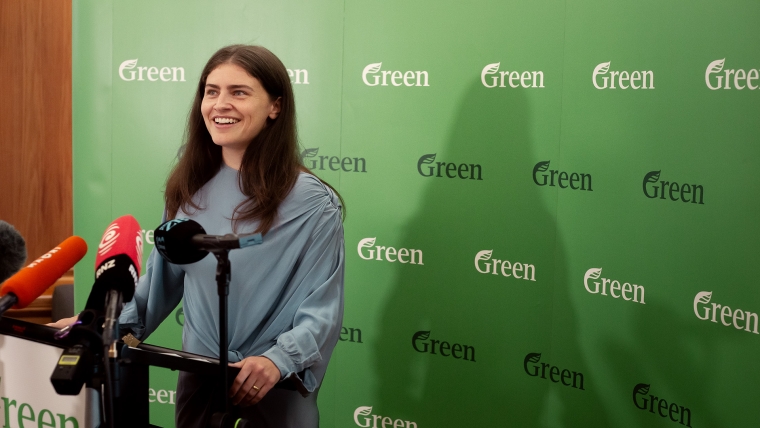
On Friday morning, Chlöe Swarbrick pitched herself as being the answer to both questions while announcing her intention to run for the co-leadership.
She described herself as a “researched radical” who wanted a “livable planet, wealth tax, rent controls, healthy rivers and a guaranteed minimum income”.
“I've also proven my ability to work with people across the aisle, to grow our movement and change hearts and minds without compromising on values”.
Swarbrick said she admired Shaw’s ability to build consensus and create policy that has survived the recent change in Government.
“What I bring to the table is not only that consensus building, but also I think that capacity to mobilize our communities as I've amply demonstrated, in for example, Auckland Central”.
The political world has had its eye on Swarbrick ever since her long-shot run for the Auckland Mayoralty. She came nowhere near winning, but caught the imagination of younger voters who volunteered in droves.
Swarbrick became something of a voice for Millennials and Gen Z, who often have much more radical politics than their more mainstream older counterparts.
Her ability to rally support and organize a campaign helped her to defeat both major party candidates in Auckland Central, an electorate which often party votes for National, in 2020.
This victory convinced the wider Green Party to contest more electorates in the 2023 election and it ultimately won two more: Wellington Central and Rongotai.
Her popularity and influence makes it unlikely that any of her caucus colleagues will challenge her. But, as she pointed out herself, the Green Party is unpredictable.
Election process
Nominations for the co-leadership close next Wednesday and will be followed by a policy conference and party-wide zoom calls to engage with the candidates.
The various party branches then discuss among themselves and fill out ballot papers which are returned on March 8. This process happens even when a candidate is unopposed.
Other possible candidates include Julie Anne Genter, who has ministerial experience, and Teanau Tuiono, who could position himself as Davidson’s eventual successor instead.
Marama Davidson has now signaled she will stay on to contest the 2026 election, despite sounding unsure during Shaw’s resignation announcement.
Swarbrick said it was her intention to work alongside Davidson to grow the Green movement and “achieve tangible, real-world, people-powered change”.
Part of her strategy could be to boost the Green Party’s presence in local elections. The party has previously won mayoral races in Wellington and Dunedin, as well as some councilors.
Swarbrick said, as co-leader, she would work to grow local branches to run campaigns in next year's local body elections and “beyond the election cycle”.
“We will continue to grow our Green Party caucus, as the leading movement of the political left, and ultimately we can lead government,” she said.
A Swarbrick-Davidson leadership would have climate change and wealth inequality as the party’s “central focus” — which means tax reform will stay near the top of the agenda.
“It has been mind-numbing to consistently hear members of the government saying they want a more productive society, without looking at the elephant in the room, which of course is our tax system,” she said on Friday.
Shaw’s shadow
Peter Dunne, a former Labour and United Future MP turned political commentator, said the Green Party had an opportunity to establish itself as the leading opposition party.
The Labour Party has been significantly diminished by its election loss and its attempt to pivot towards the centre has divided and de-energised its caucus.
“Labour looks set for a time of significant internal debate—no bad thing in itself—but one that has the capacity to widen further the divisions already evident within the party. All of which creates new opportunities for the Greens,” Dunne wrote in a newsletter.
“A more sharply defined position on environmental and social justice issues, that resonates with ‘teal’ voters in middle class electorates—like Auckland Central, Rongotai, Wellington Central and more—is an important next step the Greens need to take”.
However, Shaw faced backlash within the party for his moderation and pragmatism which could make it difficult for a new leadership duo to win widespread support.
“Whatever future leadership combination emerges within the party is unlikely to be as moderate and pragmatic as Shaw. That means that potentially the Greens could be less influential in the future,” Dunne said.
We welcome your comments below. If you are not already registered, please register to comment
Remember we welcome robust, respectful and insightful debate. We don't welcome abusive or defamatory comments and will de-register those repeatedly making such comments. Our current comment policy is here.