
The Government has provided details on how the country will manage and conserve fuel if the situation worsens.
Finance Minister Nicola Willis and Associate Energy Minister Shane Jones made the announcement from Parliament on Friday. Willis said the measures; “reflect the specific potential risks New Zealand could face as a result of major fuel disruption driven by the conflict in the Middle East”.
“New Zealand has sufficient fuel stocks, but we are planning for potential scenarios where obtaining future supply could become increasingly difficult," Jones said.
Phases
The phases can apply differently to petrol, diesel and jet fuel if needed.
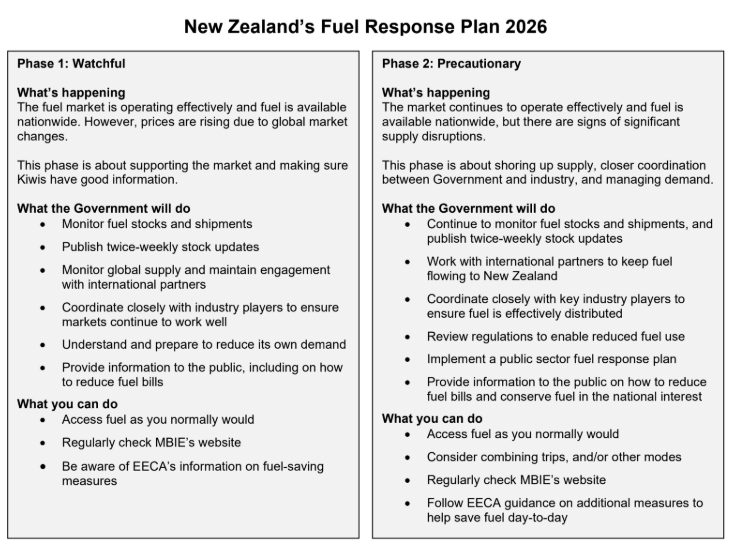
The country is currently at phase one - deemed the ‘watchful’ level which entails monitoring and strengthening diplomatic ties for supply.
Phase two would have more “active coordination between government and industry to shore up fuel supply and support increased efforts in demand reduction”, and a stronger push for voluntary fuel conservation and a public sector reduction in fuel use.
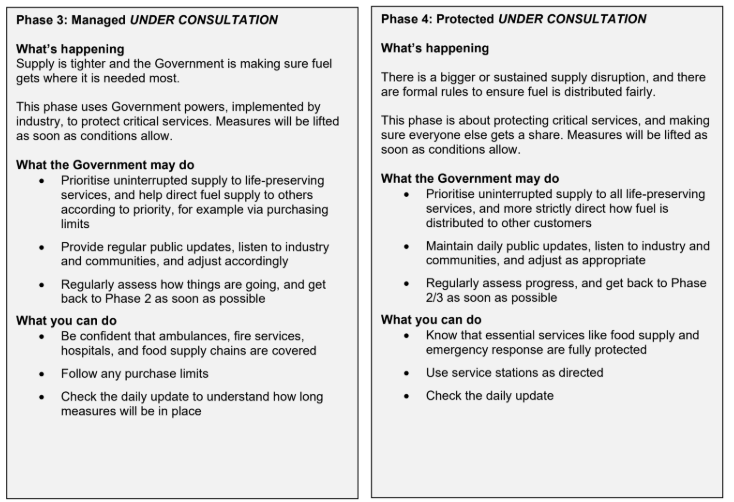
“If disruption increases, the plan allows for stronger interventions at Phases 3 and 4 including prioritising fuel for emergency services, freight and food supply chains, and key industries that underpin New Zealand’s economy,” Willis said.
“We have the gift of time,” Willis said, so would be consulting for the next two weeks with industry, fuel users, and local government on phase three and four implementation.
Moving phases
The Government’s Fuel Security Ministerial Oversight Group will decide whether the country needs to move phases based on any changes to six of the following criteria:
- export restrictions, if any of New Zealand’s source refineries introduce or relax export restrictions
- changes to New Zealand’s fuel stock levels of plus or minus three days since the most recent published update
- a fuel company informs the government that they are unlikely or unable to fill future orders
- a breach, or a notification of an imminent breach, of the minimum storage obligations
- any significant policy changes in Australia or from the International Energy Agency
- a significant disruption to regional distribution.
Fuel saving
In phase one, the the Energy Efficiency and Conservation Authority will launch an information campaign about voluntary ways New Zealanders can conserve fuel and save money. Moving up phases, phase two would encourage fuel reduction, in the hope that more intensive measures in phase 3 can be avoided.
"In preparation for potential phase fuel, we have directed the Public Service Commissioner to work with all government agencies to develop a public sector fuel plan. This includes identifying their essential fuel requirements, for example, school buses, hospital heating, but also to actively develop options for government agencies to minimise discretionary fuel use."
Willis said they wished to avoid phase three and it would only be necessary if supply tightened very significantly.
"If that occurs, the government will work with fuel companies to ensure fuel is directed to life supporting and economically critical services such as emergency services, hospitals, food supply chains and essential infrastructure."
Phase four would be due to a severe and sustained fuel supply disruption.
"In that case, the government would prioritise uninterrupted supply to life preserving services, and we would more strictly direct how fuel is distributed to other customers."
Schools
Willis said the one place they would draw the line was keeping children in schools.
"We do not want to see children forced to learn from home. We think maintaining access to schools... is essential in the Ministry of Education and working actively on plans to ensure that."
Hipkins asks; 'How's that actually going to work in practice?'
Labour leader Chris Hipkins said New Zealanders "want to know how fuel could be rationed if we get to that point".
"So if they end up at phases three and four and they're having to ration fuel, how's that actually going to work in practice? How will people find out whether they're on the priority list or not?"
He hoped the Government was working at pace.
"I understand that they're having to do things in sequence, but I think those are the sorts of questions people want to hear answers on sooner rather than later."
We welcome your comments below. If you are not already registered, please register to comment
Remember we welcome robust, respectful and insightful debate. We don't welcome abusive or defamatory comments and will de-register those repeatedly making such comments. Our current comment policy is here.