
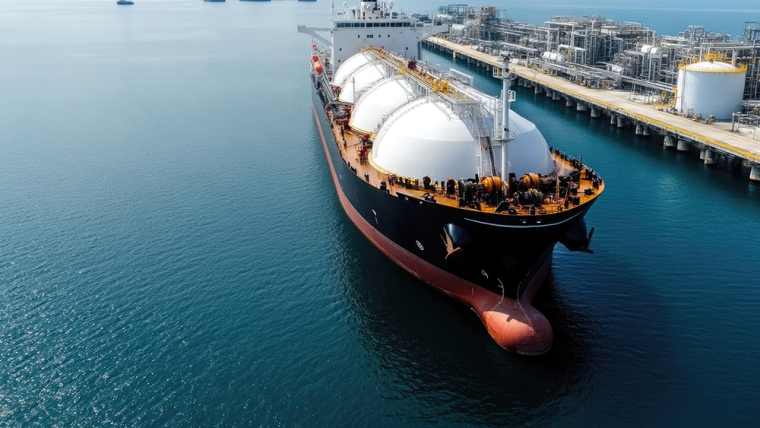
The Government isn’t considering pausing its plans to build a liquefied natural gas (LNG) terminal despite the world's biggest LNG production terminal being knocked out in the ongoing Middle East war, Energy Minister Simon Watts says.
On Wednesday, Watts told reporters the LNG import terminal was proceeding to plan.
“We’re under commercial negotiation with a number of parties in order to shortlist to be able to perform a contract for consideration and signing," Watts said.
“We remain on track to have that signed midway through this year.”
In February the Government said a LNG import facility in Taranaki, which will cost "north of $1 billion," could be operating as soon as 2027 or early 2028 to remove the risk associated with dry years. The cost of the infrastructure will be paid for via a levy on electricity, and the cost connected with importing LNG will be paid by users of gas produced from LNG.
Conflict in the Middle East has seen Qatar's Ras Laffan Industrial City - the site of the largest LNG production terminal in the world - hit by missile strikes. This LNG terminal supplies one-fifth of the world’s super-chilled fuel and gas exports from the Persian Gulf supply about 20% of world demand.
In a statement, QatarEnergy's chief executive Saad Sherida al-Kaabi said: "The damage sustained by the LNG facilities will take between three to five years to repair. The impact is on China, South Korea, Italy and Belgium. This means that we will be compelled to declare force majeure for up to five years on some long-term LNG contracts.”
QatarEnergy expects that it would take up to five years to repair, impacting supply to markets in Europe and Asia.
LNG is natural gas that has been cooled and liquified so it can be transported easily.
On its website, the Ministry of Business, Innovation and Employment (MBIE) said it was monitoring the impact of the conflict in the Middle East on LNG supply closely.
"The medium- to long-term impacts of the conflict on the LNG market are unclear at this time, because there is also a significant increase in LNG production capacity coming online."
"International Energy Agency forecasts show a 50% increase in supply capacity from 2025 to 2030 across the world, driven largely by new LNG capacity coming online in North America," MBIE said.
"There are opportunities for New Zealand to secure supply from non-Middle East locations, including Canada and Australia."
In February, the Government first announced it would contract to build a LNG import terminal in Taranaki. At the time, Watts said: “New Zealand is experiencing a renewable electricity boom, but a rapidly declining gas supply has left our electricity sector exposed during dry years, when our hydro lakes run low.”
“The result is greater reliance on coal and diesel, and ultimately higher electricity prices, putting more financial pressure on families and making businesses less competitive.”
Watts said the cost was subject to commercial negotiation but it would be about north of a billion dollars.
A government fact sheet provides more details around the costs but suggests when it comes to the cost of the LNG, there's two parts to it: the cost of providing and operating the LNG infrastructure, and costs directly associated with the import of LNG into the country.
'They should just cancel it'
Following the Government’s announcement, there were heated exchanges between Prime Minister Christopher Luxon and Labour leader Chris Hipkins. And in his State of the Nation speech, Hipkins promised to scrap the Government’s proposed LNG terminal if Labour takes office before contracts are signed.
Speaking to reporters on Wednesday, Hipkins said the Government shouldn’t just put a pause on the LNG import facility.
“They should just cancel it.”
“The LNG import facility makes us more dependent on fossil fuels. It has the potential to push up electricity prices unpredictably and ultimately, it isn’t going to give New Zealand the sort of energy security that we need,” Hipkins said.
“We have an abundance of renewable energy in New Zealand. It’s cheaper. It can be reliable if done right and that’s where the Government’s focus should be.”
We welcome your comments below. If you are not already registered, please register to comment
Remember we welcome robust, respectful and insightful debate. We don't welcome abusive or defamatory comments and will de-register those repeatedly making such comments. Our current comment policy is here.