
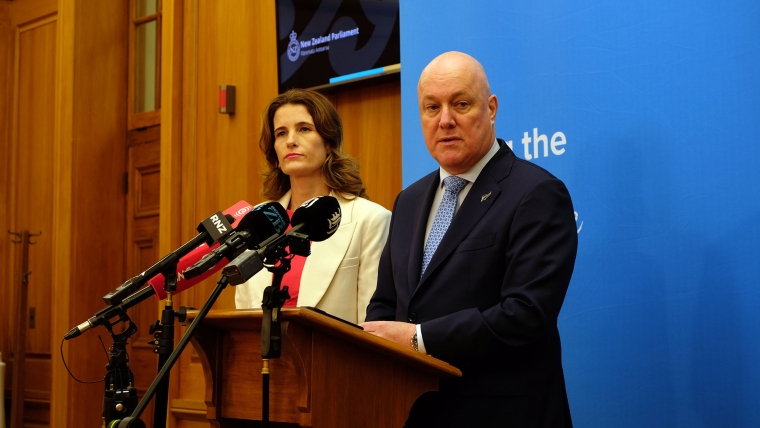
National’s finance spokesperson Nicola Willis says her party will not introduce new taxes on working people, if re-elected in November's election, and has ruled out increasing taxes for small businesses and pensioners.
However, when pressed further by reporters, she did not elaborate further on who may get taxed, saying National will have more to say about its tax bottom lines in the campaign.
“Listen to me very carefully. No new taxes on working people. No tax increases for working people … What New Zealanders can expect is no new taxes on their work and no increases to tax on … their savings, their investments or their capital," Willis told reporters on Sunday morning in Wellington.
Willis’ comments come as she, alongside National leader Christopher Luxon, said that if re-elected, the party will commit to fiscal rules called the 'Budget Responsibility Rules'.
National's 'Budget Responsibility Rules' are:
- Prioritising a return to surplus in 2028/29, and staying in surplus over time, sufficient to see the debt curve bend down
- Bending debt down below 40% of GDP, and maintaining debt below that level over time
- Keeping taxes low by right-sizing government, with core Crown expenditure as a share of the economy declining towards 30% of GDP
'This is much ado about nothing'
Labour and the Greens were critical of National's announcement, with Labour finance spokesperson Barbara Edmonds saying: "We agree that fiscal responsibility is crucial, but this is much ado about nothing."
"Once again, they’ve wasted everyone’s time on a Sunday, re-announcing what’s already in their fiscal strategy."
Green Party Co-leader Chlöe Swarbrick said: “Luxon wants us arguing about fiscal metrics because he doesn’t want to talk about his record: the highest unemployment in 11 years, small businesses closing their doors every week, and young New Zealanders leaving in search of a better life in a different country under a different Government."
'The only way to be ready for the next crisis is to get our books in order now'
In Budget 2026, the OBEGALx, the Operating Balance Before Gains and Losses, excluding the revenue and expenses of the Accident Compensation Corporation, was expected to improve compared to the half-year economic update, returning to surplus in 2028/29, expected at $2.6 billion.
That was due to increased tax revenue of $3.1 billion, a smaller than previously forecast Budget package, and it was partly offset by an increase in benefit payments.
When it came to debt, Willis told reporters on Sunday; “What we want to achieve is a balance between ensuring that we are keeping debt reducing over time, but not doing that in such a way that would involve either hiking taxes on people or ripping the carpet out from under them when it comes to public service delivery."
“As a small, commodity-exporting country a long way from anywhere, without a deep pool of domestic savings to fall back on, New Zealand carries more risk than bigger countries when the next earthquake, pandemic or global shock hits," Willis said.
“That is why these rules are so important for any Government. The only way to be ready for the next crisis is to get our books in order now, while conditions allow it," she said.
Asked what the point was of the announcement as these rules had been alluded to in the party’s previous fiscal strategy, Willis said: “These set the parameters for this campaign and I think it is well past time for parties of the opposition to set out the fiscal guardrails they intend to uphold.”
She said other political parties should be "well able to say" whether they would “commit to these three basic things that have informed the fiscal strategies of successive governments and which represent what it is to be a responsible fiscal manager."
Willis said she was not even aware whether Labour believed a surplus target was appropriate, where they thought debt should be or whether or not they believed that core Crown spending needed to be reduced in order to keep taxes low.
Asked if their coalition partners, ACT and NZ First were on board with these rules, Willis said: “We have debates as three parties, but there has been a consistent approach of recognising that keeping the finances in good order, paying down debt are very important goals for us to hold ourselves accountable for reaching."
"So it's my belief that any future budgets that a National-led government would deliver would be consistent with these commitments.”
Willis said a very significant economic shock could necessitate a deviation from those goals in the short term.
“The key is, if New Zealand has shocks like that, we want to be able to face into them confidently, so we have to build up the rainy day buffer now.”
Asked by reporters if it was disingenuous to say the last government hadn’t built up a rainy day fund, give the Covid-19 pandemic and Russia's invasion of Ukraine, Willis said no one was arguing that some spending was necessary to respond to the pandemic.
“But they took the excuse of the pandemic to put the money spending bazooka on overdrive and we are now as a country still having to clean that up.”
'Three years too late'
ACT Party leader David Seymour said: “Cutting the waste to grow the country is desperately needed, but National’s promise is three years too late. Saving money needs a strategy to achieve it, and a strategy takes courage to implement."
“ACT has killed three new taxes in this term of Government. Without ACT we would be seeing taxes on housing, tourism, and banks that are all ultimately paid by New Zealanders and their businesses. Controlling spending is only half the equation, controlling taxes is the other half," he said.
Labour's finance spokesperson Barbara Edmonds said National had only one way to achieve anything and that was through more cuts.
"You cannot cut your way to growth. Cuts push up costs, put families under pressure and leave everyone worse off. We’re announcing policies that will leave families with more and help with the cost of living."
On Sunday morning, Labour announced it would open up Government contracts to small businesses. At the time, Edmonds said the party will set a target of 15% of the Government's annual contracts to go to small businesses, break up big contracts where it made sense, and remove "unnecessary barriers" that shut small businesses out.
"This is how we grow the economy from the ground up," she said.
"National has had three years to achieve their own rules. They’ve had three years to show fiscal responsibility and put it into law. Instead we’ve had higher unemployment, record KiwiSaver withdrawals and business liquidations."
Edmonds said Labour will announce its fiscal strategy in due course.
Greens co-leader Chlöe Swarbrick said "headline figures are meaningless if people's lives are going backwards".
“Reducing the Government’s debt and expenditure through merciless cuts only increases New Zealanders’ debt and cost of living.”
“Luxon’s cuts so far have resulted in higher prescription fees, higher public transport costs, higher road user charges, higher rates bills and a higher cost of living. These things make the Government’s books look better, but life harder for working people," Swarbrick said.
No new taxes?
Taxpayers' Union executive director Jordan Williams said Willis had put "a massive asterisk next to the 'no new taxes' talking point, suggesting there could be new taxes, just not on ‘working people’".
“You can’t credibly claim to be the party of ‘lower taxes’ while going into an election offering no tax relief, allowing income taxes to rise through fiscal drag, and apparently foreshadowing higher taxes on someone other than ‘workers’," Williams said.
“At minimum, Nicola Willis needs to be transparent about what taxes she's planning to hike."
We welcome your comments below. If you are not already registered, please register to comment
Remember we welcome robust, respectful and insightful debate. We don't welcome abusive or defamatory comments and will de-register those repeatedly making such comments. Our current comment policy is here.