
by Anna Whyte and Mandy Te
This article is the first in an interest.co.nz series looking at political parties' financial and economic policies. In this installment, Opportunity Party leader, Qiulae Wong, discusses her party's proposed land value tax, KiwiSaver 2.0 and a 'citizen's income' policy - along with her views on KiwiMart, crypto bright-line tests and AI.
Land tax
The Opportunity Party is pitching a 'land value tax', which would place a 1.75% tax annually on the value of land with the aim of discouraging land-banking and large property portfolios and redirecting money into businesses.
Wong said they had proposed a 10-year transition plan for the land tax.
"...The first couple of years actually has no land tax at all," Wong said. "It's about setting up the systems and making sure everything's in place, and giving time for the market to adjust, because even the idea of a land tax coming in will have an impact on house prices, and so bringing that in dramatically overnight is not what we think is the right thing to do. And then we would increase that land tax over that time."
Asked about the lack of appetite for a land tax from political parties and the public, Wong said; “tax is always a tricky one because we want to vote in our self interests for how our lives are going to be better tomorrow, and something as big as tax reform, where we're introducing a land tax and a citizens' income, that's a fundamental change to our tax system to shift some of the burden off work and onto assets.”
“I'm not surprised that there's an immediate pushback. But we've also seen a lot of people that are really interested and curious about having that conversation much more than there has been in the past.”
KiwiSaver 2.0
The Opportunity Party is proposing to create an entirely new compulsory retirement savings scheme, KiwiSaver 2.0, with combined employer/employee contributions rising to 12% that are exempt from income tax.
KiwiSaver 2.0 would be entirely separate from the current KiwiSaver scheme, and savings would not be able to be withdrawn for first-home purchases or financial hardship.
Currently, people pay tax on the money their KiwiSaver investments earn but they do not pay tax on any money withdrawn from their account. Employers pay tax on all employer contributions to KiwiSaver schemes and complying funds - this is called the employer superannuation contribution tax (ESCT), while employees pay income tax prior to their contribution into their KiwiSaver.
Superannuation and raising the retirement age
The party is proposing a weekly 'citizen's income' of $370 to go to almost all adults, and would replace most benefits, including the superannuation.
Wong said they were not proposing to change the way superannuation is measured and delivered, aside from topping it up to its current amount from their ‘citizen’s income,’ a type of universal basic income, of $370 a week.
“What's important is we do introduce compulsory KiwiSaver that gives people a chance to make their own private savings, and then we can look at the affordability of superannuation long-term and whether we raise the age or means test in future. But only once we have compulsory KiwiSaver in place because we need to set up a system that gives people the options to save for their own future.”
She said there were pros and cons to raising the age or means testing.
“If we were to raise the age, we have to be cognisant of the fact that there are people who work in really manual jobs or people have shorter life expectancies, and raising the age is disproportionately burdensome on them.
By the same means, there are cons to means testing as well,” she said.
“The reality is we need to do something because we know that this is an increasingly unaffordable bill. So we either have to raise more revenue, or we have to find a way to adjust the scheme, and we don't have a straight answer on that now."
Labour’s proposal to return to the Reserve Bank to a dual mandate
Labour has confirmed that, if reelected to government, it will restore the Reserve Bank's monetary policy dual mandate targeting both inflation and also maximum sustainable employment. National has described Labour's plan as "economic vandalism."
Wong said returning the Reserve Bank to a dual mandate was; "not the most important thing that needs to change when it comes to our economy, and the risk is we turn this into another political football that flip-flops every time we have a change of government, and that is actually the more harmful thing."
“So, if we're going to change their mandate, then that should be something that has broad consensus across political parties. It's not going to change every time we have a change in government, so we would not be in in favour of changing it at this point.”
Opportunity’s estimate to save the public service $1.7b
The Opportunity Party has estimated its 'tax reset' policies could save $1.7 billion in administrative costs.
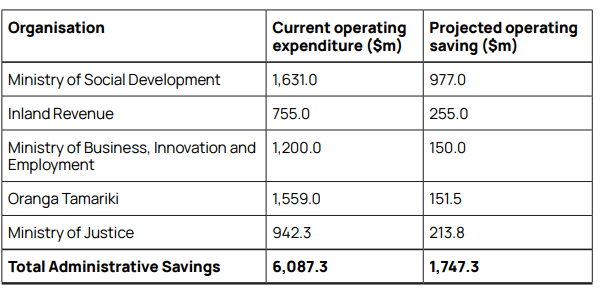
Asked if $1.7b in savings was an overblown estimate, Wong disagreed and said it was realistic.
“We've gone through multiple agencies, and so a big chunk of that is in the administration of our welfare system. So that is hugely administratively burdensome at the moment.
“The amount of time that it takes, and the processes and systems required to constantly check whether people are eligible for things like the job seeker benefit. That would be significantly reduced if we had the citizens' income.”
Wong said it was not an "arbitrary attempt to cut the public service”.
“Our goal here is to reduce the need of public servants to have to do work with young children who are living in poverty or going down a life of crime."
She described the Government's plan to decrease the workforce size of the public service by almost 9000 roles as "extremely arbitrary and not planned and intentional over a long period of time."
A bright-line test for crypto currency and other assets
ACT is promising new digital finance rules and tax breaks to change the way New Zealand treats crypto currency and other digital assets. The party promised to make profits from digital assets exempt from tax if they're held for at least a year.
Wong said there was “a valid challenge here that ACT is trying to solve, people being taxed on those assets where they don't necessarily have made the gains.”
“We're looking at this at the moment and seeing whether we would have a similar solution or something slightly different.”
The Green Party’s KiwiMart grocery idea
The Green Party wants to establish a publicly owned supermarket chain called KiwiMart, with a mandate to prioritise affordability for consumers.
Wong said affordability was not just a problem in supermarkets, "but many sectors where we've got concentrated power and a few players".
"So that happens in our grocery sector, and banking, and construction supplies, and electricity. Our solutions to that, though, are not necessarily spending a whole lot of taxpayer dollars to set up a competitor," she said.
"We've seen with Kiwibank... and I love them, but we still have Australian banks making record profits and much higher profits than the rest of the world. So Kiwibank hasn't solved banking. I don't think KiwiPower is going to solve electricity, and I don't think KiwiMart is going to solve supermarkets."
"So we would like to see stronger powers from the Commerce Commission to actually take action on a lot of the recommendations that they've already made in many of these areas," said Wong.
What about breaking up the gentailers?
Meanwhile, New Zealand First will be campaigning to split the big power gentailer companies up into separate generators and retailers, "so they can no longer control both the power and the price,” leader Winston Peters said.
Wong said while Opportunity had not proposed breaking up the gentailers, they were not closed-minded to it.
"We did look at it as part of our policy. We think that there are some other things which are still significant, which would make a big difference, including capacity investment scheme, which would incentivise more investment in renewable generation.
"We also think that government needs to ring fence the dividends from the gentailers, so that's around $500 million a year, and put that money into electrifying our economy and our homes and our businesses..."
AI policy pending
Labour is following Australia's artificial intelligence (AI) roadmap, promising to introduce an Office of AI, a minister responsible for AI, tight new rules for data centre electricity use and copyright protections for artists and media.
Opportunity Party's policy on AI won't be out until closer to October, but Wong said Labour's pledge was; "the best AI policy we've seen so far, it's better than the two-page AI plan that this government produced, and I think it does address many of the concerns, whether that's in the data centres piece, the framework around how do we use AI and how do we protect data, and and actually also looking at how do we use it for productivity, not just efficiency gains?"
We welcome your comments below. If you are not already registered, please register to comment
Remember we welcome robust, respectful and insightful debate. We don't welcome abusive or defamatory comments and will de-register those repeatedly making such comments. Our current comment policy is here.