

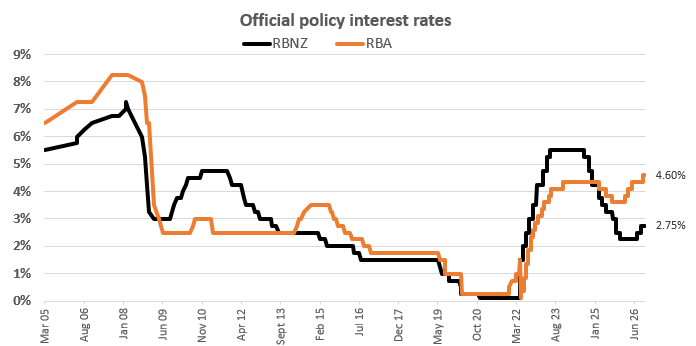
On Tuesday the Reserve Bank of Australia (RBA) is expected to lift its cash rate 25 basis points to 4.60%, taking it a whopping 185 basis points above the Reserve Bank of New Zealand's Official Cash Rate (OCR).
As the chart below shows, such a chasm between the two countries' benchmark interest rates doesn't happen too often.
I previously wrote about a major gap between the RBA and RBNZ rates in April 2022. However, back then, the shoe was on the other foot. The RBNZ had the OCR at 1.50%, a full 140 basis points above the RBA's 0.10% cash rate.
So how have the roles reversed?
Kiwibank Chief Economist Jarrod Kerr notes the RBA has played a more cautious hand over recent years than the RBNZ has.
"They [RBA] didn't hike as aggressively out of COVID so they generated a little bit more inflation than we did, but they've certainly kept the economy growing," says Kerr.
"The Australian economy hasn't recorded two recessions like we have in the last two years. So, relative performance, I think you just need to look at the data. Our unemployment rate's much higher than theirs, and we've got this sizable outflow of Kiwi going to Australia, and that tells you everything you need to know really."
In its monetary policy mandate the RBA is tasked with maintaining CPI inflation between 2% and 3%, and "focusing on achieving the current maximum level of employment that is consistent with low and stable inflation."
The RBNZ is tasked with achieving and maintaining annual inflation between 1% and 3% over the medium-term, with a focus on the 2% mid-point. It was required to support maximum sustainable employment between 2018 and 2023, a requirement the current government removed but Labour and NZ First want to restore.
NZ's latest CPI data, from Statistics NZ, showed an annual increase of 4.1% in the June 2026 year. The Australian Bureau of Statistics says Aussie CPI rose 3.5% in the July year. Over recent years annual CPI inflation peaked at 7.3% in June 2022 in NZ, and 7.8% in Australia in December 2022.
The latest unemployment data shows a 4.6% unemployment rate in Australia and 5.6% in NZ.
According to Statistics NZ, there was a provisional net migration loss to Australia in 2025 of 28,500 people, down a bit from 31,100 in 2024.
"There's been a much more aggressive stance here on inflation than in Australia, and I think that difference is showing up in the economic performance," Kerr says.
"Those migration flows I think tell you everything, right? That relative outperformance of Aussie. The good news in this is that the Kiwi dollar is doing exactly what you want it to do in this situation."
That is weakening against the Aussie dollar.
"And every Australian understands that for every dollar they take to New Zealand, they get $1.20. So New Zealand's on sale. So I think part of the reason why tourism has just ticked back to pre-COVID levels, has been a lift in Aussie tourists and making benefit of that weaker currency."
The 134,900 overseas visitor arrivals from Australia in July 2026 were a record for a July month, Statistics NZ says, and comprised 53% of all overseas visitors during the month.
Against the backdrop of the ongoing global oil shock, the RBNZ is expected to increase the OCR further after lifting it 25 basis points in each of July and September, to 2.75%.
In terms of the NZ versus Australia economic dynamic, Kerr says things are changing in both countries.
"I think the Aussies are cooling. They've played around with their golden goose in changing their negative gearing. [Negatively geared rental income losses won’t be deductible against non-investment income like wages from next July]. That's had an immediate impact on their housing market. So there's downside risk, I think, to Aussie housing and the Aussie economy at a time when I believe most of the forecasters over there are forecasting at least another one, maybe two rate hikes after next week [Tuesday, September 29]."
"So their side's cooling and we're kind of hoping the opposite for us. We're sort of hoping that there are enough things in place, whether it's the weaker currency or, the back end of the election. I think a lot of businesses want to see that done and dusted, and then away we can go," says Kerr.
"So I'd almost say, look, if I was to take a bet, I would expect the Aussie dollar to be depreciating against the Kiwi next year. That would be a sign of us regaining some momentum and the Aussies cooling."
*This article was first published in our email for paying subscribers. See here for more details and how to subscribe.
We welcome your comments below. If you are not already registered, please register to comment
Remember we welcome robust, respectful and insightful debate. We don't welcome abusive or defamatory comments and will de-register those repeatedly making such comments. Our current comment policy is here.