
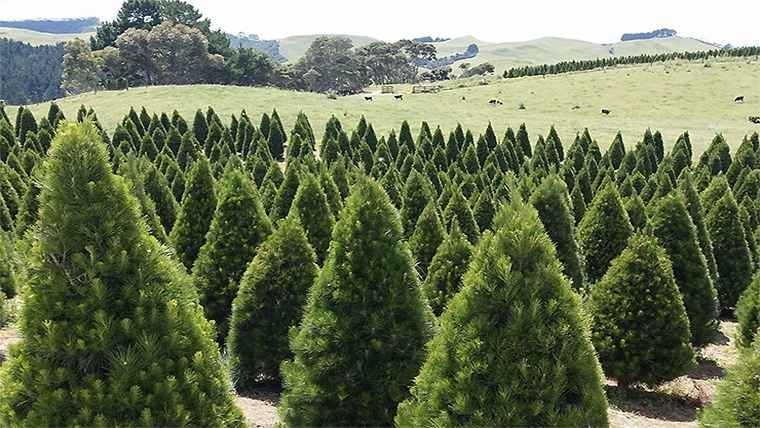
In recent months I have been writing about land-use transformation that will be driven increasingly by carbon trading. If New Zealand is to approach net-zero carbon, then it can only be achieved by a combination of modified lifestyles plus new technologies that either don’t yet exist or are yet to be commercialised. Even with all of these things, it will still require lots of forest plantings to offset carbon emissions from elsewhere in the economy.
A key point underlying the recent articles I have written is that the implications for rural-landscape change have been under-estimated and poorly communicated. A key thrust of this current article is that it is only by permanent forests rather than multiple-rotations of production forests that the march of the pine trees across the landscape can be managed.
To put some broad numbers around the situation, New Zealand’s current annual emissions of greenhouse gases, as officially measured, are approximately 80 million tonnes of carbon dioxide equivalent (CO2e). One key challenge in controlling these total emissions is that New Zealand’s population has been increasing recently at between 1.5 percent and 2 percent per annum, driven largely by immigration. These population growth rates are remarkably high for a developed country.
New Zealand’s forestry offsets as officially measured are currently around 24 million tonnes per annum of CO2e. This comes from the 1.73 million hectares of production forest. Nearly all of these forests will be harvested over the next 30 years.
Once existing forests have been harvested, that land can never provide more credits. Indeed, these lands must be replanted in forest just to avoid carbon levies being charged. This is because the essence of carbon trading is that only new carbon storage is rewarded. Once forests are harvested, then new carbon sequestration from replanted forests is needed to balance out what was lost from harvesting.
This means that if all New Zealand does is replace harvested forests, with no new forests from farmland, then it will be reporting back to the UNFCCC that its carbon sequestration is rapidly declining towards zero, whereas sequestration needs to increase.
To say that a little differently, replanting the current forests will not stop New Zealand going into reverse-gear sequestration rates. New Zealand needs to both replant harvested forests and also plant lots of new forests on farmland if it is to maintain current levels of offsets. And then plantings need to increase still further if offsets are to increase as the Government intends.
To put some numbers around that, if New Zealand wants to just maintain the current annual offset rate of around 24 million tonnes of CO2e, and if it plans to do this with production forests, then as well as replanting existing forests, it will need to plant new pine forests, with these new plantings marching across current farmland at about 65,000 hectares each year. All of these new plantings have to come from farmland.
The reason the march across the landscape has to be so fast is because production forestry is a weak provider of carbon sequestration. Averaged out over multiple rotations, these production forests only store around 350 tonnes of carbon dioxide equivalent. Under the proposed averaging system, credits from all of this are earned over the first 17 years.
This creates a perverse situation of short-term investor behaviours to generate cash being driven by the long-term benefits, yet the long-term benefits are only modest because of the harvesting.
As one scenario, if New Zealand wants to work towards sequestering around 35 million tonnes per annum of CO2e by 2050, and with interim targets along the way, then that is an additional 10 million tonnes sequestration per annum from currently. To achieve that with radiata-pine production forests, then the march across the landscape with new plantings is no longer 65,000 hectares, but around 100,000 hectares per annum, at least until 2050, and in all likelihood continuing on from there.
To put that in perspective, the total area of sheep and beef farming area is around 8.8 million hectares. So, by the end of this century the pastoral countryside, apart from the dairy land which is still too expensive to go into trees, and some dry land in Central Otago, would be a solid mass of pine trees. The current $10.5 billion of meat and co-product exports would be gone.
The obvious alternative is to focus on the steep erodible land and plant permanent forests. For example, each hectare of permanent pine forest will sequester between 1000 and 1350 tonnes of CO2e over a fifty-year period. Carbon sequestration will also continue beyond 50 years, but the official ‘look-up’ tables stop at that point, so the tables need to be extended.
The reason for focusing on radiata pine for the permanent forests is that these are the trees that grow the fastest in New Zealand conditions. Native trees sequester CO2e at around one quarter of the rate of pine according to the official ‘look-up’ tables.
However, in the long term it is feasible for mature radiata pine be replaced by indigenous forests. This requires an initial seed source for natives to grow in the shady spaces as mature pine trees die and fall. In big forests beyond the reach of seed-spreading birds, nature will need some help from humans to get the process started. That will be the task for future generations, perhaps 100 years from now.
With permanent pine forests, it would take about 1.3 million hectares planted progressively over the next 30 years to be giving us around 35 million tonnes of CO2e offsets at that time, with those offsets continuing for many years thereafter. Co-incidentally, that area of around 1.3 million hectares aligns with estimates of low-productivity erodible sheep and beef land that would benefit from being forested.
Permanent forests set up with radiata pines are not the perfect solution. However, they are the only solution with potential to provide the carbon offsets that will be needed if New Zealand is to meet its Paris commitments without destroying pastoral farming.
The big risks with pine forests are fires and exotic pests. So far, New Zealand has been blessed that the pests of radiata pine have not reached New Zealand’s shores. An attack of pine beetle could destroy a production forest, but in the case of mature permanent forests this might also facilitate conversion to indigenous forests.
The risks of fire relate both to production and permanent forests, but with permanent forests the area of pines can be much less.
The problem right now is that Government policies are encouraging behaviours for setting up of production forests on the better classes of land. The balance is out of kilter with long-term needs to get the right trees in the right place.
The key emergent question is how can New Zealand put in place the incentives and institutional frameworks to plant around 45,000 hectares of permanent forests per annum on the steep erodible lands, such that conservation benefits and carbon sequestration go hand in hand.
I have some ideas as to how that could be done, but that is a big discussion for another day. What is clear is that current policies are not going to get the right trees in the right place.
*Keith Woodford is a retired academic who now holds an honorary position of Professor of AgriFood Systems at Lincoln University, NZ. He now consults through his own company AgriFood Systems Ltd. Articles written since 2010 are archived at https://keithwoodford.wordpress.com. He can be contacted at kbwoodford@gmail.com


We welcome your comments below. If you are not already registered, please register to comment
Remember we welcome robust, respectful and insightful debate. We don't welcome abusive or defamatory comments and will de-register those repeatedly making such comments. Our current comment policy is here.