
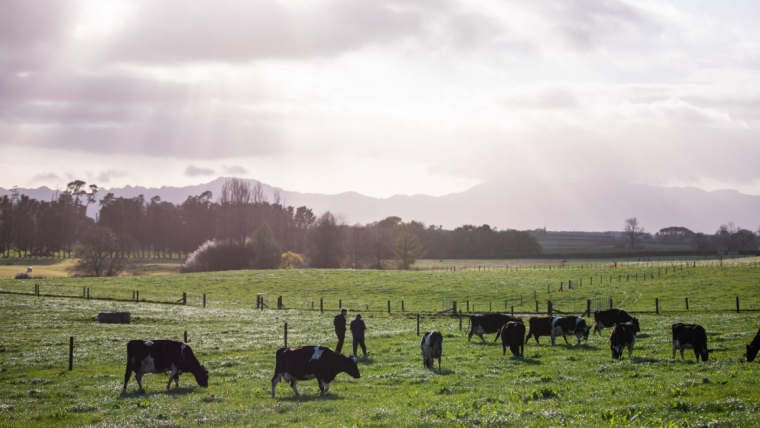
On the surface it would appear to be a good time to be considering to buy a farm - based on historic versus current prices anyway.
Data released by the REINZ show that for the year ending September 2020 total farm sale numbers have dropped by -5.6% to 1285.
Dairy farms lead the way with reduced sales. No doubt the combination of COVID-19 creating uncertainty in the marketplace, along with added complications over regulations around water, land and fertiliser have combined along with the underlying threat of the climate extremes to provide major disincentives to get into dairy farming.
- Dairying -24.1%
- Grazing -14.9%
- Finishing -9.3%
- Arable -4.6%
I can only presume that to get to -5.6%, it has been horticulture that has lifted sale numbers to balance these negative categories.
Despite the fall in the annual numbers, in the three months to the end of September there were 401 total farm sales, 131 more than the same period last year with an upsurge in sales occurring at the latter end of the period.
Despite the reduced annual sales, the median price for the three month period ending September was $26,917 compared to $25,754 recorded for three months ended September 2019 (+4.5%). Showing the surge in the tail, the median price per hectare increased +4.9% compared to the same period ending in August 2020. So, while timing for would be purchases may be past its optimum and the market swinging to be in sellers favour, with product prices showing some resilience despite the virus, and interest rates at record lows and maybe to go lower, those with access to money must be getting tempted.
It was worth adding that the REINZ All Farm Price Index increased +0.7% in the three months to September 2020 compared to the three months ending September 2019. The REINZ All Farm Price Index adjusts for differences in farm size, location, and farming type, unlike the median price per hectare, which does not adjust for these factors.
Most regions (11 of the 14) recorded increases in farm sale with only Otago, Bay of Plenty and seemingly the Wairarapa being in the negatives. Brian Peacocke, Rural Spokesman, at REINZ suggests that “The increase in total sales volumes suggests farmers and investors alike are opting for the security of land ownership as opposed to investing in other sectors which have been and are continuing to be impacted by the constraints imposed by the COVID-19 pandemic.” “The median price reinforces the above viewpoint with most categories holding par or increasing slightly, apart from the horticulture sector which continues to grow in value and go from strength to strength”.
Last month the state-owned farmer Pamu, or Landcorp, wrote down the book value of its dairy farms by 10% in the year ended 30 June. Peacocke of REINZ said that write down number was about the middle of the range with the lowest being just over 7% and the highest write down close to 20%.
The Landcorp adjustment fits what is happening elsewhere in the country with nationally dairy farms compared to September 2019, the REINZ Dairy Farm Price Index fell -7.5%.
Tatua shines yet again
In the meantime, Tatua is going from winning post to winning post with a farmer payout of $8.70 per kg MS after retentions.
Tatua results:
- Record Group revenue of $381 million
- Earnings of $151 million
- Processed 15.15 million kgMS
- Group earnings of $151 million equates to $9.96/kgMS
- Final cash payout of $8.70/kgMS - $1.26/kgMS or $19.1m before tax retained for investment.
Last season Tatua paid out $8.50 to farmers. Not surprisingly China ‘s demand has featured in Tatua’s ability to achieve this year’s record result.
The domestic economy
New Zealand’s internal performance is also looking positive with the 3rd Quarter financial performance up 8-10% after crashing to -12.2% in the 2nd Quarter. At this stage the predictions are for the 4th Quarter to also be positive. Much of this will be driven by the willingness of kiwis to continue to travel and spend. Most retail sectors are breathing a sigh of relief with what almost feels like generosity of consumers to help keep the economy moving. Even Aucklanders should be feeling welcomed in the further flung regions. Some however, are obviously feeling a little like how dairy farmers have felt for a few years with some hesitant to say where they are from, “Up North” being a thinly disguised code for Auckland. They needn’t worry too much most retailers even in the South Island are more than pleased to see them as things were certainly leaner when the Queen City was under lock down.
Today's referendum results are next notable event out of the blocks; however, I think the US election results are going to have a far greater audience and for the farming sector likely to have greater impacts.
Unfortunately, assuming Trump does not return, it is going to take years to reverse some of the negative impacts the current US administration has created. Trade though, may be one of the earlier areas that could be looked at especially with the American bias of economy over health that seems to prevail. What the ‘new normal’ looks like is going to be driven a lot from what future view the next US Government has of the world and of the US itself.
We welcome your comments below. If you are not already registered, please register to comment
Remember we welcome robust, respectful and insightful debate. We don't welcome abusive or defamatory comments and will de-register those repeatedly making such comments. Our current comment policy is here.