
The folk at NIWA climate forecasting must wonder why they bother going to work some days. Looking back at the September update on the weather for the October to November (inclusive) period no particular signs were ahead for what was in store - particularly for Hawkes Bay but also for the country in general.
Rainfall was a bob each way prediction as was temperature, although the cooler percentage was a tad higher than could be expected given the general trend of late. One thing the forecasters have been correct on though, is the increase in the extremes.
Last week, taking place in Auckland was the Climate Change and Business Conference. Some of what the focus is going to be about is the recently released “Our Atmosphere and Climate Report”.
While nothing in it is particularly new it is a reminder of what is ahead of us and given the relatively small shifts in temperature to date and the large shift in weather extremes, farmers at least should be considering climate in all future planning.
Given that climate change and its impacts is probably going to dominate news in the years to come it is worth having a ‘touch up’ on where we in New Zealand stand at the moment.
Taking a condensed view at what the climate is doing first; the national average temperature has risen by 1.13 (±0.27) degrees Celsius since 1909, at an average rate of 0.10 degrees per decade. That rate of increase sounds relatively mild and will allow ‘us’ to keep up with adaption. However, in the last 30 years that rate has trebled to 0.31oC per decade. Future predictions vary but 0.2oC per decade seems to be accepted, at least for the next few decades.
Drought or at least dry periods are becoming more common and extending in length. Auckland for example experienced its longest dry on record with 47 days dry in early 2020, well above the average length of 10 days for 1960–2019. Hawkes Bay and Northland came close to, if not having their driest season on record also.
Sea level rise, as a result of climate warming, has shown a similar pattern to temperature. New Zealand’s mean relative sea level has risen by 1.81 (±0.05) mm per year on average since records began more than 100 years ago, and the average rate for 1961–2018 was twice the average rate for the time period since records began to 1960. Storm surges increase the impacts of rising sea levels.
The warnings scientists are putting out now are little different to what was being said a decade ago. What is different is that now we are also experiencing the impacts instead of just talking about them. Back in 2018 as part a Stats NZ data graphs were constructed of the New Zealand’s population concerns around environmental issues.
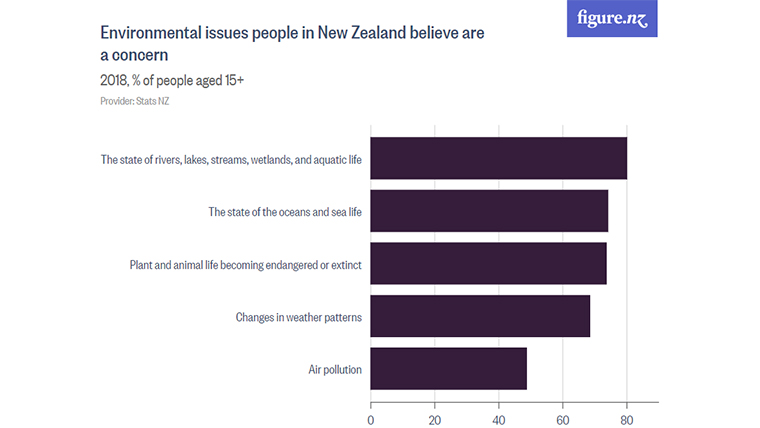
Weather patterns while ranking high still did not match other issues, notably the state of waterways and wetlands etc. I suspect the gap may have closed if the survey was done again now. Especially after the last 12 months with the number of wildfires in Australia, the USA and increasingly here. I also suspect that people focus more on what they believe can be changed, whereas climate is largely out of New Zealanders control.
Under the Paris Accord, New Zealand has committed to reducing future emissions
- 5 per cent reduction below 1990 gross emissions for the period 2013-2020
- 30 per cent reduction below 2005 (or 11 per cent below 1990) gross emissions for the period 2021-2030.
As can be seen in the below graph ‘we’ are well short. Agriculture has been a major contributor, but the biggest increases have come from transport. Road transportation emissions in 2018 were up 2.0 percent from 2017 and up 101.6 percent from 1990.
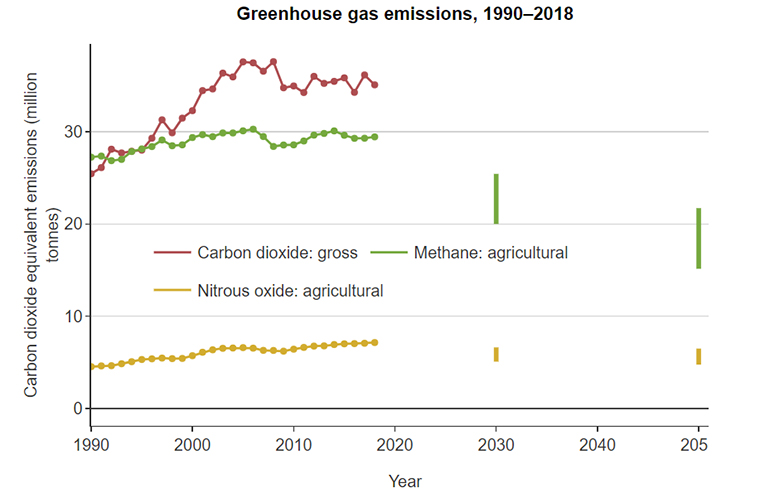
Methane emissions from livestock in 2018 were up +8.3% from 1990, and up +0.5% from 2017.
There are not many of us who are not responsible to some degree for the transport contribution but Government seems content to let the ETS component of fuel remain as the only means to dissuade drivers from adding to the problem and yet this area is far and away where the largest growth is taking place.
In the meantime, more taxpayers money is being poured into roading infrastructure.
A random fact I heard the other day is that cycling is 22 times more efficient than motoring when it comes to GHG emissions and yet cities are providing little provision to encouraging cyclists when this could provide real improvements. New Zealand still lags behind the rest of the world when it comes to incentivising people to switch to electric vehicles and public transport is severely lacking. In the meantime, agriculture is trotted out as being to the forefront of tackling its emissions and it is where most of the pressure is being applied by Government. The report says: “Carbon dioxide emissions from transport are projected to be 14 percent lower in 2035 than levels estimated for 2020. Because vehicles are replaced slowly in this country, it will take longer here for the effects of improved fuel efficiency and more electric vehicles to affect our emissions than in other countries (MfE, 2019).”
To date there is little evidence of any action to steer our transport emissions to meet this outcome (COVID-19 aside).
At the moment New Zealand hasn’t a hope in hell of meeting the Paris Accord requirements but we have had a history of being strong on rhetoric and not being able to show the results in reductions. Per capita, New Zealand is the 17th worse of the 34 OECD nations with 7.7 tonnes of CO2e. Perhaps not surprising the USA and Australia are 1st and 2nd respectively.
The irony is, no matter what actions New Zealand takes it is going to matter very little in the global sense. With total emission a tadge over 0.1% of global emissions our contribution is almost purely symbolic. The most positive news to date on global climate issues is the imminent removal of Trump from the US presidency and the USA re-joining the Paris accord.
59 Comments
I agree with the sentiment here on transport. We need to address the transport issue - first being tackled is coal which I suspect will be gone by 2030 or hardly used - the carbon price will drive this easily. Transport is harder as it requires everyone to change habits. Fuel price is one part via a carbon charge(ETS) but getting people to CHANGE is the big hairy problem. To be honest Ag needs to get over itself. Its already working on its on own way to do emissions is currently shielded - I was the conference last week and the clear message was that Ag emissions will be priced so its coming - don't delude yourself. Dairy seems to have picked the ball up and getting on with working out, measuring etc what are the emissions and how can we change - all credit to them. You only need to read the views from trade negotiators on what markets want (environmental, animal welfare, emissions etc) and you realize there is a disconnect from the market to on the ground in many cases. Many on the ground just refuse to accept they need to do anything. I watched the TV1 article on Wool on Sunday night - its a great sustainable product but the cold hard reality is that the world wont pay for it at a level needed to meet the costs of production and profit. Costs of production are going up and will continue to do so. People are shocked that the market wont pay them for it - its not fair was the inference. The market is a cruel place but you have to be brutally honest - the outlook is not good. The same goes for emissions, welfare, water - markets want this - whether some of its just a prop to create a new trade barrier is a bit beside the point. We are small and have no clout. In my experience constant moaning and thrashing about blaming someone will get you no where - the market will always win. You have to turn a problem on its head and make it an opportunity - give the customer what they want and what they want to pay for. This is hard and challenging but the other option is to keep producing things that people don't really want to pay much for and we all can guess what happens there.
Not sure why you continually focus your attacks on farming on wool, - a red herring. Wool has been declining in value since 1967 and is not pretty much irrelevant to farm profitability today. Fortunately beef, lamb and mutton prices are excellent, the world demand is increasing and we are the lowest emission sheep and beef meat producer in the world. Perhaps before making misleading comments like "the outlook is not good" - try understanding our current export profile.
Im not attacking wool I wish it was worth more - its a great product - what Im pointing out is that markets and demands change whether we like it or not and we have to change with it. The farmers on the Sunday programme certainly seemed to think it was important or are they are minority? If emissions are already low it wont be hard to then sort out the bit remaining and the industry should be in a very good place.
I agree, us City folk need to pitch in and do our bit. Down here in Christchurch the cycling infrastructure has really improved and usage is increasing, although we have a long way to go. With so many cycle paths and a dead flat city (if you don't like in the port hills), I don't understand why anyone living and working in the City and in reasonable health isn't biking and saving themselves some money and hassle (not to mention the free exercise...)
In the UK, Birmingham has announced an aspiration to stop private vehicles driving through its centre; Sheffield, Leeds and Edinburgh have experimented with (albeit limited) car-free days.
Our city councils are reluctant to adopt similar practices, fearing a big drop in parking fees and fines that make a good portion of their operational revenue.
To be honest, our local bodies have plenty of perverse incentives towards such positive changes in city planning.
Planning? Our councils actually plan things before they do them and the unintended consequences?
https://www.rnz.co.nz/news/national/407879/freedom-campers-frustrate-wh…
FYI these facilities crowd not only the local kayaking and triathlon club, but also the boat club ramp that many people use
Good piece - but Guy misses the elephant in the room. As, I suspect, would most at that conference.
Fossil energy was a one-off. First, that means it was finite, and therefore will leave us. Second, it means that if we cannot come up with an energy equivalent, we cannot do the work we were doing with fossil energy. Third, we picked the low-hanging fruit first, so less energy-return per energy expended as time goes on (less net energy available).
Too many see this as a 'change to electric cars' (and carry on carrying on) issue. It isn't. It's a case of too many infrastructural balls in the air, and too many mouths to be fed. This human/infrastructure system cannot be morphed, and will collapse.
And lastly, anyone who believes 'technology' will come to rescue us, had better reaslise that technology isn't energy. It can merely turn energy into work, perhaps a little more efficiently. We need to be preparing for the 'bottleneck' event. It's coming.
When?
''At the moment New Zealand hasn’t a hope in hell of meeting the Paris Accord requirements but we have had a history of being strong on rhetoric and not being able to show the results in reductions." Just like the rest of the signatories they are not prepared to completely stuff their economies.
I used to think that the average person wouldn't accept a reduction in their quality of life due to climate taxes etc, but Covid has changed my mind on that.
My plan B is to exercise my rights as Tangata Whenua and keep the car/boat as retribution for colonisation.
Have you formally apologised to those you displaced?
The ones who lived more sustainably, here, first?
Pot meet kettle.
And it's not 'climate taxes' (that just shows a closed, believing mindset). It's 'energy descent' that will do the curtailing. And reveal the gross nature of the overpopulation problem, en route. Proving possession of a 'boat' (and I'm guessing it'll be a powerboat from your style) will be the least of your worries.
I'm curious, who lived in the East Cape before my ancestors?
I'll take that as an admission you just made it up, like the rest of your crap.
https://www.newshub.co.nz/home/new-zealand/2018/12/taranaki-iwi-fights-…
Edit: I'm not trying to troll you, but can we *please* lay off the divisive race statements.
What divisive race comments? My tribe have no recorded contact with the Moriori, like 99% of Maori, and we have displaced no one. The Moriori are often used to validate colonialism, "oh you did it as well see".
If you're referring to the car/boat quote, that is entirely (well mostly) in jest. Many Maori are rurally located and can't afford EV's, will you stop us getting to health care and schools?
That validation theory is, as you say , merely a front trotted out by uneducated and bigoted segments. As an aside I wonder how that case in the Chathams actually panned out. If what Newshub reported was accurate I think it's a bit rich of Mutanga and co to take the position they did.
Thank you. Most Maori were not even aware of the Moriori, not to say they weren't treated poorly.
I value your comments on interest.co btw, you almost always have an observation that challenges or clarifies and I'll thank you for that.
Yes, your car/boat comment is what I was referring to. I don't think it helps anyone to be turning every conversation into a beat up or a pity party. Nobody I know of is waging any campaign to stop you getting to health care and schools.
The link I posted wasn't an attempt to justify past wrongs, it was to point out the hypocrisy of calling "colonial oppression!" while condoning the same when having been the oppressor.
No crap. Ask who your race chased out of mainland New Zealand? Don't hide behind 'East Cape' all of a sudden, or some local tribal affiliation.
And I don't make up crap - I leave that to those who have eto believe stuff - whether religious or societal-narrative.
Do yourself a favour (you won't, I suspect you're too scared) and read Guns Germs and Steel, followed by A Short History of Progress, Followed by Diamond's 'Collapse' (there are others) and then - more presciently - Tainters 'Collapse of Complex Societies'.
Come back when you're ready for a dispassionate discussion re the human dilemma.
Ask who your race chased out of mainland New Zealand?
I did ask you and you have yet to answer, I'm still waiting. I don't need your books, I have knowledge passed down by my elders in carvings, stories, waiata and karakia.
Give it up TK, PdK likes to chant his mantra but will never answer a straight question. Many have asked and we're all still waiting.
I've goven you more straight answers than you've asked questions.
And a list of reading you wouldn't have gotten through yet.
If you'd bothered.
"Ask who your race chased out of mainland New Zealand? Don't hide behind 'East Cape' all of a sudden, or some local tribal affiliation." - I never thought you'd stoop to overt racism and unfounded or unproven conjecture. Now that you have, it just reinforces my view of your dogma and intellect
Precisely. Someone I thought was a bit eccentric may well be deeply unpleasant.
Haha, only a "bit". Might be the understatement of the month.
I appreciate that the Limits to Growth message - and the truth that we compete with each other for resources - can be unsettling for those who have naiked their personal narratives to other things/values (it's not the first time someone has mentioned their boat).
But trying to avoid the message by denigrating the messenger, is both invalid, and obvious.
Both of you, do me one favour. Download the Steinbeck book Grapes of Wrath. Read it. Carefully. Then have a think about now - and in every way we are in a worse strategic position; less fossil energy remaining, more pollution, reduced quality of remaining resources (and of physical options; we pick the low-hanging everything first) and nearly 4 times the global population. Think it through.
I think these fantasies of a utopian homogeneous society that existed before "colonisation" are misguided
Of course it wasn't Utopia, we were constantly fighting each other. Maori just want their rights under the Treaty honoured Zog, and it's been a fight.
So when you say "rights under the Treaty honored" what does that mean to you exactly ?, don't get me wrong i'm all for improving the education and outcomes of Maori, But can this be sustainably done through government welfare and assistance programs i don't think so, creating a society where one race is more equal than others doesn't seem sustainable for the future.
"creating a society where one race is more equal than others doesn't seem sustainable for the future."
Absolutely correct.
Hence the need to correct the trampling of legal rights that were specifically enacted on one race simply because of their race, along with the stubbornness of not selling enough good land fast enough to please the new settlers.
It wasn't because of their race.
It was because the intruders were packing more energy (wars are about hurling as much mass as fast as possible to kill as many as possible as efficiently as possible; cannon trump mere, every time).
Nothing to do wot race per se.
With total emission a tadge over 0.1% of global emissions our contribution is almost purely symbolic.
What right have you to draw non believers into your symbolic orbit ( & negative economic impacts ).?
Guy is totally correct. Our emission total is almost within the margin of error of global emissions measurement. Anything NZ does is indeed symbolic and is therefor nothing more than virtue signaling. If NZ could count it's carbon capture accurately instead of within the bounds of a slanted process we may be a lot closer to carbon neutral. (think indigenous forests for a start)
This is exactly the kind of mentality that dooms us to failure. Why would anyone take any action when they are only one of 8 billion? We're all statistically insignificant, so none of us act.
A pathetic excuse for those too selfish to make any sacrifices for the common good.
Nz could cease all it's carbon generating enterprises immediately and wouldn't make any significant or indeed meaningfully measurable difference to global emissions. If you want to cease your modern way of life be my guest but don't expect me to for a virtuous signal to the rest of the world that is the majority source of emissions and isn't doing anything concrete either.
You haven't learned anything either.
Your 'way of life' has been leaving you since about 1970. A minor cadre saw it coming and set things up to their advantage, but that didn't halt the change. '87 and since, the stumbles have become bigger, the debt exponential. '05 was peak conventional oil, '08 the first numerical hiccup. Since then it's been zero - and below - interest-rates, exponential debt-issuance continuing unabated. There is ever-less planet to underwrite the ever-more debt, so it's not rocket science; the system is doomed to collapse, neartime.
Whether you wish it so, or not, is irrelevant. The only game in town is being as ready as possible, and virtually nobody is on the playing-field.
Every small country says the same. Every principality says the same. Every city says the same. Every household says the same. End result - no-one acts, and if the catastrophic predictions come true you can stand proud and say "hey, the bigger guy over there didn't stop driving to the shops so why would I have sacrificed 5 minutes of my life?"
This argument comes up every time climate change is discussed in here and I struggle to see any moral justification for it. I tend to give the benefit of the doubt and assume those putting it forward do in fact possess some moral character and have other objections and find this argument is a handy shield, but I am not certain.
mfd I don't give a rats @rse about the rest of the worlds efforts. I don't want to see NZ restricted by some idealistic minorities who want to say to their grandkids "well we tried" whilst sitting around their Chinese made solar panel powered LED lights as they serve up some imported tofu burgers. The climate effects we're seeing now started off 150yrs ago. Trying to reverse it in 50 at the pace encouraged is a fools errand
You'll be well qualified then.
Because the system we all constructed upon that 150 years of unfettered arrogance/ignorance, is falling apart as we speak. You just have to be dispassionate and have the knowledge - most folk run a mile rather than do that.
Ok, you "have the knowledge". Tell us then when will the great die off you speak of from starvation or whatever begin? Next year, 5 years, 10 years, when?
What do you think 'Lebensraum fur Herrenvolk' was? Rwanda? Ethnic Cleansing? Refugee streams (accelerating and to and from, more and more places)? Rising bottom-end poverty? Rising middle-class debt (which is pending poverty in a powerdown world - they borrowed against aging boxes of ticky-tacky which they thought were 'worth' a million 'bucks'. Rising need to inject debt into the system; $3 of debt to every $1 of GDP globally. Interest-rates stuck at zero (tells you growth is over).
All tells you it's happening already - you are just insulated from it by a don't-dare-go-there media, ditto politicians, and a whole lot of folk who see clothes on the Emperor. Read this, without prejudice and questioningly:
https://surplusenergyeconomics.wordpress.com/
Then this: https://royalsoc.org.au/images/pdf/journal/152-1-Turner.pdf
And this: https://www.sciencedirect.com/science/article/pii/S0921800919310067
Then have a look at the original World3 graph, Standard Run : http://www.wrforum.org/wp-content/uploads/2015/09/Limits-to-growth.pdf
and: https://sustainable.unimelb.edu.au/__data/assets/pdf_file/0005/2763500/…
Then you tell me. And does it matter? If the Titanic is sinking, do you worry which minute it will vanish? Or do you get stuck into a Plan B? Ans is the asking of the exactitude of the minute, an indicator of a need to shoot the message by shooting the messenger?
:)
We started it off 150 years ago but are still accelerating. The emissions graphs are startling - in one year now we knock out more carbon than we did between 1850 and 1900. Change is certainly needed.
I've gone ahead and made some changes to my life. I bike everywhere, have enlarged my veggie patch, rarely eat meat and if I do it's hunted, and I try not to buy stuff I don't need, certainly new stuff. None of these have harmed my quality of life and all contribute nicely to my financial wellbeing, health and no doubt New Zealand's balance of payments too.
I remain optimistic that enough people will start to make similar changes and will drag society along with them. It is unfortunate you have chosen to be a dead weight in this effort.
We're a rounding error globally, but I get that if everyone says they are insignificant then nothing will change. We could also seriously retard our economy trying to be 100% green at all costs.
What would give us the best bang for buck against climate change?
Our 'economy' is the extraction of a one-off store of foeeil energy, the using of it to do work, and the debt-issued betting on ever-more energy and work in the future.
That's it.
There are now orders-of-magnitude more forward bets, than energy and stuff to apply it to, remaining.
Bang for a calorie (or a joule) would have made sense, bang for a debt-issued, unbacked bet? Why bother with such a stupid measure?
Agree. We could cut our emissions by reducing our food and agricultural production just to cater our own needs. This doesnt help the rest of the 3rd world and doesn't help with the global collective emissions in areas where we are one of the worlds efficient producers.
If we want to reduce our emissions to 20th century levels, reducing our population by stemming inward migration, back to those levels would help. Certainly not indexing those levels to population basis makes it hard to meet.
With shipping miles generated on imports we should be trying to do as much as we can here.
Loading up domestic costs to cover these emissions and climate issues raises prices and costs whereby we create a bigger struggling proportion of the population.
Amusingly people in the UK say the same thing - oh there’s only 60 million of us and we’re much cleaner than we used to be, we don’t have to do anything. Folks in the US say - well China is 3x bigger than us and they burn more coal so we don’t have to do anything (until they are perfectly clean). So no one does anything. Per capita, NZ is pretty awful and is among the first up against the wall on the list of guilty parties. Better to start now and get ahead of the curve.
Ever wondered why many climate temperature stats start at around 1909.
dinosaur comment - so yesterday.
Get with the programme.
:)
They don’t. You just made that up.
The per-capita emissions are, I wearily explain yet again, entirely dependent on the divisor. Divided by 5 million, it looks bad. "Per capita, New Zealand is the 17th worse of the 34 OECD nations with 7.7 tonnes of CO2e".
But being as how we feed a population variously estimated at somewhere between 20 and 40 million with Ag and its support industries, perhaps, just maybe, them Emissions should be 1/4 or 1/8 of that there figger?
And as for SLR, do bear in mind that, from just north of Oaro, to Marfells Beach on the east coast of the Middle Island, they're all safe from SLR for a couple of millennia. I blame Gaia - propelling them vertically oopards to the tune of 1.5-5 metres - and no Resource Consent!
Ah, but 'we'profit from the AG, and spend the profit.
Simple really; we have to be held responsible. Your approach says the last person to own a car, pays for it's disposal/recycling. The proper approach is for the manufacturer - and perhaps even the miner - to bear the cost up-front, and to cost it into the 'price'. Deferral and duck-shoving (as per dross in Mataura, from Tiwai) was always a cop-out, and from here on we cannot afford cop-outs.
How does one calculate the negative economic impact of reducing our carbon emissions ?
Guy - you have perhaps done farming a small disservice, by not pointing out that since methane is a short term cyclic gas, farm generated methane has not had any warming impact since the late 90's (i.e. the methane cloud from NZ farm animals has been fairly constant therefore NO real warming effect). I agree with you, that all sectors - including Ag should do their bit, but first we need to get the science right so those sectors causing the most warming (seemingly transport in NZ) end up having to pay the most. If the bureaucrats want us to drop animal numbers (and thus exports) to reduce the methane cloud - they are effectively asking us to cool the planet to offset the rising CO2 from transport and other sectors which are not 'doing their bit' - then surely a credit rather then a tax is in order?
"the methane cloud from NZ farm animals has been fairly constant therefore NO real warming effect)"
That is just plain wrong. Try thinking logically. The methane wouldn't have been there ex-dairying, so it is a 'forcing'. And as you point out, it's been a permanent forcing for more than 2 decades. You confuse forcing with increase (in methane), but it's the forcing (even at static levels) that is increasing global temperature.
I sometimes lament that logic isn't taught as a stand-alone subject. It would rule out so much false assumption.
Are you suggesting that all the land in NZ cleared for farming, if still in it's 'original' state for forests and wetlands, wouldn't be producing methane?
Why the need to ask that? Spin?
What was there pre-human, was the base-line. Farming is above the base-line.
Again, why the need to confuse?
You said the methane wouldn't be there without dairy.
I'm just questioning that statement.
I'm not questioning whether dairy farming is creating more methane per land unit than before dairy farming. I'm questioning whether your statement that there was no methane being created before dairy farming is true.
We welcome your comments below. If you are not already registered, please register to comment
Remember we welcome robust, respectful and insightful debate. We don't welcome abusive or defamatory comments and will de-register those repeatedly making such comments. Our current comment policy is here.