
The latest Global Dairy Trade (GDT) has continued its downward slide. This is now starting to get to the stage where producers will be getting concerned.
This week’s auction fell -3.9% overall with the specifics of our main products below. Not all products went down with both cheddar and butter having small lifts. However, these lifts are swamped by the falls occurring with the powders.
- Butter index up 0.2%, average price US$4,868/MT
- Cheddar index up 0.9%, average price US$4,802/MT
- SMP index down 8.5%, average price US$2,972/MT
- WMP index down 3.4%, average price US$3,279/MT
Westpac have come out with a reduction in their forecasts for this season going from $9.25 down to $8.75. A couple of observations made by that bank analyst make the continued fall more concerning. The first is the lower production in milk occurring in many countries, but particularly in New Zealand that should be providing some protection to falls.
The other thing is the continued weakness in purchasing from China. The ongoing heavy responses to Covid are showing no sign of abating with yet another round of lock downs. The numbers infected are relatively low by most countries standards and so China’s response does appear somewhat draconian. They seem stuck in a ‘lock-down mindset’ which they are finding difficult to get out of.
Meanwhile, New Zealand is diverting considerable product elsewhere from China as Westpac’s graph below shows largely to other Asian countries.
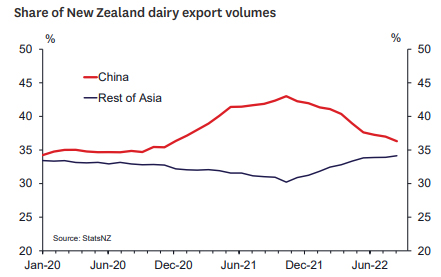
Source: Westpac Dairy Update November 2022
On a more positive note largely because Westpac is predicting the Chinese economy to pick-up into next year, they are forecasting a lift in MS per kg price in the 2023-24 season to $10.00. Interestingly, they predict that “It pays to note that the 2023/24 season will also receive a large boost from the weak NZD/USD”. Given that this year has seen the NZ$ versus US$ plummet from a high this year of near 70 USc in March to around the current 57 USc now makes one wonder just how much lower they see it falling (or the US$ rising).
Encouraging lower national productivity
Moving away from dairy prices, all food producers are facing what seem to be an increasing number of challenges; climate change, diet trends shifting, input costs etc etc. One that is raising its head at the moment and doesn’t seem to be getting much discussion, except from a positive view point is the “pay for five but only work four” idea. It has been around for a while but has gain prominence since Covid forced many people to become more flexible in the way they worked.
Being a little old fashioned the first things that hits me is how unproductive some businesses must be and presumably over-pricing for goods and services where there is 20% of slack in the system.
In the article linked, businesses mentioned range from a panel-beater firm to a software construction firm, so of scope to include more. Plenty more seem to be picking up the trend.
From an employee’s perspective the idea of getting paid the same but being required to be ‘at work’ 20% less must sound very appealing. However, where does that leave businesses that do not have the flexibility or slack in the system to incorporate this? I’m thinking particularly around the Primary Industries sector. Many firms are struggling to get enough staff now to get work done, if they increasingly have to compete with a -20% regime in many other firms it is going to get increasingly more difficult.
The Primary Industries, while the obvious losers in such systems, are not the only sector. Any business which requires someone to front to the public or operate a machine at least 5 days a week is either going to have to employ more staff to provide the required flexibility or remain closed for longer. Either option is going to add more costs to the employer and for many instances no extra productivity.
The end outcome is likely to be costs will have to be pushed on to the consumer, assuming that is possible.
The work-less-for-the-same-money theory has come from the British historian and writer C. Northcote Parkinson in 1955 who believed that the nature of man and time operated to the principle. “Work expands so as to fill the time available for its completion,”. If this trend grows it is likely to increase the divide between the 'blue' and 'grey' collar workers and the 'white' - not only in income but also into the hours worked to achieve it. Unfortunately, I can’t see dairy cows or fishing boats totally rearranging their schedules to fit with a 4 day week. I wonder how long it will take for the habits that have led to 20% unproductive time being incorporated into a 5 day week will be incorporated into the 4 day week. There is likely to be a theory somewhere that deals with that also. (A 3-day weekend does seem attractive though, but a 4-day one would be better especially if getting paid for five).
We welcome your comments below. If you are not already registered, please register to comment
Remember we welcome robust, respectful and insightful debate. We don't welcome abusive or defamatory comments and will de-register those repeatedly making such comments. Our current comment policy is here.