
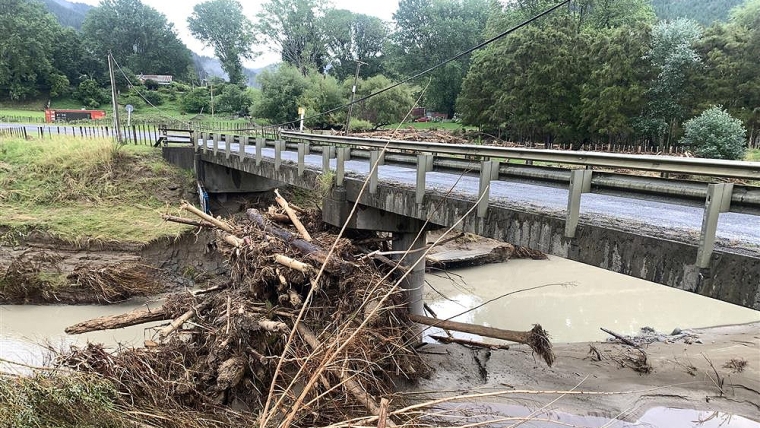
The Government response to the Ministerial Inquiry into Land Use in Tairāwhiti/Gisborne and Wairoa” was released last week.
As with most government reports careful reading is required as it is in the finer detail where the real action is. It also pays to have a fair amount of cynicism at the ready. The fact that several local stakeholders chose to ‘walk out’ of Minister Peeni Henare’s presentation also leads one to make sure as complete understanding as possible is gained. This also includes understanding some of the back-story behind the advent of pine forests on the East Coast. For Maori in particular this goes back as far as 1956 and is still ongoing.
Regarding the Report, the recommendations are to be rolled out in two main tranches - this is all assuming that whoever is in power post the October elections commits to continuing on with the programme.
Phase One, which has already begun with the $10.2 mln contribution to the clean-up, is largely focused risk reduction and cleaning up the mess:
- effective, sufficient clean-up of woody debris to manage the risks it presents;
- strengthening resource management functions and decision-making;
- strengthening partnerships for future resilience; and
- reducing risks of new woody debris flows and sedimentation.
Phase Two in part informed from Phase One is to “strengthening resilience to future severe weather events and supporting the transition to more sustainable, lower risk, land uses and practices at a district and national scale”. While the Inquiry made wide ranging recommendations to government, two in particular have been highlighted and probably at the core of the government’s response;
- changes needed to land use management including, but not limited to,afforestation and harvesting practices; and
- changes needed to regulatory settings including, but not limited to, plan rules and national direction under the Resource Management Act 1991 (RMA) (or its replacement).
Reason’s given for not enacting all of the Inquiry’s recommendations range from;
- it has already been formally declined by Government (for example, the fast-track consent of Te Araroa Kahui Kupenga Marine Facility proposal was recently declined, although not yet dead in the water);
- it would set an unsustainable precedent (for example, shift funding responsibility from local to central government for flood protection and control); and
- it may give rise to wider, undesirable implications (for example, the recommendation to review the Overseas Investment Act 2005).
Not surprisingly, “fiscal risks to the Crown” underpin much of the government’s response and they have the expectation that costs will be shared.
An appointee (an RMA advisor) will be made to advise government and support the Gisborne District Council (GDC) while also taking action to ensure local RMA functions are responding to the need to better manage the risks from erosion, sedimentation and woody debris and move land use in the region to more sustainable practices. The RMA advisor’s role is far ranging and include:
- GDC’s approach to compliance monitoring and enforcement functions, and resources needed, and whether this could be improved;
- GDC’s approach to consenting and reviewing forestry activities with a focus on the risks of clear-felling and risk mitigations;
What powers the RMA advisor has to enforce their advice are not stated. It has to be assumed that it comes from pressure from government, assuming they agree with the conclusions. This person is expected to be in place in the next week or two. Presumably some-one has already been shoulder tapped. In addition to the RMA advisor there is also to be a “Ministerial Advisor” (the Facilitator) to “to facilitate non-statutory interventions that support the Government’s response in Tairāwhiti”. In addition; “they will actively facilitate the strengthening of relationships and collaboration within
and across regions and across industry sectors (including forestry, agriculture and horticulture) to support achievement of common goals and outcomes.” An ambitious outcome especially considering they will be:
- be critical to identifying and progressing next steps on management of woody debris, as outlined above in paragraphs 33 to 35; and
- play a key role in developing the Phase Two programme.
This person also is to be appointed in August and as with the RMA advisor supposedly there for a nine-month period. I can’t help but think Hekia Parata would be a person suited to this role, at least from the community’s perspective. However, GDC and forestry companies may disagree.
It is recognised that better managing harvesting practises is of critical importance and government recognises that currently companies have reduced logging to a rate of about half of the pre- Cyclone Gabrielle event. However, even the companies admit that this is largely due to a lack of access to sites and the fact that the global economy downturn means that there is a greatly reduced demand for logs. About 90% of Tairawhiti logs are exported. Even with the slowdown larges volumes are still moving across the port.
Logs exported across Eastland the Port – for years ended 30th of June 2023,
2021 - 3.1 million tonne
2022 - 2.5 million tonne
2023 - 2.3 million tonne
So perhaps not quite the halving of volumes the government quoted.
Industry Response
The forestry industry understandably has not firmly embraced the report although there has been considerably movement, at least in the planning stage of how they intend to manage future harvesting and along with improving their liaising with GDC and government are committed to;
- evaluating slope stability when planning;
- managing the extent of harvesting clear-cuts, limiting size and staging harvest;
- managing harvest residues on landslide prone slopes;
- leaving mature trees to help trap slash in appropriate locations;
- constructing slash traps; and
- risk assessment at time of planting and replanting
While this doesn’t go as far as what the Inquiry recommended, it is dependant upon the industry interpretation and will go some way towards it. It will most likely satisfy government who will not be wanting to totally disassemble the industry. The Inquiry’s main recommendations re-harvesting were;
• There should be a limit to the total area within a catchment that can be clear-felled each year. We suggest that an appropriate area is no more than five per cent of a catchment per year.
• We suggest that an appropriate maximum staged coupe size is 40 hectares. A minimum ‘green-up’ period of five years between staged harvest coupes will minimise the risk of large-scale erosion events.
• There should be a requirement to remove woody debris from red-zoned land wherever practical or otherwise dispose of safely.
CEO of the Eastland Wood Council, Philip Hope has said “Ultimately, where the risks of slope failure cannot be mitigated due to the highly erodible soils, there may be cases for the retirement of land from productive use and not building on high-risk flood plains”.
It is likely that a 40 ha maximum area (coupe) will still be considered far to large for many in the community and the lack of government immediate direction over this could have been a major reason for some of those at the meeting to walk out. The risk of generating more slash at this point appears to be high. The Forest Owners Association (FOA) submission in response to the Inquiry report is linked here. The focus largely defends why BAU is considered to be still the best approach (taking into account the above industry recommendations) and largely economic based. As would be expected from a business company.
GDC Response
Perhaps tellingly, Mayor Stoltz emphasised that the Council firmly supports several findings in the report, including strengthening land use rules to manage activities in areas with extreme erosion, conducting flood capacity assessments, and halting clear-fell harvesting. But this leaves the question as to what GDC do not agree with.
Perhaps the issues still facing Gisborne are captured in this recent photo of a community project to rid Midway Beach of ‘human rubbish’ of which 1.3 tonnes was collected which appeared to be interspersed among the logs (non-human rubbish?) which covered much of the beach.
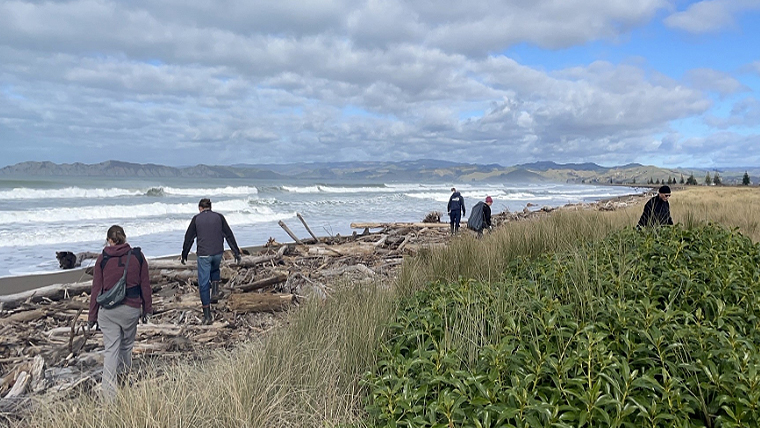
Source: https://www.gdc.govt.nz/
History
The issues around forestry harvesting are not new and there are numerous reports which warn of the potential devasting effects slash etc can create downstream. The susceptibility of forest cutover to storm-initiated mass wasting (predominantly landslides) has similarly been well documented (Bishop and Stevens 1964; Ziemer 1981a, b, c; Furbish and Rice 1983; Guthrie 2002; Marden et al. 2006, 2007) with consequent on-and off-site impacts following a storm often exacerbated by the presence of logging slash (woody debris).
There is also a high probability that the frequency of severe weather events will increase in the future due to climate change. The combination of these factors means that it is highly likely that erosion will occur in forested areas in the future, this was highlighted in 2015. As far back as 1956 when the origins of the East Coast Forestry Project had its inception with the purchase of Maori owned land and some of Waiapoa Station and Tawhiti Station. This was try and mitigate some of the erosion that was occurring in the Whatatutu catchment and potentially threatening the highly productive Gisborne flats and associated settlements. Maori were persuaded to sell their land (for public good) with the understanding that much of it (as told by then Prime Minister Walter Nash when visiting Gisborne),that being that a 1:1 ratio, would be planted as protective planting versus productive. (Chapter 5.1 of the 548 page ‘story’ makes interesting reading). There was even serious discussion as the whether conifers (pine) was the correct species to be planting.
As history has shown the original 6500ha of the Mangatu Forest has now grown to over 130,000ha and with the selling off of rights to forestry companies production harvesting is now to the fore. This is despite after Cyclone Bola in 1988, land in mature pine trees was over 90% free of visible erosion. Areas planted in trees younger than 6 years old were almost as susceptible to erosion as pasture. Research has found root actions halves in 15 months. Findings indicated that the strength, following harvest, of roots left in situ was non-existent after 40 months well before ‘replacement’ plantings can have an effect. A cynics view of past (hopefully not future) practices could be will summed up in the below cartoon.
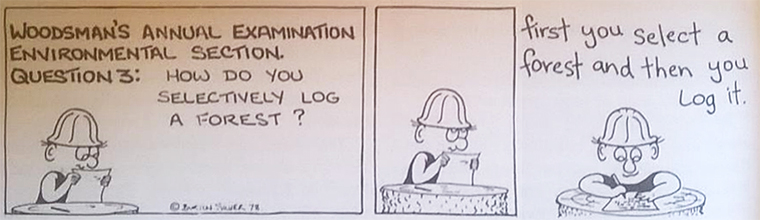
Source: https://nzif.org.nz/assets/Peter-Berg.pdf
The Mangatu Story considers that the harvesting of trees yields a period of time in which a renewal of erosion is likely because a second cycle of planting will not have the desired impact in the short term. For this reason, the protection-production continuum (could be called conundrum) in forestry requires careful management and the movement towards increased use of the East Coast forests for production is cause for concern. This only relates to erosion; the downstream effects are considerably amplified by slash.
The Future
Dr Anne Salmond in a piece in Newsroom said, regarding the option of forest companies upping sticks and leaving the East Coast “The beauty of this policy shift, from the forestry companies’ point of view, is that it will allow them to earn a handsome income for leaving their pine trees in the ground, without having to pay harvesting costs. Instead, they will be able to claim ETS carbon credits for a very long period. A brilliant escape route, given the probability that after the carnage caused by forestry slash during Cyclone Gabrielle, their licence to clear fell pine plantations on highly erodible land might be curtailed or removed altogether, making this kind of forestry unprofitable. This is not a credible form of long-term carbon sequestration, and inevitably, it will be called out as ‘greenwashing’ by the international community. Once again, New Zealand taxpayers will be left to foot the bill”.
CEO of the Eastland Wood Council said while largely agreeing with the report “there is also the risk some forestry blocks could be retired to become permanent carbon farms, to the detriment of the environment and rural communities”. Whether allowing forestry companies to ‘capture’ the available credits is a bad thing, I’m not sure. Also, one third (56,000 ha) of these forest were established before 1990 and so would not (presumably) be eligible for the ETS. So, perhaps not quite the golden egg as first thought.
My final thought on all this is responsibility needs to be shared. It’s a given forestry companies created much of the mess but it was under the supervision and regulatory climate created by both the Government and GDC. So some sharing of blame needs to take place. What does gall somewhat, and presumably has upset many in the community, is safeguards should have been in place already.
Below a link from a report done for GDC 2017
Reprint as at 1 May 2018
Resource Management (National Environmental Standards for Plantation Forestry) Regulations 2017
(LI 2017/174)
Patsy Reddy, Governor-General
Order in Council
At Wellington this 31st day of July 2017
Present:
Her Excellency the Governor-General in Council
Territorial authority
(1)Pruning and thinning to waste is a permitted activity.
Regional council
(2) Pruning and thinning to waste is a permitted activity if regulation 20(1) or (2) is complied with.
20Permitted activity conditions: slash
- Slash from pruning and thinning to waste must not be deposited into a water body, onto the land that would be covered by water during a 5% AEP event, or into coastal water. Annual exceedance probability
(a 5% AEP event has a 5% chance of occurring in any one year (or is a 1 in 20 year flood event);; a 0.5% AEP event has a 0.5% chance of occurring in any one year)
(2) If subclause (1) is not complied with, slash from pruning and thinning to waste must be removed from a water body, the land that would be covered by water during a 5% AEP event, and coastal water, unless to do so would be unsafe, to avoid—
(a) blocking or damming of a water body:
(b) eroding river banks:
(c) significant adverse effects on aquatic life:
(d) damaging downstream infrastructure, property, or receiving environments, including the coastal environment.
21Controlled activity: regional council
(1) Pruning and thinning to waste is a controlled activity if regulation 20 is not complied with.
(2) Control is reserved over—
(a) the effects on hydrological flow:
(b) methods used to minimise erosion and the deposit of slash:
(c) the effects on ecosystems, fresh water, and the coastal environment:
(d) the effects on downstream infrastructure and property:
(e) the information and monitoring requirements.
...
The final word goes to the Land Care authors: “We conclude that forestry will continue to make a significant contribution to New Zealand's economy, but several issues need to be addressed. The most pressing concerns are the incidence of post-harvest, storm-initiated landslides and debris flows arising from steep-land forests following timber harvesting. (This was 2017).
We welcome your comments below. If you are not already registered, please register to comment
Remember we welcome robust, respectful and insightful debate. We don't welcome abusive or defamatory comments and will de-register those repeatedly making such comments. Our current comment policy is here.