
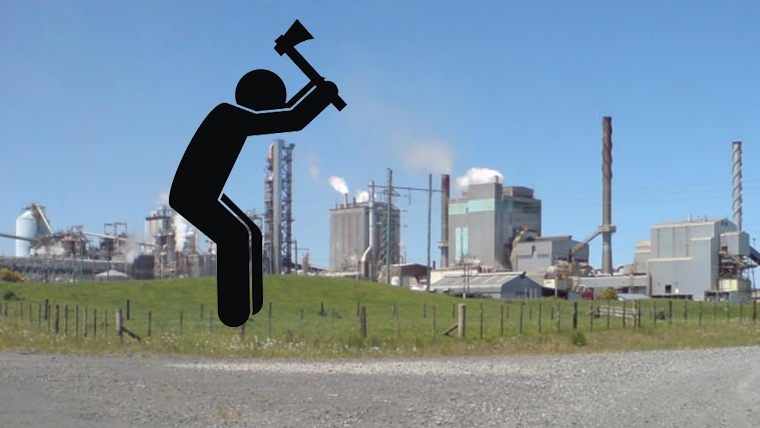
The recent decisions by Heinz Wattie and McCain Foods to close business units follows last year’s closure of Oji’s Kinleith mill. Nobody willingly closes a profitable operation and, in these cases, none of these businesses was performing well enough to escape the axe.
But it is hard to escape the conclusion overseas investors buy a well-known New Zealand business for its brands but then decide after a few years the market is too small, so it is absorbed into a bigger Australian operation. The next step is to run the marketing from across the Tasman and when that doesn’t work close the factory.
People assume these decisions are reached because of excessively high energy prices, but I suspect it is more a question of scale. The business is no longer profitable enough and it requires too much investment to restructure; at the same time, local market size, poor governance and management, inadequate capital expenditure, changing demand patterns, and world events may combine to make closure the easiest option.
The frozen produce category is predicted to experience substantial growth globally over the next six years, driven by the growth of the middle class in China and India, technological innovation and the demand for fresher food. Sales increased by 19% between 2019 and 2025 and are forecast to grow by another 44% by 2032. So why can’t they be sourced and processed here?
It is hard to accept that Wattie’s and McCain’s frozen vegetables will no longer be processed and packed in Hastings where Wattie’s started in 1934 to take advantage of the plentiful local produce. The sad fact is New Zealand is a tiny market at the bottom of the world and without the scale to supply global markets efficiently, while Wattie’s and McCain’s are both owned by international giants driven by growth objectives.
Pulp and paper is a different case, being part of a global market which has experienced huge overcapacity in recent years and is undergoing structural transformation to meet evolving environmental, labour, energy and consumer demand trends.
Closures have occurred across the United States and Europe, so New Zealand is not alone. But in meat, dairy and pulp and paper production scale and access to large markets are essential to efficient plant operation and capital investment in modernisation.
Dairy and red meat have been central pillars of the agricultural sector and New Zealand’s economy for well over a hundred years. In each case the industry has undergone huge restructuring, ownership changes and substantial capital investment. Farmer or grower involvement is a desirable component of a viable agricultural sector, but 100% cooperative ownership poses problems with raising sufficient capital, profit allocation and global strategy development.
The red meat sector has moved on from the days when New Zealand was Britain’s tame farm with British owned meat works. Cooperatives have not ultimately been successful with AFFCO, Silver Fern Farms and Alliance the only survivors under new ownership structures. All of them had an excess of inefficient capacity, designed for an earlier age, but inadequate financial strength to replace it without new capital.
Because of the nature of the dairy industry with a stable seasonal supply pattern, the cooperative ownership structure has proved ideal for most of the sector with a single cooperative replacing many smaller regional dairy companies. This hasn’t necessarily led to innovation, but to the acceptance brand building is not Fonterra’s strength, hence the sale of Mainland to Lactalis.
Innovation has come from smaller dairy companies such as Tatua and a2 Milk which has built a successful business based on a differentiated product that Fonterra decided was too small to be profitable, a similar case to Mainland.
The wine industry has also achieved great success, predominantly with a single grape variety, so it may be premature to claim this will last. However, like dairy and red meat, place of origin or terroir is critical to its popularity. Scale is important with wine, but it can also accommodate a large number of producers although rationalisation has inevitably happened here too.
Apples and kiwifruit have benefited from innovation from new varieties which differentiate them from their competitors. They have also enjoyed coordinated marketing which has succeeded in building a uniform brand with sufficient scale.
Other industries to have achieved global competitiveness are mostly limited to the results of technology where location is less important than vision and innovation such as Fisher and Paykel Healthcare, Xero, Rocket Lab, Gallagher and Halter. To be successful companies like this generally need outside capital and may also have to establish a base offshore, although Gallagher is an exception.
My conclusion is that 100% overseas acquisition of a New Zealand business is generally the first step down a path leading eventually to closure. Notable exceptions to this rule include Japanese owned ANZCO and Chinese owned Westland Milk which have committed long-term owners.
Coincidentally both are owned by Asian corporations which take a much longer view of investments than the North American and European perspective. It is regrettable New Zealand companies often struggle to attract local investment because of a shallow pool of capital or reluctance to take the risk.
We welcome your comments below. If you are not already registered, please register to comment
Remember we welcome robust, respectful and insightful debate. We don't welcome abusive or defamatory comments and will de-register those repeatedly making such comments. Our current comment policy is here.