
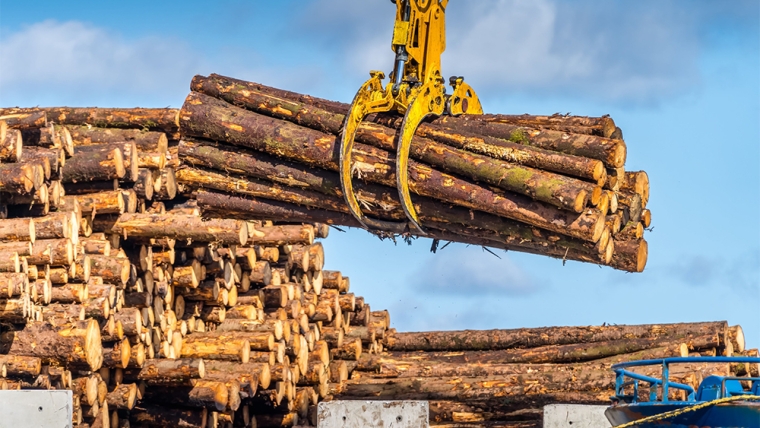
April At Wharf Gate (AWG) prices for export logs at New Zealand ports remained unchanged from March. Higher shipping costs for log exports were partially offset by increased CFR log prices in China, along with exporters absorbing a portion of the higher freight costs to maintain supply to enable vessel utilisation and meet existing shipping commitments.
Softwood log inventories in China have risen slightly, as expected, following increased harvesting activity in New Zealand during March. Inventory levels are anticipated to decline due to a meaningful reduction in log supply from New Zealand. Harvesting activity is reducing in New Zealand due to weather and forest owners, managers, and contractors responding to rising fuel costs.
The PF Olsen Log Price Index remains at $122, which is $2 above both the two-year and five-year averages.
Domestic Log Market
Usually log prices are locked in with domestic mills for at least each quarter. In many cases mills have agreed to around a $3 per tonne increase for the higher grade structural and pruned logs. In most cases this price is agreed on month-by-month basis and will be reviewed according to the cost of fuel.
The wood processing sector remains concerned about the impact of elevated construction costs on the viability of planned projects in New Zealand. While cost pressures have shown signs of stabilisation in some areas, uncertainty around future pricing, financing conditions, and overall demand continues to weigh on developer and builder confidence. This ongoing unpredictability is making it challenging for stakeholders to commit to new projects, contributing to a subdued pipeline of construction activity.
The graph below shows a recovery in new dwelling consents through 2025, with annual consents increasing by approximately 9%. However, ready-mix concrete usage (an indicator of actual construction activity) declined by 4.6% in 2025 compared with 2024.
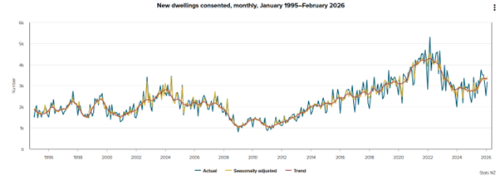
This suggests a longer lag than usual between consent issuance and the commencement of physical construction. In addition, non-residential construction, which typically has a higher intensity of concrete use, continues to decline in both floor area and value. This helps explain the ongoing weakness in concrete volumes despite improving residential consent activity.
Overall, this points to a two-speed recovery in New Zealand’s construction sector. Residential building, particularly townhouses and multi-unit developments, is expected to lead the upturn, while non-residential construction is likely to remain subdued in the near term due to persistent cost pressures and uncertainty around demand.
China
The CFR price for A-grade logs is currently in the USD 126–129 range. While exporters are offering around USD 131, the market has so far resisted breaking through the USD 130 threshold. Wholesale prices in China have remained relatively stable; however, emerging inflationary pressures, partly driven by higher oil prices, are beginning to surface.
Softwood log inventories in China have increased slightly, as expected, reflecting higher harvest production in New Zealand during March. This period typically sees elevated output due to a full schedule of working days in March and favourable operating conditions before the onset of autumn weather. Much of this volume arrives in China in April.
Harvest activity in New Zealand has since declined, influenced by several factors including adverse weather events, the Easter and Anzac holiday periods, and some forest owners scaling back production in response to rising costs, particularly fuel. The harvest activity will reduce further as woodlots are completed but the next woodlot owner is reluctant to start with uncertain costs.
As a result, inventory levels in China are expected to ease in the coming weeks as reduced harvest volumes in New Zealand begin to constrain log supply. Daily log offtake is currently steady at around 55,000–60,000 m³ per day, following a short-lived increase in demand during the first half of April.
China’s Caixin Manufacturing PMI edged up to 51.1 in March from 50.9 in February, indicating a modest but ongoing expansion in manufacturing activity. The improvement was supported by stronger output and an increase in new orders, suggesting some stabilisation in demand. However, business sentiment remains cautious, with continued weakness in the property sector and uncertainty in external demand weighing on confidence.
India
Labour shortages in sawmills at Gandhidham due to workers returning home for state assembly elections in April, resulted in reduced sawn timber production. This reduced supply resulted in shortages and increased prices. Labourers returning to Gandhidham after voting, may result in increased sawn timber production and decreased prices in May.
The current prices of green sawn pine are (INR per CFT);
USA Southern Yellow Pine - 681
NZ Radiata - 671
South American - 641
Approximately nine vessels with about 326,000 m3 pine logs have arrived in Kandla port during April.
May log shipments are priced at CFR CQD Kandla USD 158 per m3 CBM, LC 159 days, for New Zealand pine logs ex Nelson and Port Chalmers, and the same price for Australian A logs.
India expects increased diesel prices in May, which can increase production and logistics costs, and the INR has weakened against the USD by 2.4% in the last two weeks, adding pressure on the Indian importers.
Ocean Freight
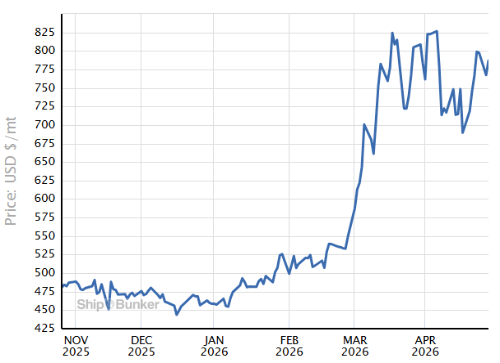
Ocean freight costs have increased significantly due to increased fuel costs since the US war with Iran. Cost increases have stabilised, but there is still some upwards price pressure.
Most New Zealand log exports are carried on Handysize vessels, which are not directly included in the BDI calculation, though broader freight cost trends can still exert indirect influence on this segment.
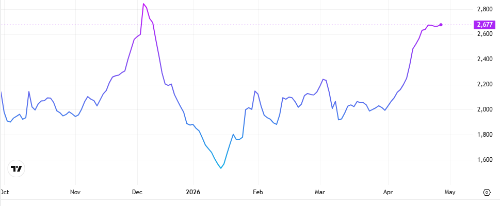
Baltic Dry Index (BDI)
Source: TradingEconomics.com
You can see below how volatile the Brent oil price is as the market reacts to news about the situation in the Middle East.
Brent Oil Price
Source: Ship & Bunker
Exchange Rates
The NZD has strengthened against the USD by 1.9% during April, while the CNY strengthened against the USD by 1%.
PF Olsen Log Price Index - April 2026
The PF Olsen Log Price Index remains at $122, which is $2 above both the two-year and five-year averages.
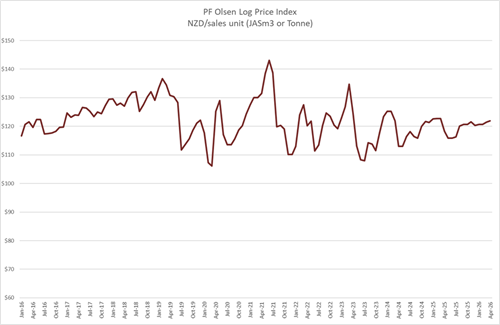
Basis of Index: This Index is based on prices in the table below weighted in proportions that represent
a broad average of log grades produced from a typical pruned forest with an
approximate mix of 40% domestic and 60% export supply.
Indicative Average Current Log Prices – April 2026
| Log Grade | $/tonne at mill | $/JAS m3 at wharf | ||||||||||
| Aar-26 | Mar-26 | Feb-26 | Jan-26 | Dec-25 | Nov-25 | Aar-26 | Mar-26 | Feb-26 | Jan-26 | Dec-25 | Nov-25 | |
| Pruned (P40) | 175-200 | 175-202 | 175-200 | 175-200 | 175-202 | 175-200 | 196 | 196 | 194 | 194 | 194 | 194 |
| Structural (S30) | 123-145 | 120-145 | 120-145 | 120-145 | 120-145 | 120-145 | ||||||
| Structural (S20) | 95-100 | 93-100 | 93-100 | 93-100 | 93-100 | 93-100 | ||||||
| Export A | 125 | 125 | 123 | 123 | 126 | 126 | ||||||
| Export K | 117 | 116 | 114 | 114 | 117 | 117 | ||||||
| Export KI | 107 | 107 | 105 | 105 | 108 | 108 | ||||||
| Export KIS | 98 | 98 | 96 | 96 | 99 | 99 | ||||||
| Pulp | 46 | 51 | 46 | 46 | 51 | 51 | ||||||
Note: Actual prices will vary according to regional supply/demand balances, varying cost structures and grade variation. These prices should be used as a guide only.
A longer series of these prices is available here.
Log Prices
Select chart tabs
This article is reproduced from PF Olsen's Wood Matters, with permission.
We welcome your comments below. If you are not already registered, please register to comment
Remember we welcome robust, respectful and insightful debate. We don't welcome abusive or defamatory comments and will de-register those repeatedly making such comments. Our current comment policy is here.