
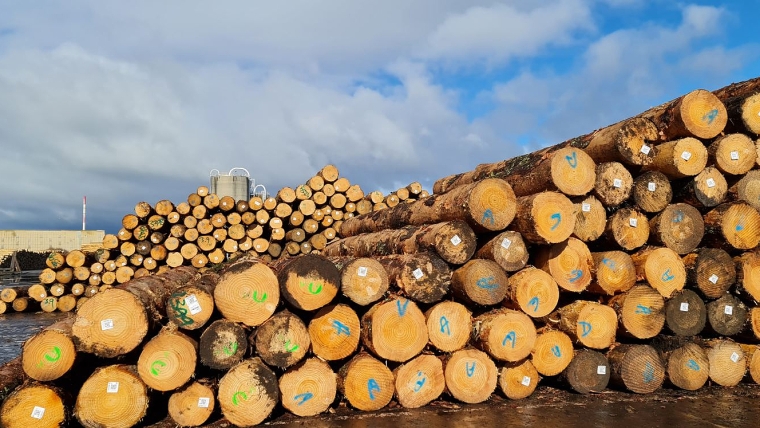
March At Wharf Gate (AWG) prices at New Zealand ports increased modestly, with gains of approximately NZ$2 per JASm³ across most ports. Higher CFR log prices in China have offset rising shipping costs.
Looking ahead, increased shipping costs are expected to be the key determinant of April AWG pricing, as fuel prices increase and global shipping routes remain disrupted.
Exporters continue to seek further CFR price increases in China to recover these higher freight costs. A weaker NZD against the USD is also providing some support to AWG prices.
Log inventories in China remain stable; however, supply from New Zealand is expected to ease as the industry responds to rising fuel and operating costs, which are constraining harvest activity.
The PF Olsen Log Price Index increased by $1 to $122, placing it $2 above the two-year average and $1 above the five-year average.
Domestic Log Market
The wood processing sector is wary about the impact of rising costs on the viability of planned construction projects. It is not only the level of cost increases that is of concern, but also the ongoing uncertainty around future pricing, making it difficult for developers and builders to confidently commit to new projects.
Many forest owners are seeking increases in domestic log prices for Quarter 2, as higher harvesting and cartage costs continue to erode margins. In response, forest owners and managers are attempting to share these cost pressures across the supply chain.
Harvesting and cartage costs across New Zealand have increased significantly with fuel costs a key driver of this increase. On average, harvesting operations in New Zealand consume approximately 4 litres of diesel per tonne of logs produced, with a further 2 litres required to transport logs 100 km. This highlights the material impact that rising fuel prices are having on overall production costs. Log buyers are therefore facing the risk of constrained supply if forest owners reduce harvesting activity or temporarily suspend operations in response to margin pressure. This creates a challenging environment where rising input costs may not be fully recoverable through higher log prices, while supply-side responses could tighten availability in the domestic market.
China
Softwood log inventories in China are currently estimated at approximately 3.0 million m³. Daily log offtake remains solid at 55,000–60,000 m³ per day, indicating steady underlying consumption following the Chinese New Year (CNY) period.
Log supply from New Zealand is typically elevated at this time of year. Vessel arrivals are often delayed until after CNY, and some woodlot harvesting operations aim to complete programmes before late autumn. Supply is expected to ease from April as harvesting conditions become more challenging with the onset of autumn weather, and reduced productivity with fewer working days due to the Easter and ANZAC holiday periods.
In response to rising costs, particularly fuel, many forest owners have reduced harvesting activity to around 80% of capacity, while some smaller operators have temporarily suspended operations. Salvage harvesting in windthrow-affected areas continues unabated.
Immediately prior to CNY, CFR prices for A-grade logs were around USD 117 per JASm³. Current sales are being concluded at approximately USD 125 per JASm³, reflecting improved pricing post-holiday. In addition, Chinese log futures prices have risen by around 4.5% over the past two weeks, indicating improved short-term market sentiment.
The Caixin China General Manufacturing PMI rose to 50.9 in February, up from 50.3 in January, signalling a modest strengthening in manufacturing activity. The increase was supported by improved output and new orders; however, overall business sentiment remains cautious, with ongoing concerns around the property sector and external demand continuing to weigh on confidence.
India
Expected log supply into Kandla has remained fluid in recent weeks. A number of bulk pine log shipments were deferred or cancelled due to rising freight costs, ongoing market uncertainty, and security concerns in the Middle East. Freight rates to India have increased more sharply than those to China, further reducing the relative competitiveness of the Indian market for exporters.
More recently, however, some exporters have signalled a return to the market, indicating renewed confidence at current pricing levels. CFR prices for A-grade logs are currently around USD 142 per JASm³, typically under letters of credit with extended payment terms of up to 150 days.
Containerised log shipments have reduced significantly, with many orders cancelled due to sharp increases in freight, fuel, and insurance surcharges, further constraining supply flexibility.
The Gandhidham green sawn timber market has strengthened, with prices increasing by approximately 9–10%, driven by a combination of higher input costs, including freight, fuel, and currency depreciation, as well as supply disruptions linked to Middle East tensions.
Current green sawn timber pricing is INR 631 per CFT for New Zealand radiata pine and INR 601 per CFT for South American material
India has also experienced a significant increase in industrial diesel prices, rising by approximately 25%, which is expected to lift manufacturing and processing costs across multiple sectors and contribute to broader inflationary pressure.
Despite the increase in sawn timber prices, there remains a disconnect between high CFR log costs and achievable sawn timber selling prices, placing pressure on sawmill margins. At the same time, demand for pallets and packaging has softened due to reduced export activity to the Middle East, further impacting industrial timber consumption.
Ocean Freight
Ocean freight costs have increased significantly due to increased fuel cost. The BDI is a composite index comprising three sub‑indices: Capesize (40%), Panamax (30%) and Supramax (30%), and reflects average daily USD hire rates across key ocean freight routes. Most New Zealand log exports are carried on Handysize vessels, which are not directly included in the BDI calculation, though broader freight cost trends can still exert indirect influence on this segment.

Baltic Dry Index (BDI)
Source: TradingEconomics.com

Singapore Bunker Price (VLSO) (red line) versus Brent Oil Price (grey line)
Source: Ship & Bunker
Exchange Rates
The NZD has weakened against the USD by approximately 4.6% over the last month. This will help offset increased shipping costs in the April AWG calculations. The CNY weakened by approximately 0.75% against the USD over the last month but has still strengthened by 5% against the USD over the last year.
PF Olsen Log Price Index - March 2026
The PF Olsen Log Price Index increased by $1 to $122, placing it $2 above the two-year average and $1 above the five-year average.

Basis of Index: This Index is based on prices in the table below weighted in proportions that represent
a broad average of log grades produced from a typical pruned forest with an
approximate mix of 40% domestic and 60% export supply.
Indicative Average Current Log Prices – March 2026
| Log Grade | $/tonne at mill | $/JAS m3 at wharf | ||||||||||
| Mar-26 | Feb-26 | Jan-26 | Dec-25 | Nov-25 | Oct-25 | Mar-26 | Feb-26 | Jan-26 | Dec-25 | Nov-25 | Oct-25 | |
| Pruned (P40) | 175-202 | 175-200 | 175-200 | 175-202 | 175-200 | 175-200 | 196 | 194 | 194 | 194 | 194 | 190 |
| Structural (S30) | 120-145 | 120-145 | 120-145 | 120-145 | 120-145 | 120-145 | ||||||
| Structural (S20) | 93-100 | 93-100 | 93-100 | 93-100 | 93-100 | 93-100 | ||||||
| Export A | 125 | 123 | 123 | 126 | 126 | 125 | ||||||
| Export K | 116 | 114 | 114 | 117 | 117 | 116 | ||||||
| Export KI | 107 | 105 | 105 | 108 | 108 | 107 | ||||||
| Export KIS | 98 | 96 | 96 | 99 | 99 | 98 | ||||||
| Pulp | 51 | 46 | 46 | 51 | 51 | 50 | ||||||
Note: Actual prices will vary according to regional supply/demand balances, varying cost structures and grade variation. These prices should be used as a guide only.
A longer series of these prices is available here.
Log Prices
Select chart tabs
This article is reproduced from PF Olsen's Wood Matters, with permission.
We welcome your comments below. If you are not already registered, please register to comment
Remember we welcome robust, respectful and insightful debate. We don't welcome abusive or defamatory comments and will de-register those repeatedly making such comments. Our current comment policy is here.