
This content is supplied by Rabobank
New Zealand’s farmers remain positive about the outlook for the broader agri economy in the year ahead despite growing concern over higher farm input costs, the latest Rabobank Rural Confidence Survey has found.
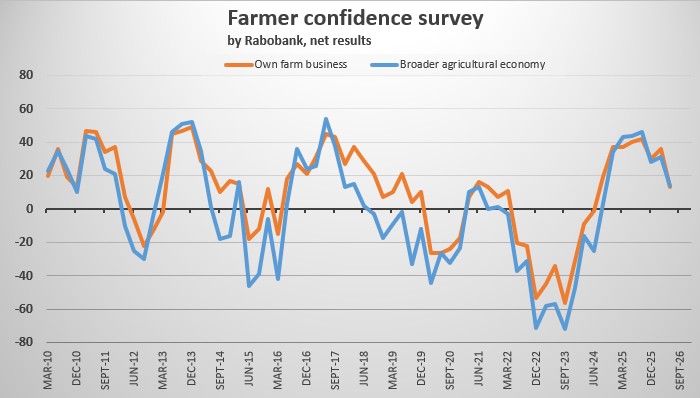
The latest survey – completed between 18 May and 5 June – found farmer sentiment remained net positive overall, as it has been since quarter three of 2024, but had fallen to a net reading of +14% (from +31% last quarter).
The quarter two survey found 29% of farmers were now expecting the performance of the broader agri economy to improve in the year ahead (down from 39% in the previous quarter), while the number expecting conditions to worsen rose to 15% (from 8% previously). The remaining 54% of farmers expected conditions to stay the same (50% previously).
Results at a glance:
• Farmer confidence has dipped lower off the back of concerns over rising farm input costs.
• Despite this, sentiment remains elevated overall and at net positive levels for the eighth consecutive quarter.
• Among farmers holding a negative outlook on the agri economy, ‘rising input costs’ (74%) was cited as the major source of pessimism, while ‘rising commodity prices’ (55%) and ‘increasing demand’ (33%) were the most prominent reasons given by those with a positive outlook.
• Farmers’ expectations of their own farm business performance over the next 12 months were also down from last quarter but remain strong.
• Sheep and beef farmers continue to be the most optimistic about the prospects for their own farm businesses, while horticulturalists are the most pessimistic.
• Farmer investment intentions were marginally lower than last quarter but remain robust with around one third of farmers looking to increase investment in the year ahead. • Land price expectations continue to be positive, with a third of farmers expecting prices to increase over the coming 12 months, and less than one in ten expecting land prices to fall.
New Zealand General Manager for Country Banking Bruce Weir said the unrest in the Middle East had driven up costs for key farm inputs, and this was the major driver of the lower farmer sentiment recorded in the latest survey. “Since our quarter one survey concluded in early March, the Strait of Hormuz has been closed and, as a result, we’ve seen prices for fuel and fertiliser rise significantly and remain elevated,” he said.
“We’ve also seen second-round effects of the closure start to emerge, with elevated energy costs feeding into broader inflation expectations,” he said. “This has taken a bit of the wind out of farmers’ sails, and it’s hardly surprising sentiment has come back a little bit this quarter – especially given the survey concluded prior to the positive developments we’ve seen in regard to the conflict over recent days.”
Despite the dip in sentiment from last quarter, Mr Weir said, farmers remained broadly optimistic about the year ahead.
“Given everything that’s happening around the world, it’s really pleasing to see farmer confidence holding up so strongly,” he said. “Off the back of strong demand from major overseas markets, pricing outlooks for all our key agri commodities remain healthy. And this is fueling farmers’ confidence that another profitable season lies ahead.”
Own farm business performance
As with confidence in the broader agri economy, the survey found farmers remained upbeat about the prospects for their own businesses, but less so than in March.
Mr Weir said the net reading on this measure had fallen to +13% from +36% previously, with farmers across all sector groupings recording lower confidence in their own businesses.
“Sheep and beef producers continue to be the most optimistic of all farmers, with tight global supply and strong demand supporting a positive outlook for red meat,” he said. “Four in ten sheep and beef farmers now expect their own farm performance to improve in the year ahead, with only one in twenty expecting it to worsen.”
“Horticulturalists continue to be the least optimistic of the sector groupings, and there is now an event split of growers expecting the performance of their businesses to improve in the next 12 months, and those expecting it to worsen."
“While Kiwifruit and several other horticultural subsectors are performing well, the outlook for others, like viticulture, is more challenging, and this is likely to have contributed to the lower overall score amongst horticulturalists on this measure.”
Investment intentions lower but still strong
The survey found New Zealand farmers’ investment intentions were marginally lower than last quarter with 32% (unchanged) of farmers expecting to increase investment and only 12% (from 8%) expecting investment would fall. This pushed the net reading on this measure down to +20% from +24% previously.
“This is still a really positive result and, if we dig into the data, we see that on-farm infrastructure and new plant/machinery are some of the key areas farmers are looking to invest into,” he said. “And we saw evidence of this at last week’s National Fieldays, with the event organisers reporting near-record attendance numbers and many retailers reporting strong sales.”
Land price expectations
The survey found farmers were expecting rural land prices to increase modestly over the coming 12 months.
“About a third of farmers were expecting land prices to increase over the year ahead, with only 8% expecting a fall,” Mr Weir said. “This is a weaker result than when we last measured land price expectations six months ago – when close to half of farmers were anticipating a lift – but does highlight a broad belief among farmers that prices will head north from here.”
Conducted since 2003, the Rabobank Rural Confidence Survey is administered by independent research agency KANTAR, interviewing a panel of approximately 450 farmers each quarter.
We welcome your comments below. If you are not already registered, please register to comment
Remember we welcome robust, respectful and insightful debate. We don't welcome abusive or defamatory comments and will de-register those repeatedly making such comments. Our current comment policy is here.