
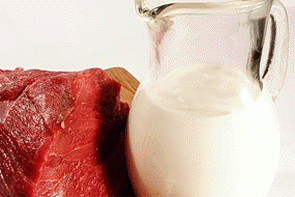
Is this growing trend in Europe to impose "a fat tax" a future threat to NZ agriculture, especialy for our dairy and meat sectors? NZ has a high obesity rate and diet data and analysis especially for our young will be important in combating this disease.
All governments world wide are under pressure to fund their health budgets, and products that are linked to health issues are vunerable to taxes to pay for the percieved problems caused. While the sheep industry has made huge progress in changing it's product from fat lamb to prime lamb ,and fat levels in these carcasses have reduced significantly over the years, any extra tax on this product will erode it's new found profits.
And with many processing companies not discounting prime or T grades for lamb, there is no incentive for farmers to change their management to address this issue. The "Glammies" competitions does highlight excellence in yield and taste but only economic pressure will bring long lasting change by breeders.
Deer farmers should look at this evolving situation as an opportunity to promote its lean unmarbled product to an even greater degree and have the science to back up this threat. And while many will say this threat is unlikely, one only has to look at the evolution of the NAIT eartags in NZ livestock, that have been created by European bureaucrats to know this threat could be real.
The growing support in Europe for a "fat tax" to counter obesity could bring a windfall to dairy testing group National Milk Records if it reaches the UK, spurring demand for checks to the fat make-up of milk. National Milk Records has already won a contract from Marks & Spencer to check milk supplied to the food-to-clothing retailer for its levels of saturated fats, deemed particularly poor for health, as opposed to unsaturated fats.
The basis of this test is then used to determine payments to farmers, who have traditionally just been paid according to overall proportions of fat, and protein, in milk. "Where Marks & Spencer leaders, other often follow. It could well set a trend," Andy Warne, the NMR managing director, told Agrimoney.com.
And there is the potential for the test, of which NMR is the only UK supplier in dairy, to become mandatory, if the trend towards "fat taxes" introduced in Denmark and Hungary take root elsewhere. Denmark in October unveiled a tax of DKK16 per kilogramme of saturated fat on products with a content of the product of more than 2.3%, a level seen as catching butter, cheese, meat and vegetable oils.
However, early results in Hungary – which has the world's eighth highest obesity rate, according to the OECD - of a fat tax on fizzy drinks, high-sugar confectionery and chocolate and some salty snacks and sauces have proved disappointing. In the UK, Prime Minister David Cameron said in October that a fat tax "is something that we should look at"."I am worried about the costs to the health service, [and] the fact that some people are going to have shorter lives than their parents."
At NMR, chairman Philip Kirkham said that a fat tax "could be replicated in the UK", adding that the group's fat breakdown checks "will be essential for the UK dairy industry to manage this transition". Dairy farmers can manage the levels of fat in their cows' milk through controlling diet, with an increased content of rapeseed oil and linseed oil, and lower corn levels, seen as promoting saturated fat content.
We welcome your comments below. If you are not already registered, please register to comment
Remember we welcome robust, respectful and insightful debate. We don't welcome abusive or defamatory comments and will de-register those repeatedly making such comments. Our current comment policy is here.