
 By Bruce Wills
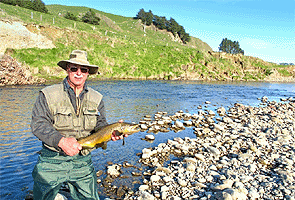
According to Fish & Game’s Wellington Manager, Phil Teal, employers should have been on sickie patrol from Monday, since that signalled the start of the 2012/13 sports fishing season.
What is more, according to Fish & Game, rivers such as the Waikanae, Otaki, Hutt, Ruamahanga, Manawatu and Rangitikei will be running clear and apparently this is ideal for trout fishing.
If trout is the canary of our waterways - though I would prefer native fish instead - then Fish & Game’s “recent monitoring has also shown good numbers of trout in the rivers, so prospects are looking good…Wellington, Wairarapa, the Kapiti Coast and Manawatu have world-class trout fishing opportunities right on the doorstep – these regions have a growing reputation for quality river fishing”.
Wait a minute. Did I see the Manawatu mentioned?
Does this mean that river and its region are looking forward to a bumper fishing season?
What does this bullish outlook for trout mean then for the overall health of waterways in the Manawatu?
This was not the only surprise either.
Against all odds, or at least the scientific models, Lake Rotorua’s water quality has improved.
The latest water testing by Bay of Plenty Regional Council returned average water quality. To be boringly precise, the Trophic Level Index (TLI), which measures the amount of nutrients in the lake, has continued to fall.
Against a scale of less than two being very good and more than five being pretty poor, Lake Rotorua returned a 4.1. That makes the river decidedly average, but in the time it has taken to get there, average is a pretty excellent result. Especially now it is below the 4.2 target, which the regional council had previously set for Lake Rotorua.
To me that is a positive step forward.
It comes at a time when councils are reporting much improved compliance by farmers up and down the country.
It remains instructive that Bay of Plenty Regional Council’s original modelling said things were going to get worse before they got better. That brought media criticism about farm practice and is perhaps the concern I have for other areas now going down this track.
Models are one thing, but they are not fool proof guarantees without being put alongside practice. Neither is what you read in the papers. This is something my Vice-President, Dr William Rolleston, learned when he saw some indignant letters appearing in newspapers. It related to that most touchy of subjects, genetic modification but the comments attributed to Dr Rolleston were not in fact said by him.
Instead, he was quoting Dr Clive James of the International Service for the Acquisition of Agri-biotech Applications. It was Dr James and not Dr Rolleston who said the delay of genetically modified technology, like Vitamin A rich ‘Golden Rice,’ was a crime against humanity.
Strident words indeed, but when you consider there some 250 million preschool children who are vitamin A deficient and between 250,000 and 500,000 of them will become blind as a result, you can understand why Dr James was blunt. Yet the uncompromising words he chose can be explained by the 1.9 to 2.7 million preventable child deaths caused by VAD, or Vitamin A Deficiency.
Perhaps the misquoting of our Dr Rolleston highlights why we need to question assumptions.
This is why Lake Rotorua’s improvement is not down to just one good year.
We know that because the trend is an improving one from doing things better. I am not just talking about our farms but our communities too.
Rotorua District Council boldly moved to the land based treatment of its human and industrial sewage. This is a big step forward because the status quo for many councils remains our rivers or the sea.
Farmers, likewise, got the message to improve practice and have moved to fence off stock, focus on erosion and to capture nutrients, later recycled back to farm pasture as liquid fertiliser.
Farmers are not going to take all of the credit here because farming was never the entire problem.
It is however a triumph for the whole community according to Neil Heather, Federated Farmers Rotorua-Taupo provincial president. He should know because he lives close to Rotorua on the iconic Paradise Valley Road.
I know from speaking to our members there, we have found some eye-opening things.
We now know gorse can leach some 50 kilograms of nitrogen per hectare and that is more than most dairy farms.
Even pine plantations generate four kilograms per hectare each year and these show how varied the effects on water can be.
Like quality wine, good things take time but I believe we can and are incrementally getting better.
Rotorua is simple proof of what happens when the whole community, town and country alike, work together.
-------------------------------------------------------------
Bruce Wills is the President of Federated Farmers. You can contact him here »
9 Comments
Is this article based on one Rotorua monitoring result or is there a time series of results somewhere to view?
updated with link to BoPRC news release: http://www.boprc.govt.nz/news-centre/media-releases/september-2012/cautious-optimism-on-rotorua-lake-result/
Bruce: OK first: Curmudgeonly "An ill-tempered person full of resentment and stubborn notions"
Agreed! Good humour is esstential to solve this.
"Models are one thing, but they are not fool proof guarantees without being put alongside practice"
Also agreed, its called feedback of course, an age old method to inform our models.
Question: Why are many so disparaging of a solid thought through approach based on science and best practice??
Is it possible to reconcile what Bruce has said with the press release from the regional council which includes this:
This year Lake Rotorua has had no algal blooms in the lake and water clarity has been exceptional. Regional Council General Manager Natural Resource Operations Warwick Murray said there were reasons for the good result - but also sounded a note of caution about the possible short-term nature of the improvement.
"The unusually good result could be due to a combination of a colder and wetter summer earlier this year, coupled with in-lake actions such as alum dosing of streams which feed into the lake to remove the harmful phosphorus," he said.
"Water quality in Rotorua lakes is affected by the nutrients nitrogen and phosphorus entering the lakes. These nutrients enter the lakes from a range of natural sources and human activities. The largest contributor to nitrogen in Lake Rotorua is agriculture. Our research has determined that we need to remove 320 tonnes of nitrogen from entering Lake Rotorua to achieve sustainable long term water quality," Mr Murray said.
There was a risk that the exceptional TLI result would be seen by some as "fixing" the lake and that no further action was required, but this was not the case.
"While the TLI result for Lake Rotorua is excellent and very promising there is still much work to be done to achieve sustainable long-term gains in water quality. Up to now we have largely focused on treating the symptoms in the lake and in streams in order to get water quality improvements in the shorter term.
"If we are to achieve sustainable long-term improvements, we will need to turn off the nutrient tap up in the catchment. This in particular means making changes to both the way we manage our land and how we use it," he said.
Once again Bruce Wills writes a sensible , fact based article . Once again it highlights how irresponsible and quite frankly irrational the continual moaning and emotive opposition to all types of agriculture is from rabid zealots such as Dr Joy and Bryce Johnson .
Quite clearly by dangling the carrot and not weilding the stick ,agriculture in this country has an enormous capacity to steadily change and sensibly react to environmental concerns in regards to our waterways . Fish and Game are happy to talk up the fisheries and say what good stocks of healthy fish are present at the start of the season when license sales are at their peak (thus maximising their revenue ! ) . One could quite rightly assume that these claims are directly at odds with their incursions into the media saying that our rivers are rooted . It wreaks of double standards to me , surely if the situation is so dire then Fand G should discourage people from buying licenses in sudh highly nitrogenous ares !
Jezza.....Curmudgeonly "An ill-tempered person full of resentment and stubborn notions"
"irresponsible and quite frankly irrational the continual moaning and emotive opposition to all types of agriculture is from rabid zealots such as.....:
Hmmmm...I welcome both inputs from Bruce & Mike Joy. Both are excellent at what they do & Im excited that Bruce is on board now with some green cred.
It would appear that the excellent result for lake Rotorua is a good early provisional result with much good work to be contunued...........
One swallow does not make a summer.
It does pay to remember that Federated Farmers makes sure its gets dragged kicking and screaming through any attempt by Rotorua DC and Bay of Plenty RC to implement changes to land use plans that will affect agriculatural land use.
The Rotorua Lakes and Land Trust http://rotorualakesandlandtrust.co.nz/ is a shining example of what can be achieved when a community takes ownership of local issues. If Feds weren't part of RLLT quite simply it wouldn't exist and a lot of good work would never have happened. Nothing wrong with robust debate. ;-)
Rotorua could show quite a few other communites around the country what can be acheived through working in partnership.
We welcome your comments below. If you are not already registered, please register to comment
Remember we welcome robust, respectful and insightful debate. We don't welcome abusive or defamatory comments and will de-register those repeatedly making such comments. Our current comment policy is here.