Content sourced from the Ministry for Primary Industries (MPI)
It has been a season of two halves for many primary sector producers.
The first six months of the year were great for pasture growth, but a severe drought gripped much of the country from late January until April. This will have serious ongoing financial implications for many pastoral farmers.
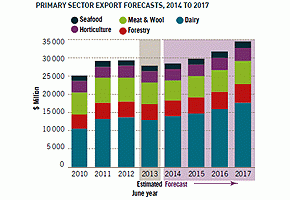
The drought, coupled with a stronger New Zealand dollar, has contributed to a dip in primary sector export earnings for the year to June 2013.
Longer-term prospects remain promising, however, due to ongoing demand growth for food and fibre in emerging markets and a gradual improvement in global economic conditions.
Looking ahead, dairy exports are forecast to increase by nearly $5 billion to $17.7 billion by 2017. Forestry and wine exports are also expected to increase significantly over the next four years.
DAIRY
New Zealand milk solids production in 2012/13 will experience its first year-on-year decline for six years, as a result of the drought. As at 1 July 2012, there were 5.01 million dairy cows and heifers in New Zealand, a 4 percent increase on the previous year.
A mild winter and excellent spring conditions contributed to good production at the start of the 2012/13 season. But, low rainfall and a record-high soil moisture deficit in many areas from January to March saw production fall sharply.
As a result, production is expected to decline 1.2 percent to 1 665 000 tonnes of milk solids in 2012/13. Dairy export revenue is expected to fall by 5 percent to $12.9 billion in 2012/13.
Further out, dairy export returns are forecast to increase due to strong demand from emerging markets and higher international prices.
Export receipts are forecast to increase by an annual average 8 percent over the outlook period, to reach $17.7 billion in 2016/17.
MEAT and WOOL
The year to June 2013 has been a tough one for the meat and wool sector.
It has had to deal with the most widespread drought since 1945/46, a strong New Zealand dollar, and prices for sheep meat, venison and wool retreating from the highs of the previous year.
Exports of meat, wool, hides and skins for the year ending June 2013 will decline 10 percent to $5.95 billion.
They are forecast to decline another 9 percent in 2013/14, because of ongoing drought effects.
Sheep and beef numbers are expected to decline gradually to 2017, due to better returns from dairying. E
xport receipts are forecast to increase, however, due to a gradual lift in lamb and beef prices on the back of economic recovery in NZ’s main export markets.
Future prospects will also benefit from growing demand for animal protein in Asia.
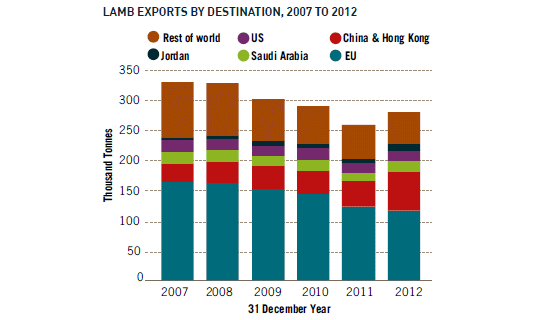
One of the most notable trends in this regard has been a rapid increase in lamb exports to China – in the five years to June 2012, China’s share of New Zealand’s lamb exports nearly tripled to 21 percent.
FORESTRY
Forest product export earnings in the year to June 2013 are similar to previous years at $4.3 billion, as record log export volumes offset lower prices for most other forest products.
Forest export receipts are expected reach $5 billion in 2016/17, based on steady growth in international demand for logs.
Medium-term prospects for New Zealand timber, panels and pulp are more subdued.
In the longer-term, New Zealand is well positioned to increase export returns from the forestry and wood processing sectors.
In the 10 years to 2025, wood availability is forecast to increase by nearly 50 percent, to 35 million cubic metres per year.
Most of this increase will come from small growers who established forests in the early 1990s, but the harvest will depend on market conditions.
There are opportunities to increase the value of exports through more processing of wood. The Wood Council of New Zealand has recognised this opportunity and developed a strategic plan with a vision of more than doubling forest and wood processing exports to $12 billion by 2022.
HORTICULTURE
Together, the largest export-focused horticulture sectors, kiwifruit, wine, pipfruit and vegetables, will earn around $3.2 billion in export earnings in the year to June 2013.
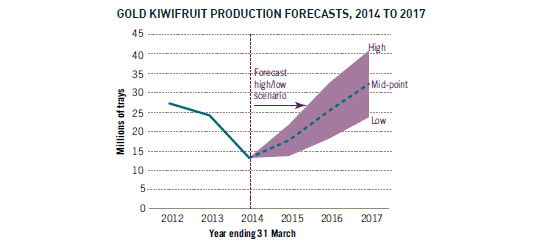
This represents a small decline on the previous year, due to the impact of the bacterial disease Psa on the gold kiwifruit harvest.
This is expected to decline further in 2013/14, as the industry replaces the traditional Hort16A gold kiwifruit cultivar with more Psa-tolerant ones.
Over the rest of the outlook period, horticultural exports are expected to increase by an average of 4.7 percent per year, to reach $3.6 billion in 2016/17.
This is largely due to an expected rebound in the kiwifruit sector from 2013/14, and ongoing growth of the wine industry. Forecast production scenarios are included in the graph below. The kiwifruit industry’s ability to establish the new cultivars will be pivotal to these.
SEAFOOD
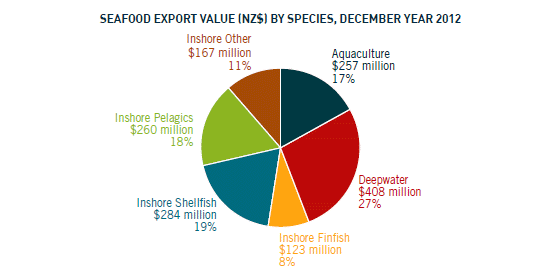
Seafood exports are expected to total $1.5 billion in the year to June 2013. Wild-capture fisheries account for 83 percent of these earnings.
The aquaculture sector – the marine farming of shellfish and fish – accounts for the remaining 17 percent.
The medium-term outlook for seafood is reasonably subdued, with export earnings forecast to increase to $1.8 billion in the year to June 2017.
This is based on a modest increase in export prices for both the wild capture and aquaculture sectors.
Export volumes are expected to remain relatively static over the outlook period, reflecting sustainable harvesting of wild fisheries and the long lead times required to consent and develop new marine farms.
-----------------------------------------------------------------------
The full Report can be downloaded here »
We welcome your comments below. If you are not already registered, please register to comment
Remember we welcome robust, respectful and insightful debate. We don't welcome abusive or defamatory comments and will de-register those repeatedly making such comments. Our current comment policy is here.