
By Keith Woodford*
Towards the end of 2015 there was a massive re-assessment of A2 milk on the New Zealand and Australian stock exchanges. The shares of ‘The a2 Milk Company’ (abbreviated hereafter to their NZX code of ATM) closed the year at almost four times their price back in May, and with market capitalisation at $NZ1.35 billion. For a few heady hours the capital value was close to $1.7 billion – more than Trade Me and almost double The Warehouse. Since then the shares have settled back somewhat, but still showing a three-fold gain from 12 months earlier.
In essence, the drive was fuelled by several major Australian institutional investors building their stakes, and then hundreds of smaller investors climbed on board. This was in response to ongoing good news stories from ATM, based on sky rocketing sales of infant formula in Australia and China, with this news particularly well reported in the Australian media.
Share markets tend to ebb and flow, and I never advise people whether I think the ATM shares are a good or a bad buy. Share market sentiment is unpredictable. But there is no doubt that the dairy world is changing.
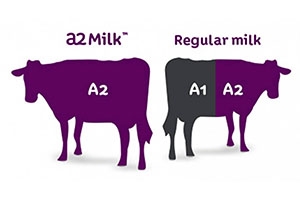
Back in September, ATM was reporting that 28% of pregnant Australian women were drinking a2 MilkTM, with this then flowing through to a demand for the a2 PlatinumTM infant formula produced for ATM by Synlait. This was and is despite the ATM products being about twice the price of other brands. Chinese mums were then responding on the basis that if that was what Australian mums were doing, then they would do the same.
Unlike New Zealand, where A2 milk is hard to find and with poor keeping quality, the Australian-produced milk has excellent shelf life and is clearly the top premium brand.
In this article, my aim is not to tell that success story in any more detail. Rather, my aim is to say to New Zealand farmers, it’s time our industry woke up to what is happening. What is wrong with our industry that science, initiated here in New Zealand, is being ignored in this country? And much of this is at the expense of New Zealand’s 11,000 dairy farmers who have missed the boat.
In theory, ATM is still a New Zealand company but increasingly the investors come from Australia and beyond, and that is where all the top ATM executives are. Here in New Zealand, there are about 35 farmers supplying A2 milk to Synlait, for which they receive a paltry premium of 15c per kg milksolids. And Synlait will also be clipping the ticket nicely (and legitimately) for the processing and packaging services they provide. But in the main, the benefits are going elsewhere.
It is ironic that Fonterra owned a 50% share in the first of the A2 patents. This patent, amongst other things, prevented farmers in most parts of the world from selecting for A2 herds – unless either Fonterra or ATM gave a license. How such a patent could ever be issued is another story. It should never have happened, but the ‘herd forming’ component somehow slipped through into the American patent and then was rubber stamped elsewhere across much of the world.
Despite co-owning this key patent (initially with the Child Health Foundation, and subsequently with ATM), Fonterra decided to downplay the A2 issue – something that they must surely be now wondering about. So they ignored the asset they held. It could have given Fonterra a big ‘early mover’ advantage.
In late 2015, the herd-forming patent ran out, and now there is no patent restraint on anyone anywhere in the world setting up A2 herds. And indeed it is starting to happen in a significant way. There will, however, be trademarks, brands and some specific testing methods that are still protected.
All of the international semen supply companies have had their bulls typed for A1 and A2 for several years. Accordingly, If clients asked, these companies could always advise which bulls were A2A2 (i.e., carrying double copies of the gene variant which needed to produce A2 herds). But now some of these companies are actively advertising it.
Several years ago, when travelling in an overseas country, I visited a farming group comprising three families who between them produce a billion litres of milk per year. That is more than all of the total milk products we consume locally in New Zealand. My visit was unrelated to A2, but at the end of the visit I did bring up the topic. A smile came over their faces. I said I would go out to my car and get a copy of my book on A1 versus A2. They said ‘‘No need. We now realise who you are. And in any case we already have several copies of your book”.
They explained to me how they had calculated that, when the patent situation changed, they could, and if necessary in a matter of weeks, be producing more than one million litres of A2 milk per day. At that stage they saw the A2 issue as a potential threat to their business and were planning accordingly. My guess is that they have been quietly getting organised ever since.
In recent weeks, the somewhat renegade ‘Milkweed’ journal, which goes to more than 5000 American farmers on subscription, has told its readers that now is the time to go A2. At least for some of them, it is going to happen.
Unfortunately for New Zealand farmers, it is going to be easier for the big American mega-farmers to shift to A2 milk than is the case for New Zealand farmers. Four key factors are: 1) they have multiple herds and can therefore easily segregate the A2A2 cows; 2) they artificially inseminate their 15-month heifers and this gives them more replacements to work with; 3) sex-selected semen works better in their systems than our seasonal systems; and 4) high replacement rates are economically positive for them, given the price of cull cows relative to the cost of raising replacements.
The one advantage New Zealand farmers have is that they are starting ahead of many countries in relation to their baseline A2 status. In all likelihood, New Zealand is starting ahead of the USA, China and much of Northern Europe – but not southern Europe.
In a logical world, Fonterra would have been acting a long time ago. But Fonterra is locked into historical positions and is unlikely to change in the near future. Fonterra will argue that the science remains unproven.
Well, the science is increasingly proven.
I began studying these issues back in 2003 and quickly realised there was a smoking gun. By the time I wrote my book ‘Devil in the Milk’ in 2007, the human clinical trials were still missing (they are very hard to do) but the underpinning science was growing fast. Of course the mainstream industry did their utmost to discredit me – they saw it as a threat – but in the long term they have only fooled themselves.
In the last 18 months, there have been papers published in Nutrients, the European Journal of Clinical Nutrition, the International Journal of Food Science and Nutrition, Nutrition and Metabolism, and Nutritional Biochemistry. I am linked into some of this research – I am a co-author on three of those papers. There is more to come. Quite simply, the share-market tide may ebb and flow, but the science is becoming a river.
So what can New Zealand farmers do? At the very least, New Zealand farmers should be using A2 semen as a de-risking strategy.
It should be easy to use A2 semen, but for that to occur LIC needs to come to the party and set up an A2 ‘bull of the day’ service for each of the three main breeds (Friesian, Jersey and Kiwi Cross). In the past, LIC has been unwilling to do this, but now is the time for farmer members to put the pressure on.
A second step – and this is so easy to do – would be to prominently display the A1 and A2 status of all bulls in the LIC catalogues – both hard copy and online. LIC have all of this information, but they make it hard for farmers to find.
These simple steps will not be enough to bring New Zealand up to speed and get the early mover advantage. It is too late for that. But at least they will help prevent New Zealand farmers getting left further behind in the dust.
The counter argument is likely to be that New Zealand dairy industry will lose potential genetic gain by doing this. Well, together with Lincoln University Master of Agricultural Science student Italo Mencarini, I have studied that as part of broader analyses of converting herds to A2, and we have published that work through the New Zealand Society of Animal Production.
If everyone goes A2, then it is possible that the genetic gain we could otherwise obtain in the next ten years might take us an extra year or so. But that is only if everyone is using A2 bulls, and as a consequence we need to drop well down the ranking list to get sufficient supply. However, farmers do not currently maximise genetic gain. If that last drop of genetic gain is so important, then one of the first strategies farmers should be using would be to artificially inseminate their 15-month heifers, like farmers almost everywhere else do, rather than using bulls. That will more than compensate for any slight reduction in the rate of gain from moving to A2.
So my call to action is for New Zealand dairy farmers to ring their LIC directors and tell them what they want. After all, LIC is indeed a farmer-owned co-operative. It is up to farmer members through their LIC directors to set the policies.
And as a final reminder, don’t forget that ‘The a2 Milk Company’ sells its milk across Australia as the leading branded milk at more than twice the price of Fonterra’s milk.
Keith Woodford is Honorary Professor of Agri-Food Systems at Lincoln University. He combines this with project and consulting work in agri-food systems. His archived writings are available at http://keithwoodford.wordpress.com
We welcome your comments below. If you are not already registered, please register to comment
Remember we welcome robust, respectful and insightful debate. We don't welcome abusive or defamatory comments and will de-register those repeatedly making such comments. Our current comment policy is here.