
By Keith Woodford*
In New Zealand, we have yet to come to terms with the reality that the future of our dairy industry is highly dependent on China.
America does not need us. Europe does not need us. The oil producing countries can no longer afford us. Africa has never been able to afford us.
So it is all about Asia.
Our dairy products can have a place in many Asian countries – Thailand, Singapore, Malaysia, the Philippines, Sri Lanka, Vietnam, Korea, Japan, and so on. All of these countries can and will make a difference to overall demand. But without China, it won’t be enough.
Further west, Iran my well open up, particularly if oil prices recover. India is the other big one, but for the foreseeable future, India will largely meet its own needs.
In the past, our dairy industry has benefited greatly from high oil prices. This sounds counter-intuitive, but for the last ten years, apart from China, it has largely been the oil-producing countries who were out there using their oil income to buy milk powder. There has been a remarkable correlation over this period between oil prices and milk powder prices.
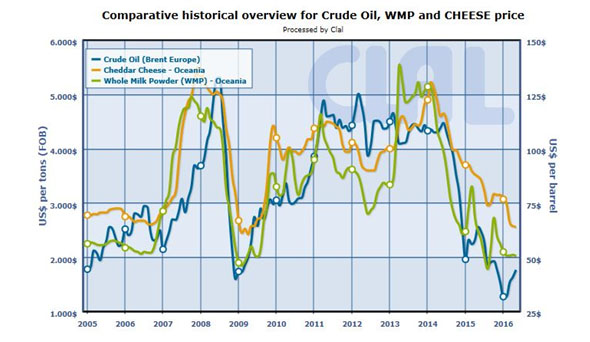
Source: http://www.clal.it/en/?section=petrolio
There were even a couple of years when oil-producing Venezuela was our largest purchaser of whole milk powder (WMP). But Venezuela is now in turmoil and any recovery will be slow.
So the key reality, is that regardless of what happens elsewhere, and even with an oil rebound, the numbers can never stack up without China in the mix.
The idea that China ever left the market is considerably misplaced. The 2015 calendar year was indeed a quiet one for China’s milk powder imports, with whole milk powder imports declining to 347,000 tonnes after purchasing 619,000 tonnes in 2013 and 671,000 tonnes in 2014. Nearly all of this WMP came from New Zealand.
Despite this step back, China was still by far the largest importer of WMP in 2015. Next came Algeria with 210,000 tonnes, much of it purchased from the adjacent EU.
Algeria tends to be a buyer that comes in and out of the market, buying mainly when prices are low. However, in the early months of 2016, and despite low dairy prices, it seems that Algeria is largely absent from the market. Algeria’s problem is the same as other oil and gas-producing countries – they no longer have the cash flow needed to purchase WMP.
In the last few days, the EU Milk Observatory has published global import and export data for the first three months of this calendar year. What is evident, is that China’s WMP and SMP (skim milk powder) imports are recovering, although there is still some way to go to reach the 2013 and 2014 figures. So far, WMP volumes are up 24 % and SMP volumes are up 29% on the same three months last year.
A key note of caution is that although China’s milk powder imports are increasing again, the increases are lower than for most other dairy products. There is emerging evidence that WMP will be a declining component of the Chinese dairy industry in future.
For example, latest statistics from industry analyst CLAL in Italy depict how liquid milk consumption per capita in China increased 9% between 2013 and 2015. However, milk powder consumption per capita dropped 17% during this same two-year period. Over a longer five-year period, liquid milk consumption per capita is up 35% but WMP consumption has essentially been static.
Over the most recent two-year period from 2013 to 2015, China’s cheese imports increased 60%, butter imports increased 36%, infant formula imports increased 57% and liquid milk imports increased 150%. It was only WMP and SMP that went down.
So far this year, China’s liquid milk imports (mainly UHT) are running at 80% up on the same months last year.
In 2015, China’s largest category of dairy imports was whey at 436,000 tonnes. This largely comes from the world’s big cheese producing regions, these being Europe and the USA.
The final destination of all this whey powder is unclear. Some will be for human consumption, and some will be ‘sweet whey’ containing a mix of whey and lactose, which probably ends up in animal feeds.
One of the interesting statistics is imports of pure lactose. The most recent statistics for the first three months of this year show that China is only number two for lactose imports.
So who beats China on lactose imports? The answer is good old New Zealand!
So why do we import so much lactose into New Zealand? The answer is that our cows produce milk in which lactose is a lower proportion than the international standard. So each year we import up to 100,000 tonne of lactose, largely from Europe and the USA, which we then mix in with our NZ-made milk powder.
Lactose is typically one of the lower value components of milk powder. So not only does its importation to New Zealand give us an internationally standardised product; it also bulks-up the milk powder and hence is a nice money-making venture.
Within the trade, the presence of imported lactose in New Zealand milk powder is no real secret. However, it is an issue to be thought about by those who argue that we could get more mileage from our so-called grass-fed products.
Turning back to China, the overall evidence is very clear that China’s demand for imported dairy products is increasing. However, the future demand for WMP is less certain. If China does want more WMP in future, then it will be following a pathway different to other countries that have travelled from a ‘developing’ to a ‘developed’ economy.
A big part of the equation is working out how much milk can China produce for itself. The answer is that China struggles to produce the feed for its growing herds. Hence, milk production over there is expensive.
If it were just a case of simple economics, then China would import much or even most of its dairy products. But these things never come down to simple economics. Food security, plus the politics and welfare of rural development, also come into the equation.
In a simple world of open borders and totally free trade, then China would import most of its cheese and butter. It would also import much of its UHT (long life) milk. And with emerging technologies for extended shelf life (ESL) refrigerated milk, it would also import increasing quantities of ‘fresh milk’. In that simple world, as internal chilled facilities improve, the demand for both local and imported WMP could be expected to decline.
Estimates of the proportion of China’s dairy consumption that is currently imported depend, to a considerable extent, as to how the imported whey is allocated between human and animal uses. However, as a working number, I estimate that total dairy imports for human use are about 15% of total liquid milk equivalent (LME) consumption. My expectation is that this will increase. But in reality we don’t have quality ‘on the ground’ research to make sound estimates of what is happening to China’s overall industry.
So how should we be responding in New Zealand?
The first point on which agreement should be easy to obtain – if logic is the basis of our judgements – is that we cannot have a vibrant dairy industry without China. The second point of agreement –although I have not had time to develop this argument here – should be that wholesale conversion of New Zealand’s dairy land back to sheep and beef cattle is no solution. It is very easy to show that the economics of that do not stack up.
The challenge we face in New Zealand is that over the last 15 years we have developed an industry that is highly dependent on WMP. This is a very different industry than the butter and cheese-dominated industry that we had throughout the 20th century.
Since the turn of the century, the WMP strategy has worked very nicely for us until the last two years, built on oil-funded purchases by the oil producing countries, combined with the unique trajectory of China’s economic growth.
There was a very good reason why we went the WMP way. Quite simply, for a seasonal industry that produces most of its product in spring and early summer, and given the price signals of the time, it was an apparently obvious way to go. Seasonal production and WMP go hand in glove.
But what we have is a one-trick pony. To take an analogy from another industry, we have nearly all of our dairy eggs in the same basket.
If we want to reduce our risks from a highly volatile product, then we are going to have to restructure our industry. Unfortunately, our industry has yet to come to terms with what that means. It won’t be an easy journey.
Keith Woodford is Professor of Agri-Food Systems (Honorary) at Lincoln University and a Senior Fellow (Honorary) of the NZ Contemporary China Research Centre. His archived writings are at http://keithwoodford.wordpress.com
We welcome your comments below. If you are not already registered, please register to comment
Remember we welcome robust, respectful and insightful debate. We don't welcome abusive or defamatory comments and will de-register those repeatedly making such comments. Our current comment policy is here.