
By Keith Woodford*

In late 2015, the New Zealand Government made a commitment at the Paris climate negotiations that by 2030 New Zealand will reduce greenhouse gas (GHG) emissions by 30 percent compared to the 2005 levels. This overall commitment includes methane and nitrous oxide emissions from agriculture. These agricultural emissions are converted for carbon-accounting purposes to the equivalent tonnes of carbon dioxide. The daunting and unique challenge for New Zealand is that agriculture emissions comprise some 50 percent of total emissions.
Given the fundamental biology of ruminant animals, there are limits as to what can be done to reduce livestock emissions without drastic destocking. And destocking would have a major impact on the whole economy. Also, in a global context, and unless everyone goes to a vegan diet, eliminating New Zealand’s pastoral agriculture would not make a great deal of sense. This is because New Zealand is one of the more efficient producers of milk and meat on a relative GHG intensity basis.
Alternatives such as reducing the number of cars on the road, or the numbers of kilometres they are driven for, is not going to solve the problem. A car that is driven for 15,000 km each year produces about 2.7 tonnes of carbon dioxide. This is very similar to the carbon dioxide equivalent emissions of a dairy cow. There are simply not enough cars on the roads to make enough difference.
Whether or not New Zealand should or should not have agreed to these GHG reductions is not a topic I want to get into here. Some groups are already arguing our commitments are insufficient; others will say we have gone too far. Those are arguments for another day. The key point of this article is that our Government has signed up to a 30 percent saving by 2030, and there is no obvious wriggle room. So it would seem that 30 percent is what we will have to achieve.
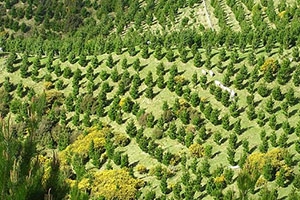
When I look at the numbers, the overall task in front of us is not achievable unless a lot more trees are planted. We need to reduce our annual net emissions by about 18 million tonnes. Over a 30-year rotation, each hectare of trees will, on average, soak up between 20 and 25 tonnes of carbon dioxide each year.
However, it is not quite that straight forward. In the early years of growth, the sequestration of carbon is less than later in the cycle, so by my calculations we need to be planting about 80,000 hectares of new pine forests each year and starting right now. This is in addition to the replanting of existing forests that are harvested.
In recent years, the economic incentive to plant pine trees, or any other type of forest, has been very limited. Some new forests were planted between about 2008 and 2010 based on calculations that the value of carbon credits would make it a worthwhile endeavour, but that system has been a fizzer. The original estimates were that carbon would be priced between $15 and $25 per tonne, but after 2011 the prices crashed. This crash was at least in part a result of allegedly fraudulent credits which New Zealand and other countries purchased, largely from the Ukraine and Russia.
Looking back over the last ten years, and indeed 20 years, there had been lots of huff and puff but little real action. Whatever action has occurred, such as the emission trading scheme (ETS), has largely been flawed and ineffective. In the next five years, the talk will have to change to action.
Given the pickle we are in, it would make sense for lots of trees to now be planted. But it is not going to happen without a change in Government policy. The history of the last ten years has shown that making private forest investment decisions in an environment where carbon markets are at the mercy of political decisions is not a smart move. So private landowners will continue to sit back and watch.
If the Government were serious about providing solutions, they would start purchasing North Island hill country and turning it into forest. Government would then own the credits which could be sold to emitters. Any surplus could be sold overseas. However, there is currently little if any talk of this occurring.
Alternatively, the Government could underpin the carbon market at a minimum price of say $25 per tonne with a long-term guarantee. Whether that would be a sufficient price to encourage hill country farmers to plant trees, or for corporates to enter the land market to make their own investments, would need to be tested. Once again, the credits could be sold to carbon emitters, either in New Zealand or overseas.
These ideas may well be too radical for many people to support. My response is for those people to come up with a better alternative. If we don’t plant more trees then we either have to kill the cars, kill the cows, or most likely kill both.
One thing I do know is that private investors will want a considerable risk premium before investing in carbon, given the fickle nature of politics. Without cast-iron guarantees they will not invest.
A further problem with forestry is that if and when the trees are harvested, the carbon credits have to be repaid. That means that the carbon credits are really just an interest-free loan. So what will the timber value be in another 30 years?
Over the last 20 years, the lumber value of the timber has gone backwards. Current prices are almost the same in nominal dollars as 20 years ago. Adjusted for inflation, the price has dropped by well over 30 percent. The reason there are currently so few new forests being planted is that it makes no economic sense. Without substantial carbon credits, it will stay that way.
Meeting the 2030 targets will not mean we are at the end of the road. To keep earning carbon credits to offset other carbon emitting activities, we will need to plant more and more of our hill country into forests, be that pine trees or allowing native forests to regenerate. However, by then the world may be a very different place.
The key long-term energy technology that I am watching out for is thorium. It is nuclear but it can be safe. China, Russia, India and Canada are amongst the leading countries researching these possibilities. Thorium nuclear power technology already exists, but it has to be scaled-up to commercial levels, and that presents its own challenges. However, there is enough thorium fuel to last many thousands of years, the radioactivity is short-lived, it does not make nuclear bombs, and it does not create greenhouse gases.
In the meantime, we have to plant trees. Given the commitments our Government has made, there is no alternative.
Keith Woodford is an independent consultant who holds honorary positions as Professor of Agri-Food Systems at Lincoln University and Senior Research Fellow at the Contemporary China Research Centre at Victoria University.

We welcome your comments below. If you are not already registered, please register to comment
Remember we welcome robust, respectful and insightful debate. We don't welcome abusive or defamatory comments and will de-register those repeatedly making such comments. Our current comment policy is here.