

By Gareth Vaughan
More than a hundred years ago a ship named the Titanic was launched. It was said to be unsinkable.
The reason we've all heard of this ship today is because it wasn't unsinkable. In fact the Titanic sank on its maiden voyage in 1912 after hitting an iceberg in the North Atlantic Ocean.
It even turned out the ship was poorly prepared for such a scenario, not having enough lifeboats. More than 1,500 people died. "Titanic" thus became a byword for disaster, tragedy and hubris.
I thought of the ill-fated ship this week after reading details of the Reserve Bank's latest bank stress testing. This is not because I think or want New Zealand banks to suffer a similar fate to the Titanic. I don't. Rather it's because the Reserve Bank makes it sound as if the banks are unsinkable.
In this year's solvency stress test the Reserve Bank modelled a four-year scenario where house prices fell 47% from the very elevated November 2021 peak, share markets dropped 42% from December 2021, the unemployment rate - currently 3.3% - rose to 9.3%, Gross Domestic Product contracted 5%, the Official Cash Rate (OCR) peaked at 5.5% and the two-year mortgage rate at 8.4%, and banks were hit by a "one-in-25 year" cyber-risk event.
The Reserve Bank says this scenario caused loan impairments of $20.8 billion over four years, saw banks post losses during year two, and cop aggregate costs of $1.3 billion from the cyber-attack(s).
This stagflation and cyber-attack combination certainly packs a punch. But not only did NZ banks survive, even before mitigating actions they still had enough capital to both continue lending and maintain capital ratios above their minimum regulatory requirements.
The Reserve Bank did note, however, this would be a "challenging macroeconomic environment for households and businesses," I.E. people, with a significant number of bank customers unable to repay their loans and watching their wealth erode.
The Reserve Bank also suggests most banks would need to initiate mitigating actions such as issuing capital, restricting dividends (poor shareholders), and cutting costs in order to replenish their capital buffers, and to meet rising regulatory capital requirements being phased in over the years to 2028. More likely, in my view, the Reserve Bank would just kick the can down the road on the deadlines for the increased capital requirements again as it did when Covid-19 hit.
Clearly NZ banks are strong. This is good. And certainly with the big four oligopoly it's what you would expect. After all the four - ANZ, ASB, BNZ and Westpac - hold a combined 87%, or $447.829 billion, of NZ's $512.719 billion of total bank loans. As ANZ's recent annual profit of $2.3 billion highlights, they're also very profitable.
A beef
My beef with the stress tests is not that the Reserve Bank does them. Given the central bank's financial stability mandate it needs to do something of this ilk. It's rather that I believe the stress tests should be taken with a large grain of salt. They're a good academic exercise for central bank boffins to undertake. And they can map out a vast range of potential catastrophic scenarios. But no one knows exactly what combination of events will cause the next crisis and/or be experienced during it.
This year's solvency stress test asked banks to consider how a cyber-attack would impact their business for the first time. Banks were required to base this on a one-in-25 year cyber risk event/s, whatever that means, which affects the general banking system.
According to the Reserve Bank, banks modelled the impacts of scenarios including various distributed denial of service attacks, attacks locking banks out of critical infrastructure, kill chain malware and ransomware events with all attacks modelled to extend over one to two months.
It's not clear whether any of these scenarios included state sponsored attacks. But it's certainly good banks are modelling cyber-attacks given they're constantly facing them. Ross McEwan, CEO of BNZ's parent National Australia Bank, recently said his bank faces more than 50 million attacks on its digital channels every month.
Alarming revelation
The latest stress testing also incorporated high interest rates, for the first time since 2014. Alarmingly here the Reserve Bank says banks noted the difficulty in modelling the impact of higher interest rates, given a lack of historical data. This seems surprising given the rise in interest rates as recently as the lead up to the Global Financial Crisis (GFC) when the OCR peaked at 8.25% between July 2007 and July 2008.
"This highlighted some limitations for the stress test modelling of new economic risk factors. A number of banks indicated they are investing in their modelling capability and that this stress test proved a useful exercise," the Reserve Bank says.
I'm old enough to remember when unemployment topped 11% in 1991 and some mortgage interest rates hit double digits in 2008. And I'm younger than some of the people working in our banks. So in our world of rising interest rates it's concerning banks are apparently struggling with their modelling.
Another thing that's interesting to consider is that NZ's major banks emerged from the latest crisis stronger than when they went into it. In major part this is due to the mitigation measures the Government and Reserve Bank put in place.
When Covid-19 hit the wage subsidy and mortgage deferral scheme gave people the confidence to continue borrowing and spending. The Reserve Bank dropping the OCR to just 0.25%, keeping it there from March 2020 until October 2021, and removing loan-to-value ratio restrictions, helped give them the means to do so.
Thus NZ banks topped $6 billion in annual profits for the first time in the September 2021 year as they realised almost all the loan provisioning taken at the onset of Covid-19 wouldn't be needed.
When the GFC kicked in banks were also supported. The Reserve Bank slashed the OCR from 8.25% in July 2008 to 2.50% in April 2009, making 150 basis point cuts in both December 2008 and January 2009. The Government also introduced the Crown retail deposit guarantee scheme, and a Crown wholesale funding guarantee scheme covering overseas bank borrowing that was used by ANZ, BNZ, Westpac and Kiwibank.
Pandemics, foot & mouth and more
In May 2020 the then-Reserve Bank Deputy Governor Geoff Bascand acknowledged the Reserve Bank's stress testing of banks hadn't run a fully fledged pandemic scenario. It had, however, tested an outbreak of foot and mouth disease.
The very real risk of foot and mouth (FMD) remains, with the Reserve Bank's Financial Stability Report this week noting the recent outbreak in Indonesia.
"In New Zealand, the probability of an outbreak remains low owing to effective border controls and the lack of direct flights from Indonesia currently. However, an outbreak would have a large adverse impact on the sector if it occurred, as it would be likely to trigger a swift suspension of all FMD susceptible animal-based exports. We are working with other parts of government to monitor the current Indonesian outbreak and risks to New Zealand," the Reserve Bank says.
Another scenario I would think worth modelling, given the ownership of our major banks, is a banking crisis in Australia spilling into NZ. But it's good to see from the Financial Stability Report that the Reserve Bank is keeping a watchful eye on China, our key trade partner, with a section on the implications of a slowdown in Chinese growth.
It's great that NZ banks come through Reserve Bank stress tests so well. But this doesn't mean nothing could ever go wrong. You never know what the exact nature of the next crisis will be thus it's impossible to prepare for everything. What happened to the Titanic reminds us you just don't know exactly what's out there, and where human error and greed might lead.
Another point is, if a worst case scenario happens with runs on NZ banks and/or bank(s) flirting with the possibility of failure, does anyone believe the Government will just stand back and watch? History suggests that's very unlikely. At the end of the day bank customers are voters and governments can pretty much bail anything out if they really want to.
In conclusion and to answer the question posed in my headline, no bank stress tests aren't bunkum. But they should be taken with a grain or two of salt.
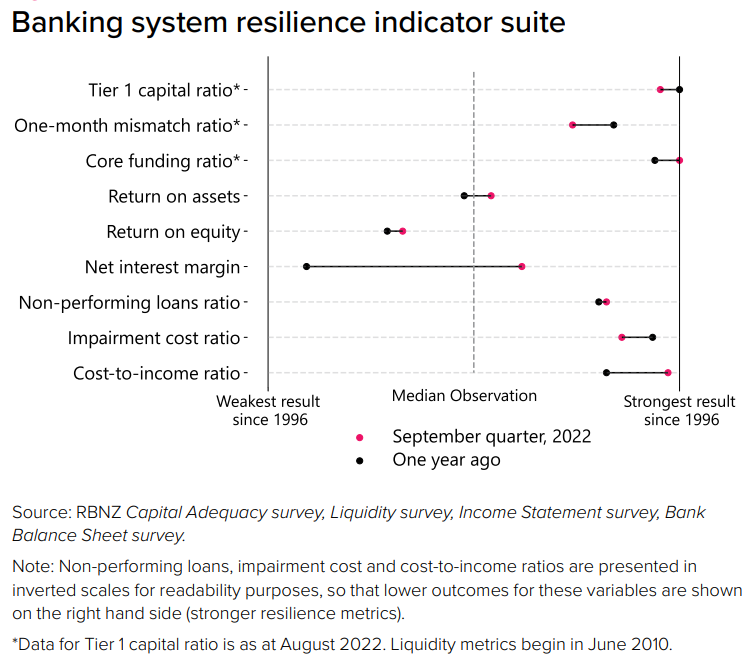
*The chart above comes from the Reserve Bank's Financial Stability Report.
*This article was first published in our email for paying subscribers early on Friday morning. See here for more details and how to subscribe.
We welcome your comments below. If you are not already registered, please register to comment
Remember we welcome robust, respectful and insightful debate. We don't welcome abusive or defamatory comments and will de-register those repeatedly making such comments. Our current comment policy is here.