

ANZ New Zealand has a group of borrowers who bought homes when house prices were especially elevated in 2020 and 2021 "under heightened alert," as past due loans and the volume of borrowers in negative equity creep higher, CEO Antonia Watson says.
In last Wednesday's Financial Stability Report the Reserve Bank said 25% of outstanding mortgages were taken out between late 2020 and late 2021 when house prices were high and interest rates low. As of March this year, Reserve Bank figures show $347 billion worth of home loans. Thus a quarter of that is a bit less than $87 billion worth.
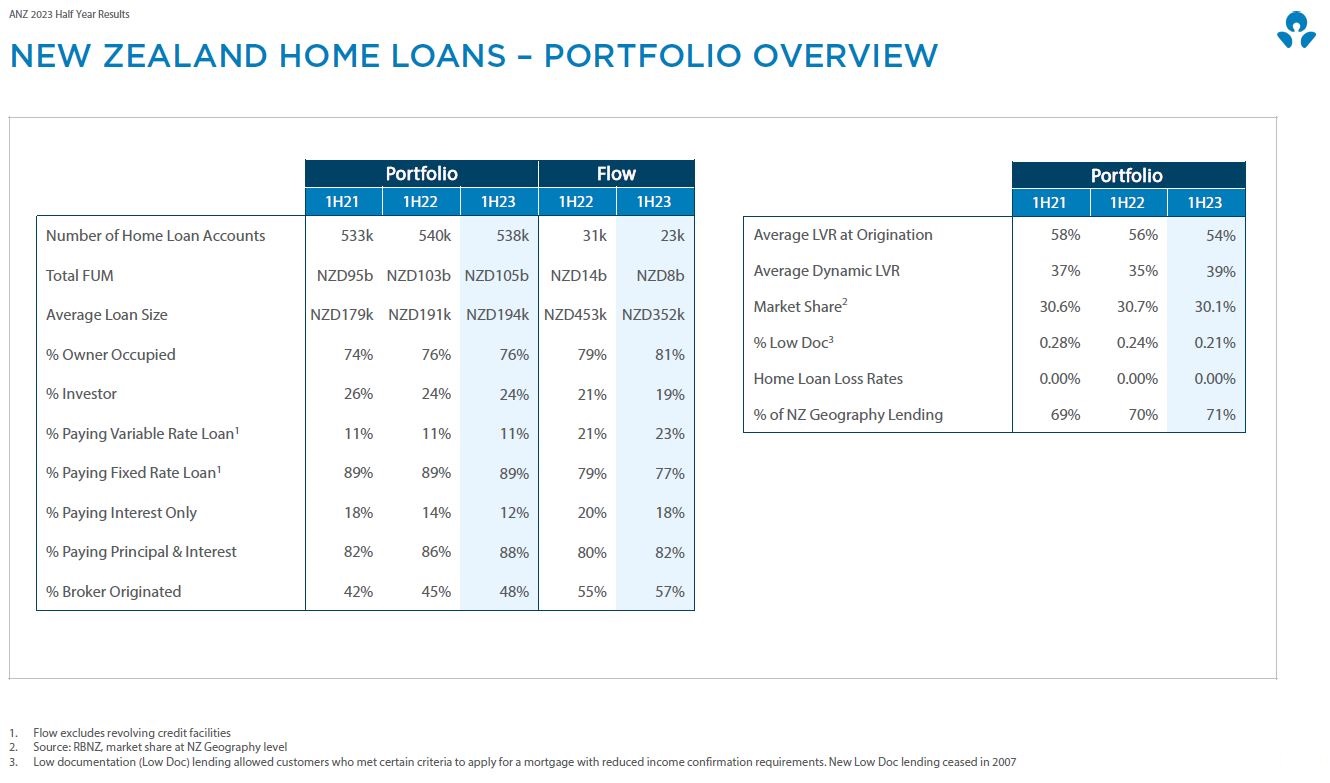
The Reserve Bank also confirmed that 25% of loans stress tested by banks in 2020-21 are now above their stress testing limits. Banks use test rates to assess would-be borrowers’ capacity to meet repayment requirements if interest rates rise. ANZ NZ is NZ's biggest home lender with a $105 billion home loan portfolio.
Speaking to interest.co.nz after ANZ NZ released its interim financial results on Friday, Watson said the 25% figure for borrowers stress tested in 2020-21 was "probably about right" for ANZ NZ's home loan portfolio.
"Not forgetting that our affordability tests tend to be on the conservative side. So yes, there are some people paying more now than they were tested at. They've probably also had a pay rise don't forget," says Watson. "People have had pay rises and people have still got jobs. So all of that really sits on the positive side."
"The cohort of people who bought at the peak of the market and who might be in negative equity, we're definitely seeing an increase in the proportion of our book in negative equity. But it's still small. It's 2% or something like that," Watson says.
"Obviously if you've still got a job and you can service the loan it becomes not so relevant. So employment is really important here."
Unemployment remains low, with the latest Statistics NZ figures putting it at 3.4%. Nonetheless Watson says ANZ NZ is keeping a close eye on borrowers who bought homes in 2020-2021 and whose mortgage rate may now be higher than the rate they were tested on.
"That particular cohort we've got them under heightened alert, making sure that we're looking for the watch points, contacting people proactively if they look like they're in trouble. And if anyone feels like they're getting in a bit of trouble the best thing to do is come and see us as early as possible," says Watson.
Negative equity is when a house price falls in value to the extent where the owner owes more on their home loan than what the house is valued at. The NZ median house price peaked at $925,000 in November 2021, according to the Real Estate Institute of New Zealand, and had dropped $150,000, or 16%, to $775,000 in the latest figures, for March this year.
And since October 2021 the Reserve Bank has increased the Official Cash Rate by 500 basis points to 5.25%, with the average carded, or advertised, two-year bank mortgage rate rising to 6.491% from 2.715%.
"We've got 45 basis points [of loans] at 90+ days past due. That's back just a squeak above where we were pre-Covid, which was still historically low. We're absolutely expecting that number to rise," says Watson.
"But customers have put themselves in pretty good positions overall...About two-thirds of customers have moved onto higher rates with about a third left, and of them 40% don't move onto a higher rate until next year or afterwards. People have been paying down their debt because when interest rates went down they didn't readjust their home loan repayment. So that put them in a better position. Our average rate across our portfolio at the moment is 4.46%."
After a credit impairment charge of $121 million in its interim results, ANZ NZ's total credit impairment provisions increased to $860 million.
Shayne Elliott, CEO of ANZ NZ's parent the ANZ Banking Group, says the provisions set aside for potential losses in NZ are now "higher than at any time in our history." Elliott notes, however, that NZ past due loans from retail customers are at levels still substantially lower than Australia.
'They're so much a last resort I wouldn't even want to talk about them at the moment'
At the start of last week there were 38 properties being advertised as residential mortgagee sales nationwide. During 2009, during the Global Financial Crisis, there were 3,024 mortgagee sales. Interest.co.nz asked Watson whether mortgagee sales could make a come back.
"Mortgagee sales, look they're so much a last resort I wouldn't even want to talk about them at the moment."
"What we want to encourage customers to do now is come and see us without any fear that they're going to lose their home because there are so many options we have before that happens," Watson says.
We asked Watson to elaborate on these options.
"Term out the loan. So if you were sitting on 15 years to go, term it out to 20 years so you reduce the repayments. Go to interest-only. We do some stress testing on our [loan] book that says [for example], 'if interest rates go up to 7.5% what percent of our book would need to go to interest only and they'd still be fine.' So that's a big buffer for people."
"Loan repayment holidays are sometimes suitable, we did them on mass at the beginning of Covid. That was suitable for a low interest rate environment. We'd never want to do them on mass now, but it's absolutely an option, especially to tide people over just for a little while well they're getting back on their feet again say, or if they've had an unexpected expense which we sometimes see," says Watson.
Another option is working with the customer on their overall financial position and options they might have. Or customers might proactively decide their current loan, in terms of the value of the house they've got, isn't feasible and decide to downsize to another home. And people with investment portfolios can reduce their debt by selling a property.
"There's all sorts of different options out there on the table which is why discussing it with someone is really helpful," says Watson.
'Short and shallow' recession seen
Meanwhile, Elliott says a "short and shallow" recession is "looking probable" in NZ.
"We're well placed to assist customers and manage stress given the strength of our franchise, our balance sheet and the provisions we've set aside for potential losses in New Zealand which are higher than at any time in our history," says Elliott.
*This article was first published in our email for paying subscribers. See here for more details and how to subscribe.
We welcome your comments below. If you are not already registered, please register to comment
Remember we welcome robust, respectful and insightful debate. We don't welcome abusive or defamatory comments and will de-register those repeatedly making such comments. Our current comment policy is here.