

Our first article in this series highlighted how much banks pay mortgage brokers for the business they funnel to them.
Now we want to take a slightly deeper dive into these flows.
It has long been assumed 'Australia' is a broker-dominant home loan market and 'New Zealand' isn't. But from our recent dig into bank-disclosures, this no longer seems to be the case.
Transparency varies between institutions, but we are fortunate the largest New Zealand bank, ANZ, is very transparent in these matters on both sides of the Tasman. BNZ is similar, as is its parent National Australia Bank. ASB is very opaque, but its parent, Commonwealth Bank of Australia, is as transparent as both ANZ and NAB. Westpac gives limited visibility. Locally Kiwibank is yet to step up although it says it will. But at least it's better than laggard ASB.
From these disclosures we found there has been a rather rapid rise in the role of mortgage brokers here, to the point where the difference with Australia is small now.
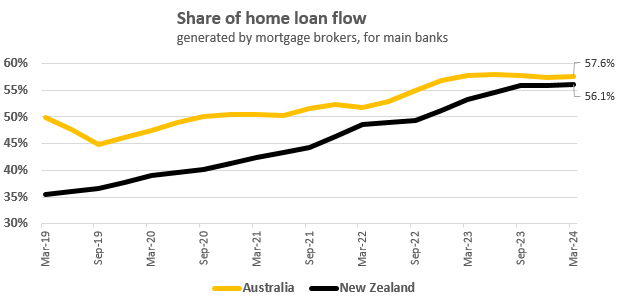
Over the past five years, the broker share has basically risen ~20 percentage points from about 40% to nearly ~60%. We think Kiwibank has outperformed that 'growth', rising by ~25 percentage points from 37.5% five years ago.
A key reason for this overall drive-shift has been the appetite of ANZ for more of their home loan business to arrive from brokers. This has given the market shift some significant heft. Westpac has been the other driver, somewhat surprisingly, but probably because its in-house channels underperformed.
The following chart-set tracks the dollar commissions each main bank has probably paid to mortgage brokers for the business they refer. All are estimates, some tighter than others for the same 'transparency' reasons noted above. We will update these estimates as better sources reveal themselves in the future.
($ million, at annual rate, quarterly to March 2024)
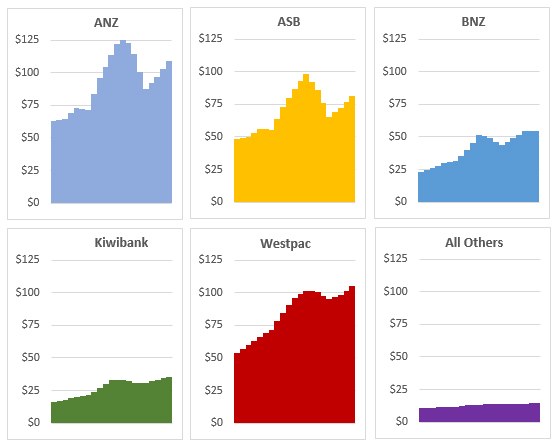
Of note is that both Kiwibank (~62%) and Westpac (~61%) now basically match ANZ (~61%) in terms of their flow coming via the broker channel, that ASB is probably the highest (~66%), and BNZ is lagging (~47%).
On that basis, both Kiwibank and Westpac had record-high broker flows in the March half year.
The data also shows the period when ASB pulled back from home loan growth after their masters at CBA became uncomfortable with them writing business that was not profitable. They are now back in the market however. Even though it didn't garner headlines at the time, it seems ANZ pulled back similarly at the same time for the same reasons.
ANZ and Westpac are the two banks likely to be paying more than $100 million per year to brokers.
Now that the Kiwi broker channel is beefing up and looking more "Aussie," it's attracting the attention of the Australians. Although the big Aussie broking channels are not here in force yet, its peak body, Finance Brokers Association of Australasia, has arrived hoping to roll up the local industry into one larger and more persuasive advocacy force. (It will be no surprise to learn that the 11,000+ member FBAA is based in wide-boy Queensland).
FBAA has a compelling pitch; "protecting the future of our industry and dealing with regulatory matters of the day." FBAA's "proven track record" of batting back Australian regulatory restraints has been successful. After all, none of the substantive reforms recommended in Australia by Hayne or the Australian Productivity Commission, not to mention Trowbridge, have succeeded at the political phase, all due to effective lobbying.
Here freedoms to operate are limited by the financial advice regulatory regime overseen by the Financial Markets Authority, with financial advice provider licensees required to file their regulatory returns by 30 September.
New Zealand brokers are also facing sceptical assessments by our Commerce Commission. Thus local mortgage brokers are likely to welcome FBAA's help here.
*The Financial Advice regime came into effect in March 2023. The FMA’s Financial Advice Provider page has more information that could be useful too. As mentioned, all FAP licensees need to file their regulatory returns by 30 September.
*This article was first published in our email for paying subscribers early on Thursday morning. See here for more details and how to subscribe.
We welcome your comments below. If you are not already registered, please register to comment
Remember we welcome robust, respectful and insightful debate. We don't welcome abusive or defamatory comments and will de-register those repeatedly making such comments. Our current comment policy is here.