

Mortgage brokers are growing in significance in New Zealand's housing market with an increasing number of banks' mortgages originated by brokers.
So how many brokers are there, what percentage of loans do they originate at the key banks, and how much money do they make?
Helpfully some of the major banks are quite transparent about broker originated lending. And that's the basis of our new all-industry estimate of the level of mortgage broker fees paid.
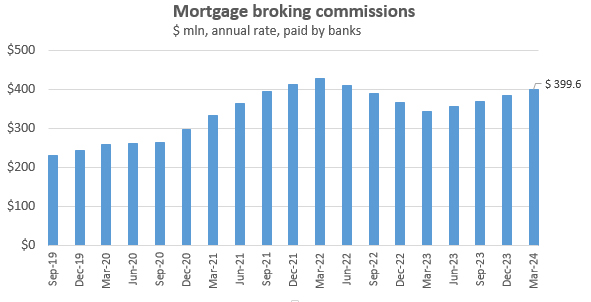
We estimate this industry earned about $400 million in the year to March 2024, a rise of 16.8% from the same quarter a year earlier.
Obviously mortgage lending didn't grow that fast. So why are mortgage brokers' fees swelling impressively?
The answer is banks are doing less direct home loan business with borrowers and more through mortgage brokers.
We should note they prefer to be called "mortgage advisers", and the Financial Markets Authority (FMA) is currently in the process of registering them under that name. Sadly, however, the recent Commerce Commission draft report on competition for personal banking services found, although they should bring better outcomes for their clients, there is actually no evidence this is happening overall. So we are staying with the mortgage broker label. 'Advice' is currently an unproven attribute. (The Commission's 16 draft recommendations include one about broker commissions plus one related to FMA guidance for brokers and their compliance).
To calculate the flows from banks to brokers, we started with the Reserve Bank's C5 "housing loan" data.
From this we can calculate that more than 92% of all housing loans are with the big five banks. This gives us high confidence that what follows is accurate and comprehensive.
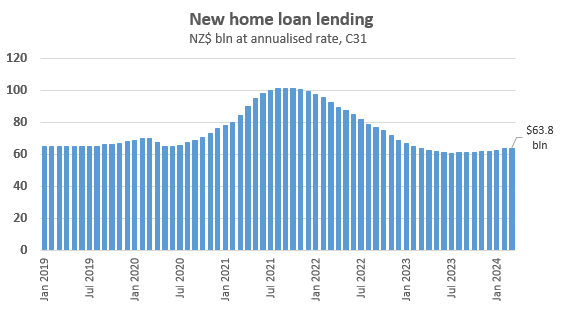
But mortgage broking fees are mostly paid on the "flow" of current transactions. The Reserve Bank's C31 series wraps up this data. ANZ and ASB, the two top mortgage banks, only pay upfront commissions, each at an 85 basis points (bps) rate.
BNZ and Kiwibank pay a 55 bps upfront commission plus a 15 bps "trail commission". That might seem less than the ANZ/ASB rate but the trail is paid for the life of the loan, and not just the current interest rate contract period.
Westpac is more generous, paying 60 bps upfront and a trail commission of 20 bps. And these higher levels means the Red Bank pays brokers nearly as much for their loan generation as ANZ does, almost certainly topping ASB.
To build our understanding within the C5 and C31 sector fencing, we turned to disclosures from the banks themselves.
ANZ is very open. At each group corporate results announcement it discloses the proportion of the home loan portfolio that was broker-introduced. And ANZ discloses the proportion of the recent lending flow that came from brokers. For ANZ NZ this flow is a rather remarkable 61% in the half-year to March 2024. That is a huge step-up over the past five years; in March 2019 it was 41%.
BNZ is equally transparent. For it 'only' 47% comes via brokers currently.
Westpac however is much less transparent, only disclosing portfolio levels at 53%. We use some other metrics to estimate Westpac's flow rate is probably close to 61%, similar to ANZ. (Although just as likely to be a bit more).
Kiwibank has told us separately its broker channel flows, in conversation, but have not released strictly comparable data. We have asked, but it has not arrived yet. We assume the March 2024 half year is at 62.5%, which ties into Kiwibank's earlier portfolio disclosures.
ASB is the least transparent, and probably has the highest broker-introduced levels. That's because it has traditionally had an aggressive home loan strategy which is very focused in Auckland-where brokers are most active. We have asked ASB for comparable data too, and it hasn't responded yet. For this review we assume ASB gets more than 65% of its current home loan flow via brokers, including its AIA channel. We also impute the ASB levels to match the March/September schedule of the other main banks.
All of these levels are sharp increases from five years ago.
So even though new home loan growth itself (Reserve Bank C33) is currently quite low, brokers have done better by writing more market share, and that is bolstering the sector considerably.
Mortgage broking is on the rise. Many of the largest mortgage broker groups are consolidating, and that gives them more negotiating power with the lenders.
We actually don't know how many mortgage brokers there are, but that level will be disclosed soon; the FMA will have a tally when its regime becomes effective. We expect it to be about 2,000.
If that is in fact the level, then the $400 million annual gross commission works out at $200,000 per broker. But just like real estate agents, it's likely a smaller subset does an outsized share of the business.
Further, mortgage brokers do more than just 'advise' on home loans. They also sell insurance, and they broker personal and commercial loans too. Earnings from these other activities are not part of our study here.
We are keen for feedback on this estimate. We intend updating this work every six months, after the latest bank disclosures are released.
*This article was first published in our email for paying subscribers early on Tuesday morning. See here for more details and how to subscribe.
We welcome your comments below. If you are not already registered, please register to comment
Remember we welcome robust, respectful and insightful debate. We don't welcome abusive or defamatory comments and will de-register those repeatedly making such comments. Our current comment policy is here.