

The Reserve Bank (RBNZ) is consulting on the Government's proposed prudential regulation tax that would introduce user pays for deposit takers, insurers and key financial market infrastructure providers who clear, settle and record payments and transactions.
The prudential levy consultation paper, issued on Tuesday, estimates the tax would raise $209 million over three years from deposit takers - including banks - insurers and financial markets infrastructure (FMIs) providers.
Deposit takers would pick up the tab for $113 million, or 54% of the total, insurers $81 million, or 39%, and and FMIs $15 million, or 7%.
Based on March 31 assets, the proposal would see ANZ NZ, with $219 billion in assets, pay in the vicinity of $10 million annually. BNZ, ASB and Westpac NZ, with between $130 billion and $144 billion of assets each, would all pay several million dollars, and Kiwibank, with assets of $43 billion, would pay significantly less.
IAG NZ, the country's biggest insurer, could be looking at an annual levy north of $5 million.
The consultation paper floats the options of a full cost recovery levy, or a partial cost recovery model, coming out in favour of full cost recovery.
"A full cost recovery model implies that industry should pay for all of the costs the Reserve Bank incurs in performing its prudential function and exercising its powers under prudential legislation. Whereas a partial cost recovery model splits this cost between industry and the New Zealand taxpayer," the consultation paper says.
"Full cost recovery appears to be more consistent with international practice for prudential levies: other countries that charge similar levies, including Australia, the UK, Canada, and Ireland, use full or close to full cost recovery."
"... on balance we are proposing that a prudential levy regime is based on full industry cost recovery."
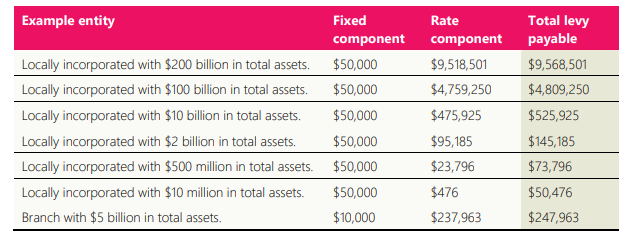
Within the three sectors proposed to pay the levy, the RBNZ says bigger entities should "contribute proportionately more towards the costs of regulating and supervising their sector." The RBNZ's preference is for a fixed component to the levy, suggested at $50,000 for all locally incorporated deposit takers, with each also paying a "rate component" determined by a deposit taker’s average total assets for a financial year.
Deposit takers include banks, building societies, credit unions and finance companies.
Plans for the prudential regulation tax were announced by Finance Minister Nicola Willis in May's budget. Bank are also being asked to cough up the lion's share of levies to be paid by entities supervised under the Anti-Money Laundering and Countering Financing of Terrorism Act.
Private sector asked to cough up so government can pocket a bigger RBNZ dividend
The cost of undertaking the RBNZ's prudential role is currently met through its five-year funding agreement with the Finance Minister. Prudential regulation, covering the likes of capital adequacy, liquidity management, and risk control, aims to maintain the safety, soundness, and stability of financial institutions.
The consultation paper notes the RBNZ generates revenue from seigniorage - issuing New Zealand dollars and coins, fees and investment returns. Seigniorage contributed to annual government revenue to the tune of $397 million, according to the RBNZ's most recent annual report.
In April 2025 Willis released the RBNZ's latest five-year funding agreement, which runs from 1 July 2025 to 30 June 2030. It allocates operating spending of $750 million and capital expenditure of $25.6 million.
The RBNZ notes the agreement states "how much of our revenue we can retain to meet operating costs and capital expenditure." Any surplus is paid to the Crown via an annual dividend, which was $542 million for the 2024/25 year.
"The introduction of a prudential levy will not increase the Reserve Bank’s operating budget or the functions it undertakes. Rather, if our prudential function becomes funded by a levy it would cease to be accounted for under the five-year funding agreement," the consultation paper says.
"All else equal, this would increase the size of the dividend the Reserve Bank pays to the Crown. A prudential levy would effectively shift the burden of funding the costs of the Reserve Bank’s prudential function to regulated entities."
The consultation paper notes section 293 of the RBNZ Act gives the RBNZ legal authority to charge regulated entities a levy.
Flat fee for FMIs
In terms of FMIs, the RBNZ is proposing to charge all four FMI operators it regulates, including the RBNZ's own ESAS and NZClear payment system, $1.23 million.
"We consider it is pragmatic to distribute regulatory costs evenly across the regulated population because all FMI are considered systemically important," the RBNZ says.
"The Government has made an in-principle decision that if the prudential levy were to proceed, it would be implemented in 2027. The proposed timeframe would have regulations with an effective date around August 2027, and levies first collected for the financial year 2027-2028."
"The feedback received on this consultation will help the Minister to decide whether to recommend the Governor-General makes regulations providing for a prudential levy and will inform the content of those regulations. The Reserve Bank and the Treasury will also provide further advice to assist the Minister in making a decision. If the Government decides to proceed, the Treasury will then be responsible for progressing further work to make the necessary regulations. Further consultation on the draft regulations is not proposed," the RBNZ says.
"Implementing a prudential levy would transfer the cost of funding the Reserve Bank’s prudential function to the entities we regulate and supervise. Due to the Reserve Bank’s funding agreement, this will result in a fiscal benefit to the New Zealand Government that would allow it to spend those funds on other governmental priorities, or support fiscal consolidation."
Submissions on the consultation paper are sought by October 16.
The table below shows proposed levies for deposit takers.
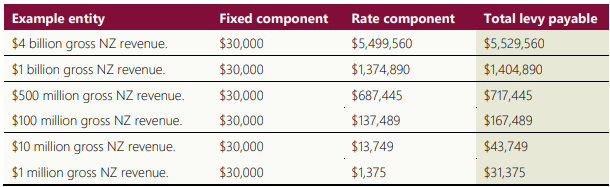
The table below shows proposed levies for insurers.
*This article was first published in our email for paying subscribers. See here for more details and how to subscribe.
We welcome your comments below. If you are not already registered, please register to comment
Remember we welcome robust, respectful and insightful debate. We don't welcome abusive or defamatory comments and will de-register those repeatedly making such comments. Our current comment policy is here.