
Summary
• Higher US wage and European inflation data triggers further increase in global rates
• Fed widely expected to raise rates 50 basis points this week but the market is now pricing an almost 50% chance of a 75bps hike in June
• Aggressive central bank tightening, underwhelming earnings outlooks, Chinese lockdowns, Ukraine war make for a long list of headwinds for risk assets
• US equities tumble on Friday (S&P500 -3.6%, NASDAQ -4.2%)
• Amazon crumbles 14% after providing disappointing revenue guidance, says it has over-invested
• Bloomberg reports that EU is preparing to phase out Russian oil imports by end of the year
• Chinese policymakers promise more support for the economy - Chinese equities higher but commodity markets unimpressed
• USD lower on Friday but still has its best month in years
• NZD falls to fresh YTD low amidst rising risk aversion; down over 7% in April
• Big week ahead: Fed (+50bps), BoE (+25bps), RBA (+15bps) all expected to raise rates. NZ Household Labour Force Survey (HLFS) expected to show fresh multi-decade low in the unemployment rate.
Good Morning
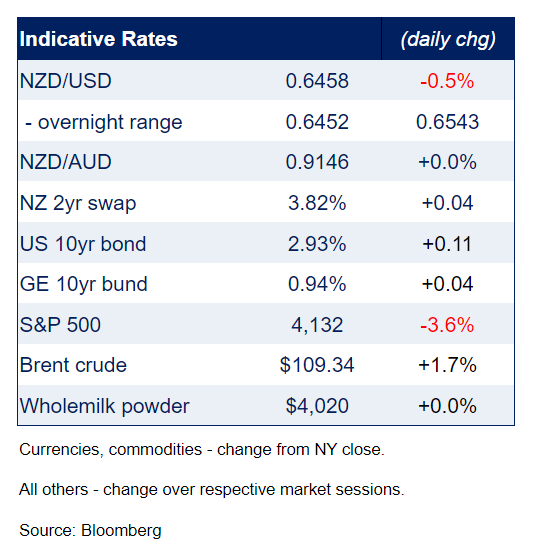
Global rates moved sharply higher again on Friday, following upside surprises to US wage data and European core inflation. The Fed is almost universally expected to raise its cash rate by 50bps this week, but the market has moved to price an almost 50% chance of a 75bps hike (!) in June. The prospect of aggressive central bank tightening and underwhelming earnings outlooks from Amazon and Apple saw the S&P500 and NASDAQ plunge by around 4%, capping off a dreadful month for risk assets. The NZD and AUD were weaker on Friday amidst weaker risk appetite, the NZD ending just above 0.6450, a more than 7% fall on the month.
The Employment Cost Index (ECI), considered one of the most comprehensive measures of US labour costs, was much higher than expected in Q1, reinforcing the market’s heightened inflation concerns. The ECI surged 1.4% q/q in Q1 (1.1% exp.), its largest quarterly increase since the survey was established in 1996, in part due to a jump in benefits payments (such as pensions). On an annual basis, the ECI is now running at a 4.5% pace while private sector wage growth is even higher, at 5% y/y. The data corroborates the elevated readings coming from other wage measures, such as the Atlanta Fed’s Wage Growth Tracker, which is tracking at 6% y/y.
With the US labour market exceptionally tight and wage growth running above levels consistent with the Fed’s 2% inflation target, markets expect an increasingly aggressive response from the Fed. Markets are fully pricing a 50bps hike at this week’s Fed meeting, given it has been well telegraphed by Fed officials, including Chair Powell. However, the market is now pricing an almost 50% chance of a 75bps hike in June, as well as another 50bps hike in July.
The last time the Fed raised (rather than cut) the cash rate by 75bps was in late 1994, towards the end of that tightening cycle. Market pricing is consistent with the current tightening cycle being even more aggressive than the one in 1994, which famously caused another brutal bond bear market.
In Europe, headline inflation was in line with expectations, at a post-euro high of 7.5% y/y in April. But market attention focused on the much higher-than-expected core inflation reading which, at 3.5% y/y, is now well above the ECB’s 2% inflation target.
ECB Chief Economist Lane confirmed that rate hikes are coming, telling Bloomberg TV “the story is not the issue about are we going to move away from -0.5% for the deposit rate, the big issue which we do need to still be data dependent about is the scale and the timing of interest-rate normalization.”
The lack of pushback against market pricing for ECB rate hikes from Lane, who is usually considered one of the most dovish members of the committee, is notable. Lane added that the weakening in the euro would be an “important factor” in determining their forecasts.
In contrast to recent cycles, where currency strength has been a constraint on policy tightening, EUR weakness is exacerbating inflationary pressures in the current cycle. The market is now almost fully pricing a 25bps ECB hike in July and 3.5 hikes by the end of the year. The 2-year German rate was 6bps higher on Friday, at 0.26%, close to its highest level since late 2013.
In some ways, the price action in equities and rates on Friday was a microcosm for the month of April. Bond rates surged higher as the market braced for more aggressive central bank tightening with inflation concerns top of mind. US Treasury rates were 10-11bps higher across the curve, with the 10-year rate ending the session at 2.93%, just below the psychologically important 3% mark.
The German 10-year rate was 4bps higher, at 0.94%, closing near a seven-year high. The 60bps increase in the US 10-year rate during April was its biggest one month move since January 2009. The Bloomberg US Treasury index is now 12.3% lower than its peak in mid-2020, by far its biggest drawdown since at least the early 1970s.
Talk of 75bp Fed hikes is hardly doing the equity market any favours. Investors are coming to the realisation that the so-called ‘Fed put’ is quite some distance away, and the Fed is not going to bail out the equity market by deviating from its hawkish path while inflation remains so elevated.
The NASDAQ was down a huge 4.2% on Friday, ending a miserable month for tech stocks.
On the month, the NASDAQ was 13.2% lower, its worst month since October 2008, while the S&P500 didn’t fare much better, down 8.8% on the month (-3.6% on Friday).
Shares in Europe weren’t hit as hard, despite the proximity to the Ukraine war and spiralling energy prices, with the German Dax down only 2.2% in April and the EuroStoxx 600 index 1.2% lower. The outperformance can partly be explained by the differing composition of the indices, with European benchmarks typically more heavily weighted towards the likes of industrials and banks, while US indices have far greater exposure to interest rate sensitive tech stocks.
All sectors in the S&P500 were in the red on Friday, with Consumer Discretionary (-5.9%) leading the way as the market factored in a weaker revenue outlook and more cautious guidance from Amazon. Amazon said it had overinvested in both its warehouse space and labour force and now had excess capacity. Amazon’s share price crumbled 14%, weighing on both the S&P500 and NASDAQ given its chunky weights in both benchmarks.
Meanwhile, Apple’s share price fell 3.7% despite beating analysts’ earnings estimates, with the company warning that supply disruptions, including those related to the lockdowns in China, could hit revenue by $4-$8b in the current quarter. Consumer discretionary stocks on the S&P500 underperformed staples by a whopping 15% in April, a sign that markets expect consumers to rein in discretionary spending as real disposable incomes get hit by rising inflation.
Notionally, ~80% of companies have beaten earnings estimates this quarter, but investors have focused on more cautious guidance from companies ahead of what is likely to be a much more challenging macro environment ahead.
The Ukraine war remains another major headwind for risk appetite. In news over the weekend, Bloomberg reported that the EU would propose a ban on Russian oil, to be phased in by the end of the year, although such a move would require unanimous support and some countries, such as Hungary, have been resistant to this point.
Meanwhile, the UK’s defence secretary warned that Russia could formally declare war on Ukraine on May 9th, when the country celebrates the end of WWII. A formal declaration of war, rather than the ‘special military operation’ term that Russia has used to date, would enable it to call up reservists and replenish front-line forces, likely signalling it is preparing for a drawn-out conflict.
Chinese policymakers continue to make more noises about providing support to the economy. A statement from the Politburo on Friday vowed policies to meet the country’s ambitious 5.5% annual growth target while promising to “strengthen infrastructure construction in an all-around way.”
The statement also said policymakers would “support healthy growth of platform firms”, seemingly signalling a shift away from the regulatory crackdown on tech firms. The announcement sparked a 2.4% increase in Chinese stocks on Friday while the Hang Seng rallied 4%, bringing its two day move to almost 6%.
There was less obvious enthusiasm from commodity markets at the possibility of an infrastructure-led fiscal stimulus, with big question marks remaining around how this might be achieved if a significant proportion of the country is locked down. Copper was up only 0.8% on Friday while Singapore-listed iron ore futures were down 1.2%, suggesting the market isn’t expecting a ‘big bang’ stimulus like that seen after the GFC.
The Chinese PMIs released over the weekend reinforced the case for policy support for the economy. The Manufacturing PMI fell to 47.4 while the Non-Manufacturing index, which covers services and construction industries, tumbled to 41.9, well below market expectations. The market remains concerned about the impact on global growth (and supply chains) of prolonged Chinese lockdowns as the country pursues its zero-Covid approach in the face of Omicron outbreaks.
Turning to currencies, the USD lower was on Friday (DXY -0.6%, BBDXY -0.3%) but it still recorded its best month in years. On a DXY basis, the 4.7% increase in April was the biggest increase since 2015, while the broader BBDXY index’s 4.5% gain was its best since 2012. The sharp escalation in Fed rate hike expectations and increase in risk aversion during April has been a potent combination for the USD.
After falling sharply the previous day, the CNY stabilised on Friday, with USD/CNH edging back down to around 6.64. Likewise, after breaking above 131 on Thursday night in the wake of the BoJ’s renewed commitment to its Yield Curve Control policy, USD/JPY nudged back below 130 on Friday.
Meanwhile, the EUR rebounded 0.4% to 1.0545, helped by the higher-than-expected European core CPI data and more hawkish comments from ECB Chief Economist Lane.
Commodity currencies remained under pressure on Friday, even against a weaker USD backdrop. The NZD and AUD were both around 0.5% lower while the CAD was off 0.3% amidst the sharp falls in US equity markets. The NZD was off a massive 7% in April, its worst month since mid-2013, ending just above 0.6450.
NZ rates were 4-7bps higher on Friday, reversing the previous day’s falls, with the 2-year swap rate ending at 3.82% and the 10-year rate at 3.92%. Volatility remains extremely high, and liquidity strained. Aussie bond futures’ yields have increased 8-10bps since the NZ market close, which will set the tone for the local market when trading reopens this morning.
In domestic data, the ANZ consumer confidence index rebounded in April although, at 84.4, remains mired at levels below those seen during the depths of the GFC. Confidence is facing multiple headwinds including sharply rising mortgage rates, falling real incomes due to high inflation, lingering Covid uncertainty, and now falling house prices. At face value, consumer confidence is at recessionary levels.
Big week ahead
It’s a big week ahead. The Fed is almost universally expected to raise its cash rate by 50bps and announce the start of Quantitative Tightening (‘QT’) at Thursday morning’s meeting, while the RBA and Bank of England are also expect to lift their policy rates. The US nonfarm payrolls report takes place on Friday, with the market looking for a 390k increase in jobs and a fresh low of 3.5% in the unemployment rate.
The domestic highlight this week is the HLFS labour market report, where we (and the market) are looking for the unemployment rate to nudge down to a fresh multi-decade low of 3.1%. (It was 3.2% in the December quarter).
In the session ahead the ISM Manufacturing index is expected to increase slightly, to what would be a still healthy 57.6.
*David Chaston is away on holiday. Nick Smyth is Senior Interest Rate Strategist at BNZ Markets. BNZ's full Markets Today report is here.
We welcome your comments below. If you are not already registered, please register to comment
Remember we welcome robust, respectful and insightful debate. We don't welcome abusive or defamatory comments and will de-register those repeatedly making such comments. Our current comment policy is here.