
Summary
• RBA joins the tightening club, no longer patient. NZD/AUD falls to multi-year low
• NZD/USD also hits a fresh low, but currently slightly up from this time yesterday
• GDT dairy auction shows big 8.5% fall in prices
• Some slippage in fiscal policy ahead of next NZ election; NZ rates hit fresh multi-year high, albeit driven by global forces
Good Morning
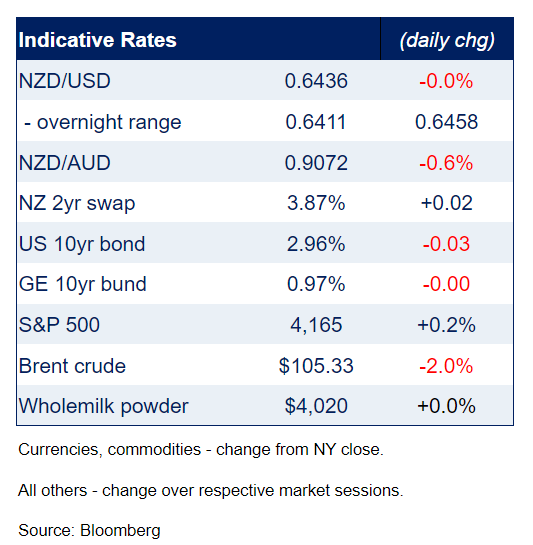
US equity markets remain choppy and currently show a modest gain, following a strong late rally yesterday. The US 10-year rate has pushed slightly lower after returning to the 3% mark. The AUD has been the best major since this time yesterday, although the net gain came ahead of a hawkish policy update alongside the RBA’s first rate hike this cycle. The NZD hit a fresh near 2-year low last night, but now shows a small gain from his time yesterday, while the RBA’s move sent NZD/AUD lower. The GDT auction was very weak.
Equity markets remain choppy, with a strong late rally in the S&P500 soon after we went to print yesterday, taking the index higher and, the index making further gains overnight. In the bond market, brokers report that real money investors bought US 10-year Treasuries after they reached the 3% mark, and they have traded as low as 2.91% overnight, currently down 3bps for the day at 2.95%. There may been some squaring up of positions ahead of the FOMC meeting tomorrow.
A lower US 10-year rate has gone against the grain of a flat Germany 10-year rate, at 0.96%, after it briefly pierced 1% for the first time since 2015, and a 5bps lift in the UK 10-year rate, playing catching to global yields after the May day holiday. Lower US rate spreads have seen the USD weaken a little, with the DXY down 0.2%. It could be another case of some squaring of positioning ahead of the FOMC tomorrow.
Economic data released have been second-tier, but getting plenty of media attention was the US JOLTS report, which highlighted the strength of the US labour market, with a record 11.5 number of available positions while a record 4.5m Americans quit their jobs in March. There were 1.9 jobs for every unemployed worker. The data comes ahead of Friday’s employment report for April, which is expected to show the unemployment rate falling to 3.5%, the low reached ahead of the beginning of COVID19. The combination of labour market tightness and inflation at a forty-year high backs the market’s view of a front-loaded tightening cycle to get the Fed Funds rate quickly up through neutral, and this is the message expected at the FOMC update tomorrow.
European unemployment data were in line with expectations, with Germany’s unemployment rate for April steady at 5.0%, and the euro area’s unemployment rate for March dropping to 6.8%, its lowest level since the euro was introduced. The data comes ahead of what is looking like a very challenging growth period for the region.
Yesterday, the RBA joined the policy tightening cycle, raising the cash rate by 25bps to 0.35%, opting to a take middle ground between the majority who expected a 15bps hike and the handful that expected a larger 40bps hike. The commentary around the move was hawkish, with a significant upward revision to inflation projections and the Bank signalling that this would require a further lift in interest rates over the period ahead. This was a big capitulation for the Bank which, for the first time, finally recognised what the market saw at least six months ago – that Australia was no different to other countries in facing significant inflation pressures and that a significant tightening cycle was appropriate. It wasn’t that long ago that the RBA thought a rate hike wouldn’t be needed until at least 2024 and only two months ago said it would be patient.
Even though the market has been well positioned for a significant tightening cycle, the RBA’s acceptance of this view was still enough to drive Australian rates and the AUD higher. The 3-year bond future is up 13bps in yield terms to 3.16% since the announcement and the 10-year rate is up 8bps. The lift in the AUD to just under 0.7150 didn’t last long and it has fallen back to its pre-RBA level of 0.7090. Still, the AUD has been the best performer over the past 24 hours, but that reflected gains well ahead of the meeting.
NZD/AUD fell from just above 0.91 to just under 0.9040 after the RBA’s announcement, breaking below the 2020 low of 0.9055 to a level not seen since 2018. The cross has since pushed higher, to 0.9070. Last night NZD/USD traded at a fresh low just above 0.6410 last night and it has since edged higher to 0.6430.
The GDT dairy auction price index plunged 8.5% at the overnight auction, more than the 2-3% expected, driven by falls across all product groups. Skim and Whole milk power prices fell 6.5%, while butter was the biggest mover, down 12.5%. The price index has now fallen for four consecutive auctions, taking the cumulative price decline to 13.4% since 1 March. Since that time, the NZD has fallen about 5%, cushioning the blow for prices in NZD terms, and the move comes after an extraordinary surge, so dairy farmers’ incomes will remain very healthy this season. Still, NZ’s soft commodities basket has been underperforming Australia’s hard commodities basket and this has been a key driver of NZD/AUD weakness over recent quarters.
Yesterday morning, Finance Minister Robertson delivered a pre-Budget speech. The key take-out for the market was some slippage in fiscal discipline, with the Government no longer expecting to reach an operating surplus until 2024/25, even though strength in recent fiscal data pointed to surpluses coming earlier than previous forecasts. This suggests a bigger fiscal splurge ahead of the next election and a larger debt issuance programme – adding to the extra debt required as the RBNZ sells its “QE bonds” back to the government.
The fiscal slippage didn’t seem to perturb the NZGB market, with rates up 2bps across the curve, more a reflection of global than domestic forces. The 10-rate closed at its highest level since 2015 at 3.71%. Swap rates were also up 2bps across most of the curve, with the 5-year rate closing at 4.0%, the highest close since the end of 2014, although it did trade above that level intraday last week. The lift in Australian rates since the NZ close could impart a further upside bias to NZ rates today.
The calendar in the day ahead is full. The RBNZ Financial Stability Report at 9am won’t likely be market moving but commentary on NZ’s housing market will be interesting amidst steadily falling prices and rising interest rates. NZ’s labour market reports soon after will be contaminated by the impact of Omicron, so the signal to noise ratio will be low, but evidence of a tight labour market and rising wage inflation should still come through.
On global releases, Australian retail sales, US ADP employment and the US ISM services index are the key releases. All this comes ahead of the FOMC meeting at 6am NZ time tomorrow morning, where a 50bps hike is well anticipated and fully priced, and timing will be given on the start of quantitative tightening, expected to begin soon. There will be more interest in Powell’s Press Conference for a sense how rapid the Fed Funds rate might need to increase and how much beyond neutral it might have to go in light of recent economic developments.
Events Round-Up
NZ: Building permits (m/m%), Mar: 5.8 vs. 12.2 prev.
AU: RBA cash rate target, May: 0.35 vs. 0.25 exp.
GE: Unemployment rate (%), Apr: 5.0 vs. 5.0 exp
EC: Unemployment rate (%), Mar: 6.8 vs. 6.8 exp.
US: JOLTS job openings (m), Mar: 11.5 vs. 11.2 exp.
GDT dairy auction price index (%): -8.5 vs -3.6 prev.
*Jason Wong is Senior Markets Strategist at BNZ. BNZ's full Markets Today report is here.
David Chaston is away on holiday.

We welcome your comments below. If you are not already registered, please register to comment
Remember we welcome robust, respectful and insightful debate. We don't welcome abusive or defamatory comments and will de-register those repeatedly making such comments. Our current comment policy is here.