

Regular readers will know we have been following bond yields more closely than usual recently.
Our last two Breakfast Briefings have noted the rise in benchmark government bond yields in major economies, like the US, China and Japan.
Overnight, even the European Central Bank signaled its next policy rate move is likely to be up.
This matters for home loan borrowers - a lot - because there has been a herd shift to floating mortgage rates, perhaps driven by mortgage broker recommendations on the basis the Official Cash Rate (OCR) will keep on falling.
But it looks increasingly like poor advice.
The strategy to take a higher floating rate now only works if you can switch to a lower fixed rate in the future.
However, fixed rates may already be at the bottom of the cycle.
And money markets are giving direct signals that they don't see any more OCR rate cuts over the next few years. Tuesday's pricing has seen the already small chance of an OCR cut virtually vanish.
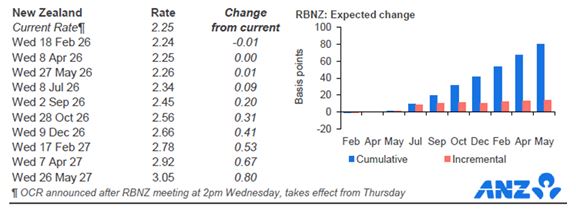
What's more, they are pricing for a 75 basis points rise over the next two to three years. True, the pricing doesn't show any rises until well into 2026. But the current 2.25% OCR could rise to over 3.00% in the next cycle.
That completely undermines the idea of accepting high floating rates now, for lower fixed rates in the future.
Worse, those rising international benchmark rates are pushing up swap rates. On Monday they jumped sharply again. Fixed mortgage rates are influenced far more by wholesale swap rates than by the OCR.
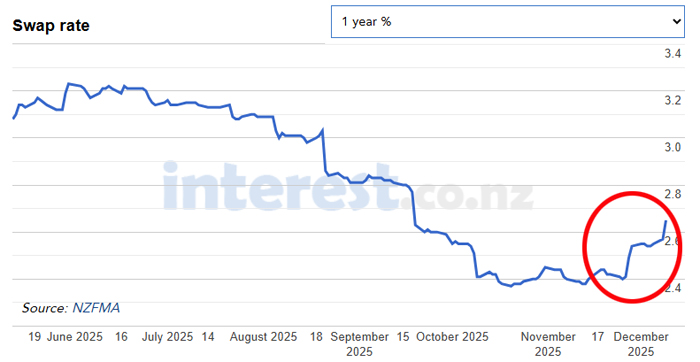
And it is these swap rates that set the cost of money for banks offering fixed rates.
It seems increasingly unlikely fixed mortgage rates will fall from here. It seems increasingly likely that they will rise.
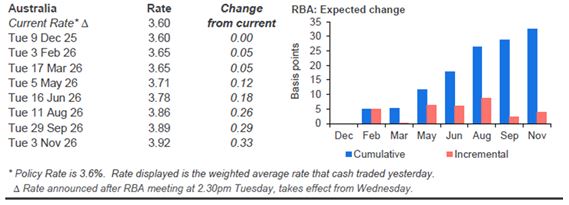
And while we are at it, we should note that New Zealand policy rate expectations priced by the money markets are far more aggressive than for Australia. They are only facing only a 30 basis points rise over the next year or so.
We welcome your comments below. If you are not already registered, please register to comment
Remember we welcome robust, respectful and insightful debate. We don't welcome abusive or defamatory comments and will de-register those repeatedly making such comments. Our current comment policy is here.