

By David Hargreaves
Lower and lower and lower go the interest rate predictions.
It's almost a given that the Reserve Bank will drop the Official Cash Rate this week - not least because the RBNZ virtually said it would - so, the key talking point is how much lower rates might go.
Kiwibank economists were the first among the major banks to suggest that the OCR, currently at a record low 2.25%, might ultimately have to go as low as 1.5%. They pick this will happen by early next year.
Now, Kiwibank's got company, with BNZ economists changing their pick for the low point from 1.75% to 1.5% also - but they think it will happen before the end of this year.
BNZ head of research Stephen Toplis said in the BNZ's weekly Market Outlook that if the RBNZ remained fully committed to pushing CPI inflation higher then it had "absolutely no option" but to cut the OCR this Thursday, pencil in at least one further reduction and commit to ongoing rate cuts if need be.
"Only then does it stand any chance of keeping the [New Zealand dollar] in check which, currently, is about all it can hope for in a world where central banks seem to have less and less impact on economic outcomes," Toplis said.
Taking all factors into consideration, Toplis said the BNZ economists believed the RBNZ would cut rates this week and then build two further rate cuts into its "central scenario".
"Anything less and the NZD will head higher still and the Bank’s credibility will be brought into question," he said.
Accordingly, the BNZ economists were are also making an adjustment to their own forecast interest rate track.
"We already had rate cuts penciled in for August and November. We are now inserting another cut into that track for the September OCR review," Toplis said.
"On this basis, we now see the cash rate troughing at 1.50% by the end of this year. By then we think it will be clearer that inflation will pick up allowing the cash rate to stabilise."
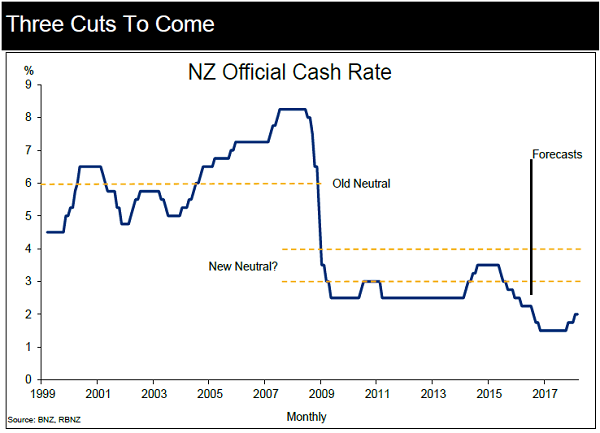
However, Toplis said the balance of risks around these forecasts should be seen as "symmetric".
"If the NZD slumps, the Fed tightens, house price inflation accelerates, the labour market tightens further and dairy prices bounce then there will be fewer rate cuts than we have forecast. If, on the other hand, the NZD stays stronger for longer, the global economy weakens and the Fed delays further then more OCR stimulus would be forthcoming."
Toplis said the BNZ economists' rationale for the timing of the rate cut track was largely tactical in nature.
"In short, if the RBNZ is convinced that interest rates need to be lower then there is no point cutting in August and then waiting until November for the second cut.
"And, then, if the Bank does cut in August and September, and still has an easing bias, the wait until February (from September) is way too long to risk delay. Hence, it will be a question of move quick, move often until such time that the Bank believes it has a modicum of control."
Some people were arguing that the RBNZ "should well and truly bite the bullet" and actually cut 50 basis points this week, Toplis said.
"We have to concede that the degree of undershoot we are seeing in the CPI argues strongly for the Bank responding in such a manner.
"The only reason we are placing a relatively low probability on this outcome is that we think this would simply be a step too far for a group of conservative policy-makers who have shown themselves to be reluctant cutters (and for good reason) in the recent past."
The BNZ economics team have long argued that rate reductions are actually not needed in New Zealand until such time as the economy shows definitive signs of slowing - and Toplis re-iterated that vieew again.
"...We are strongly of the view that rate cuts in New Zealand are having only a very modest impact on the NZD.
"The real driver is what central banks, especially the [US Federal Reserve], are doing elsewhere as evidenced by the rise and fall of the NZD last week as perceptions of the Fed changed.
"Be that as it may, the RBNZ has said that it will remain firmly committed to getting CPI inflation to the mid-point of its target band. It shouldn’t really matter to them whether this happens through lower interest rates stimulating domestic demand or lowering the NZD.
"This being so we simply have to take the Reserve Bank at its word."
We welcome your comments below. If you are not already registered, please register to comment
Remember we welcome robust, respectful and insightful debate. We don't welcome abusive or defamatory comments and will de-register those repeatedly making such comments. Our current comment policy is here.