

There is a case for the Reserve Bank to cut the Official Cash Rate (OCR) from its record low of 1.75%, says BNZ head of research Stephen Toplis.
This case, Toplis says, is based on weaker than expected inflation, a strong New Zealand dollar, and a housing market that's softer than the Reserve Bank expected.
"A purely mechanistic approach to monetary policy would now argue for a cut in New Zealand’s cash rate," says Toplis, whose criticism of the Reserve Bank courted the wrath of Governor Graeme Wheeler earlier this year.
In a speech in February last year Wheeler said the Reserve Bank avoids taking a mechanistic approach to interpreting its Policy Targets Agreement with the Government, saying a mechanistic approach could lead to an inappropriate fixation on headline inflation.
Toplis points out that at the time of the May Monetary Policy Statement, the Reserve Bank was clear in its message that there was an equal chance of a rate cut as a rate hike.
"Since that time the balance of economic data that we have received suggests that the RBNZ should be lowering its CPI inflation forecasts to levels that are not only well below the mid-point of the RBNZ’s target band [between 1% and 3% on average over the medium term] but staying there for some time."
The latest official inflation figures showed a quarterly seasonally adjusted CPI reading of negative 0.1% and an unadjusted reading of 0.0%. This brought annual inflation for the year to June to 1.7%, down from 2.2% in the March year. The Reserve Bank's own forecast of 0.3% quarterly inflation came in its May Monetary Policy Statement.
Toplis says that although much of the fall stemmed from plummeting petrol prices, because headline inflation impacts inflation expectations and wage setting behaviour it still matters.
"Also there were some other one offs, namely fruit and vege prices, which provided a partially offsetting shock. Moreover, for the first time in seven quarters, the RBNZ’s, somewhat esoteric, but preferred, core measure of inflation (the sectoral factor model estimate) fell. Not only did it fall but at 1.4% it’s well shy of the 2.0% target. To cap things off, it seems to be a measure that is hard to budge with the annual reading having been in a range of 1.2% to 1.5% for 22 quarters," he adds.
"Assuming no reversal of the 'shocks' that impacted the second quarter’s outturn, the RBNZ’s annual CPI inflation projection would fall to 0.7% by March 2018."
Meanwhile, the Kiwi dollar has again “misbehaved," with the Trade Weighted Index (TWI) at 79.16, 4.5% above the level assumed for the September quarter by the Reserve Bank.
"Our back of the envelope calculation combining both the starting point adjustment and the currency impact, and excluding all other factors, would produce a new RBNZ track something like that in the graph below," says Toplis.
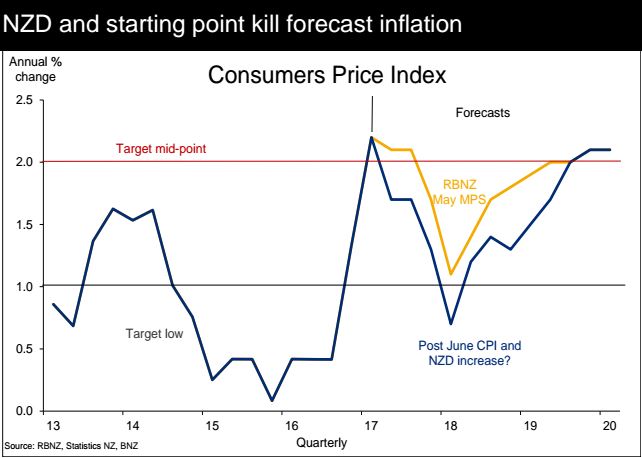
This, Toplis argues, provides room for the Reserve Bank to justify cutting the OCR.
"But it doesn’t end there. The spread between lending rates and the OCR have been widening suggesting that the RBNZ has witnessed a tightening that it didn’t deem necessary. This adds to pressure for an offsetting rate cut."
"And last but not least, the housing market must surely have softened more than the RBNZ had assumed when it put together its May forecasts. This may, or may not, matter in a strict inflation outlook sense but we, amongst others, have argued that rampant house price inflation would restrict the RBNZ’s ability to cut rates if for no other reason than the threat to financial stability that such a cut would generate. While one can still argue that house values are too high, the argument for not cutting because of the state of the housing market is diminished," Toplis says.
The Reserve Bank next reviews the OCR on August 10 when it's also due to issue a Monetary Policy Statement.
We welcome your comments below. If you are not already registered, please register to comment
Remember we welcome robust, respectful and insightful debate. We don't welcome abusive or defamatory comments and will de-register those repeatedly making such comments. Our current comment policy is here.