

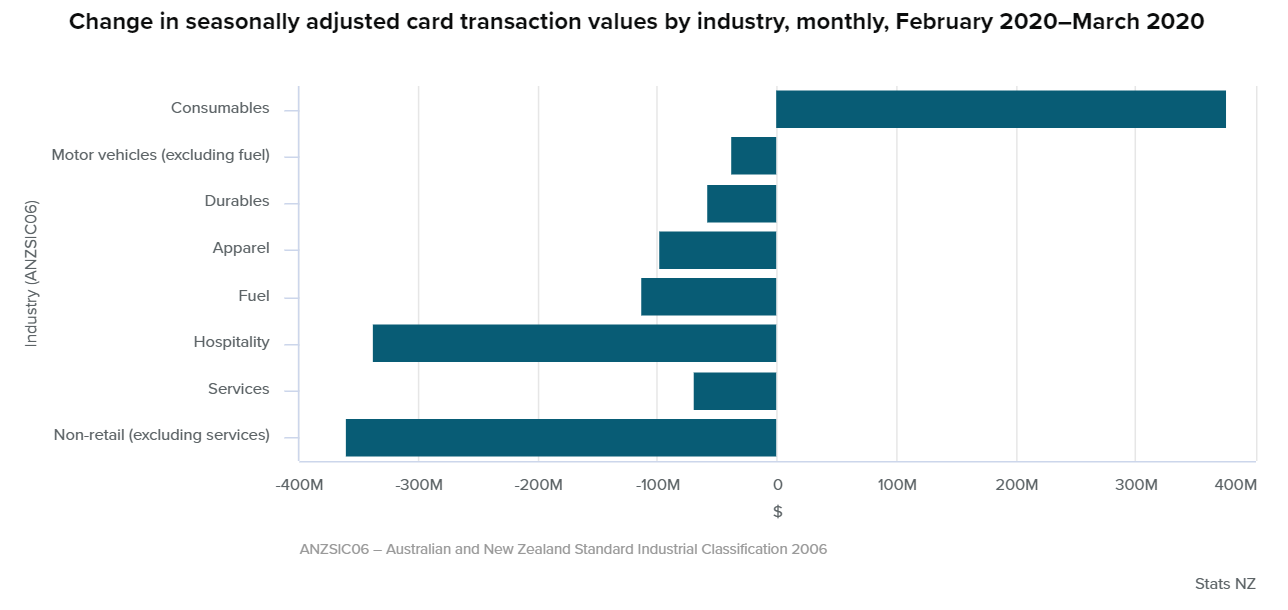
If it feels like you've been spending a lot at the supermarket recently - well, you have. Statistics New Zealand reports that food and grocery spending rose a massive $376 million (17%) on a seasonally adjusted basis last month.
Stats NZ's retail statistics manager Sue Chapman said groceries had record high sales in March and the increase was the largest dollar value and percentage increase in grocery sales since the retail card spending series began in 2002.
"Supermarkets remain open as an essential business and there have been widespread reports of people stocking up on food as the month progressed," she said.
But as you might imagine, with the lockdown kicking in late in March, the good news pretty much began and ended with the supermarkets.
Total retail sales fell $231 million (3.9%) in March 2020, after adjusting for seasonal effects. And this was the biggest fall on record in both percentage and dollar terms.
ASB senior economist Mark Smith said that picking what the precise movement in the March figures would be "was always going to be a lottery".
"That said, the 3.9% reported fall in March was more than we had expected. Movement in many of the industry categories was extreme."
He said April figures will likely be weaker still for non-essential retail not able to benefit from online purchases.
"With social distancing expected to remain and with the household sector facing sizeable job losses, weakened incomes and balance sheets, it will take a while for the retail sector to rediscover its mojo."
Back on the detail of the figures - spending on eating out and accommodation plunged more than $300 million or almost one-third in March in the wake of measures to slow the spread of COVID-19.
“Efforts to slow the spread of COVID-19 in the last couple of months led to the closure of all non-essential businesses and people were told to stay at home from midnight March 25,” retail statistics manager Sue Chapman said.
“This hit hospitality hard. Restaurants, cafes, and bars, as well as hotels, motels, and other accommodation, saw sales drop sharply.”
Spending on hospitality fell the most of any retail industries in dollar terms, with $338 million (30%) less spent on eating out and staying in hotels and motels.
“Hospitality was also affected by fewer international visitors due to travel restrictions since February,” Ms Chapman said.
“The border restrictions came into effect from midnight 19 March to almost all travellers, except returning New Zealanders,” she said.
Fuel spending was down $113 million (19%). This coincided with both the drop in pump prices in the month and lower volumes sold due to New Zealand moving into the COVID-19 Alert System from 21 March, which restricted all non-essential travel.
Sales of clothes and shoes (apparel) fell $98 million (31%).
Furniture, hardware, and appliances (durables) sales were down $57 million (3.9%) and motor vehicles were down $38 million (20%).
Core retail spending (which excludes vehicle-related industries) decreased 1.5% in March 2020, after a 0.7% rise in February.
The total value of electronic card spending, including the two non-retail categories (services and non-retail) was down 8.7% in March 2020, after a 0.4% rise in February.
The largest decrease was non-retail (excluding services), which includes travel, gambling, and wholesale. This industry was down $359 million (20%).
In actual terms, retail spending using electronic cards was $5.7 billion, down $103 million (1.8%) from March 2019.
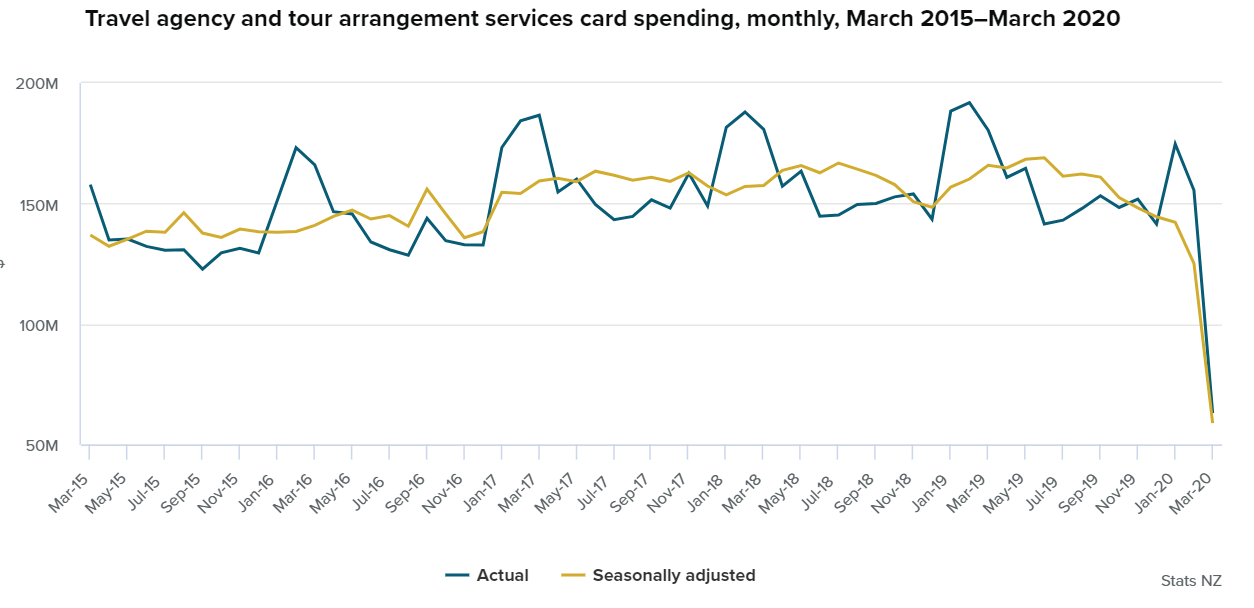
For the first time, Stats NZ published "lower-level card spending data" including the travel and tour arrangement industry to help New Zealanders assess the impact of COVID-19.
Card spending on travel fell 53% ($66 million) in March 2020, in the wake of international and domestic travel restrictions to slow the spread of COVID-19. This fall is three times bigger than the previous largest drop in January 2008 when spending fell 12 percent ($21 million).
We welcome your comments below. If you are not already registered, please register to comment
Remember we welcome robust, respectful and insightful debate. We don't welcome abusive or defamatory comments and will de-register those repeatedly making such comments. Our current comment policy is here.