
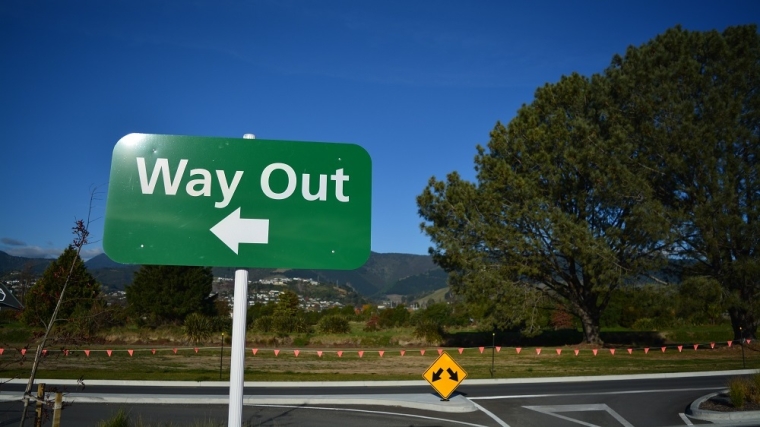
As the door to New Zealand creaks open after being slammed shut two years ago the country faces a rather pivotal period.
The big question will be: Which way will most of the human traffic be heading when it comes to long-term migration over the next year or two? Will people be coming through the 'In' door or heading for the 'Exit'?
It's not just a matter of interest. It's a matter of vital economic importance.
Consider the NZ domestic situation. Since the border was shut we've seen house prices rise in the order of 40%. We've seen unemployment shrink to just 3.2%. Labour shortages abound. Wage pressures are building.
Theoretically what should be seen as things open up is a return of the inflow of migrants, with particular emphasis on those that can fill industries with the most glaring staff shortages - and dairy is one that comes to mind.
But it's not that simple. For a start we presume that lots of people want to come here and live. That might turn out to be the case, particularly as thoughts in the other side of the world now turn to for the first time in years to war and even the unthinkable 'big bang'. But it might not prove to be the case. We shall have to wait and see.
And then what will the Government's attitude be? It has indicated thus far it doesn't want things to simply return to how they were before the border shut.
Work is under way on the whole migration issue.
The Productivity Commission has been asked to look at immigration settings and is well under way with that work, having already released some preliminary findings. Its final report to the Government is due in April.
Inevitably though the Government will come under immense pressure (it's already building) to open the floodgates and allow industries to fill jobs with migrants. And with unemployment at such barely existent levels and with industries generally stressed by staff shortages, it will be hard to say no.
So, the resolve of the Government will be interesting to see.
What about the other side of the migrant equation though? How many people will want to leave?
Economists at the country's largest bank, ANZ, were suggesting this week that the reopening of New Zealand's border could see "a large net outflow of Kiwis" during the rest of this year. And they think that with likely continuation of a strong Australian labour market a net outflow of something in the order of 20,000 people across the ditch would be "consistent with previous flows" when the labour market across the ditch was last as strong as the economists are expecting.
Why might people want to leave NZ in big numbers? Well, the housing market could be a big factor. If young people see good jobs going across the Tasman and think they might be able to get into their own houses more easily when compared with in our own stratospheric market, then why wouldn't they want to go?
After all, we have been here before during times when the grass has looked greener on the other side.
Obviously if a lot of people did suddenly decide to make the move to Australia, there would be major consequences. First, it would put even more pressure on our super tight labour market. Second, potentially a lot of upward pressure would be removed from New Zealand's housing market. And this at a time when the market is rapidly sobering up after its two-year buying bender.
If large numbers of this country's great and good do start heading for the exits then I'm sure the fact New Zealand's housing market has become so rarified will be a major factor. And it will be a crying shame if this leads a big number of people to desert.
But who would blame them?
People have to do what is best for them and their future and if significant numbers of Kiwis decide the future is better offshore then what would we do about it?
Of course, as I've said before the easy fix for any Government here if we start to get a major outflow of people is to start encouraging more inbound migration.
It seems to me that we will likely already be seeing the dynamics of an open border and whether there's an exodus of people beginning before the Government's made any substantive decisions on immigration settings.
What therefore may well likely happen is that we will see policy on the hoof reacting to the actual movements in migration - rather than a considered policy that looks at what the ideal settings might be for the country's future.
And frankly, given how our migration policies have run in the past, that would be no great surprise. But it would be a huge pity given that we've had this two year 'window' when there's been negligible migration movement and a chance to sit down, have a cup of tea and actually assess what we want as a country from a migration policy.
Because, surely, a migration policy should be seen in the context of a broader population strategy and should consider the long term objectives of New Zealand. And not be driven by the short term consideration of which industries are going to be short of staff next week, etc.
Anyway, we will start to find out soon enough which way the human tide is going following the border opening.
Absent a proper population strategy and a well thought out approach to migration - which I think it's now already too late for us to achieve in the near term - I would hope at least that the Government does watch very closely what happens.
It is to be hoped that if we do indeed need polices that are reactive to the emerging migration trends that these will at least be policies that give proper consideration to the economic performance in the future and to just exactly what sort of country we want in the years ahead. Let's not just have short term fixes, please, that's how our migration policies have been run for many years.
I confess to not really having a clue what the big migration trend will be over the next year or two. It may be the feared exodus. It may be that there will be lots of people wanting to come here.
Either way, we should as a country to be ready. I fear that we aren't.
We've had two years of closed borders that have given us time to prepare for the reopening.
But when it comes to it all that's happening is that we are opening the doors and hoping for the best.
So, fingers crossed. And, no, 'fingers crossed' is not a strategy. But it's what we've been left with in the absence of a strategy.
*This article was first published in our email for paying subscribers. See here for more details and how to subscribe.
We welcome your comments below. If you are not already registered, please register to comment
Remember we welcome robust, respectful and insightful debate. We don't welcome abusive or defamatory comments and will de-register those repeatedly making such comments. Our current comment policy is here.