

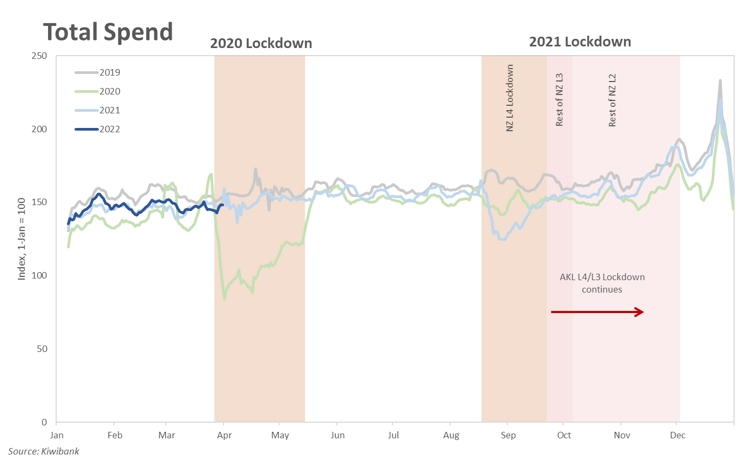
Household spending in the March quarter was especially weak, say Kiwibank economists. And the signs are that rising costs and a weaker housing market will dampen consumer spending as the year goes on.
In the latest quarterly release of spending data from Kiwibank customers, Kiwibank chief economist Jarrod Kerr, senior economist Jeremy Couchman and economist Mary Jo Vergara said household consumption has been a key source of economic momentum since the recovery after the first lockdown in 2020 took shape.
"But rising prices, rising interest rates and a housing market in retreat eat into households’ discretionary spending. And weaker consumption points to weaker economic growth," they say.
Consumer spend was weak over the March quarter for a variety of reasons, the economists say. This included seasonal weakness, payback from the Delta lockdown rebound, and the Omicron outbreak. The deepest decline in spending was seen in high -contact services including retail, hospitality and entertainment.
"Beyond the March quarter, household consumption faces several headwinds as budgets are stretched thin by rising inflation, rising mortgage rates, falling house prices and recent revisions to regulation."
Kiwibank electronic card spend fell 9.1% in the first quarter of 2022. However, the economists point out that spend over the March quarter is "typically soft" as it follows a surge over the holiday period.
"However, the March quarter this year was especially weak. It’s payback for the massive spend-up over the Dec-21 quarter as Auckland exited lockdown."
The Kiwibank economists say a "rampant" housing market has underpinned much of the strength in housing-related spending.
"However the market is cooling, and spend dropped 22% over the March quarter. Seasonality may explain the pullback. However several surveys over the March quarter revealed weakening consumer confidence as households face the Omicron outbreak, rising mortgage rates and rising inflation. Today’s climate is not ideal for splurging on big ticket items."
They say another culprit for weak spend may be the stricter consumer credit legislation (CCCFA) that’s binding new bank lending.
"For households in pursuit of a mortgage (or wishing to top up), changes to the CCCFA ultimately mean cutting back on spending. No more new pools, new furniture, or new pets.
"The new responsible lending rules have been hard to swallow. Given the backlash, the Government has tweaked the rules so that going through past expenses with a fine tooth comb is no longer necessary. These changes are expected to come into effect by the second half of the year, at the earliest. We are unlikely to see a meaningful change in spend behaviour until then."
The economists noted, however, that flight bookings climbed a massive 80% over the quarter.
"There’s pent up demand to venture beyond our four walls. And the decision to leave has been made easier with the removal of MIQ. The ability to return home without the need to enter managed isolation may explain the sudden surge in bookings."
Looing ahead, the economists note that there's a price and wage growth "mismatch".
"Inflation is at a 30-year high and a 7%+ peak looks increasingly likely by the day. But at 2.5%, wage growth is not keeping up with the rapid rise in living costs.
"Kiwi households are seeing their real incomes being eroded. A more expensive shopping trolley eats into disposable income, making budgeting that much more difficult. And inflation hurts more for those who don’t have as much wriggle room.
"Households on low or fixed incomes are disproportionately affected, as food and fuel typically make up a larger share of their budget. With prices expected to continue rising in the near-term, households will be forced to tighten their belts and shorten their shopping lists."
And then there's rising interest rates...
"In the face of rising inflation, the RBNZ has hiked the cash rate [OCR] to 1% in successive moves. And fixed mortgage rates have lifted in lockstep. We see another 150bps of hikes in the pipeline for the cash rate this year (to 2.5% by November).
"All mortgage rates have further to rise. Most rates will be 2-2.5%pts higher than the lows seen early in the Covid crisis. A strong labour market, however, ensures households are still capable of making good on their mortgage and rent payments. But there’s little doubt that a more expensive bill will also squeeze discretionary spending."
And finally, there's the "weaker wealth effect"...
"Following unsustainably high house price growth last year, the housing market is now in full retreat," the economists say.
"February marked the third consecutive month of house prices in decline. And we expect a cumulative 5% decline by the start of 2023.
"Housing, however, is the single largest form of wealth among Kiwi. Households also consume some of the capital gains generated in the good times in the form of mortgage top-ups or by downsizing and crystalising gains.
"But a cooling market, as is the case today, adds another dampener to consumer spending. Falling house prices and tighter lending rules are not supportive of borrowing and spending."
We welcome your comments below. If you are not already registered, please register to comment
Remember we welcome robust, respectful and insightful debate. We don't welcome abusive or defamatory comments and will de-register those repeatedly making such comments. Our current comment policy is here.