
The Reserve Bank (RBNZ) may have to lift the Official Cash Rate higher than earlier thought if the labour market doesn't show some sign of loosening soon, ANZ economists say.
At the moment the OCR is at 3.5% and is widely expected to be raised another 75 basis points on November 23 in the next review.
ANZ economists say in their latest Quarterly Economic Outlook that their current prediction is for a peak in the OCR of 5% next year.
But they say, while they do expect CPI inflation to slow from the 7.2% level seen as at the September quarter, they still see "significant upside risk" to the domestic inflation outlook.
"If the labour market doesn’t show signs of loosening soon, the OCR will very likely need to go higher than the 5% peak we’ve pencilled in.
"...While our forecast is that a 5% OCR will get the job done, the potential for ongoing positive inflation surprises (particularly via labour costs) shouldn’t be discounted.
"Indeed, the [September quarter] read on the labour market was worryingly tight, with records broken all around and recent business survey data from the NZIER’s Quarterly Survey of Business Opinion showing labour as a limiting factor ratcheting up to record levels in Q3."
For the RBNZ to unlock "inflation target achieved" status, they need softer domestic demand to translate into softer demand for labour, the economists say.
"Without that, the wage-price spiral continues, core and domestic inflation pressures remain too high, and the OCR will need to be lifted even higher."
That’s exactly how the data have evolved over the past 18 months or so, they say.
"And we’re not yet convinced domestic and core CPI inflation has stopped surprising on the upside."
Wage growth is where "the rubber meets the road" for the "sticky domestic inflation pulse", the economists say.
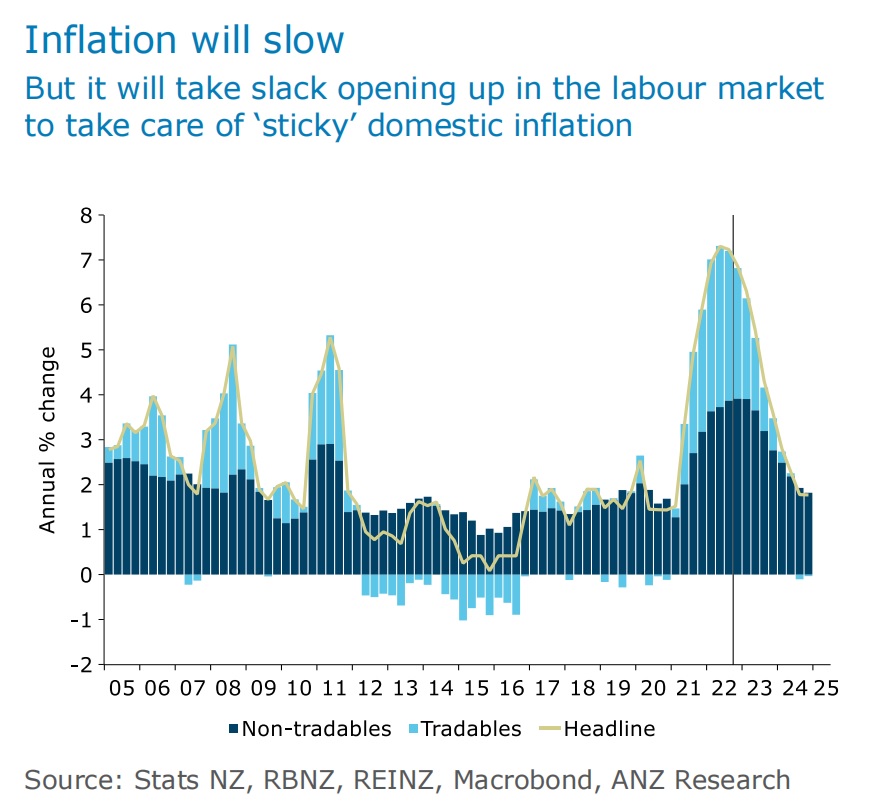
"And with average hourly earnings surprising all forecasts in Q3 at a record high of 8.6% y/y the RBNZ should be worried about just how developed the wage price spiral has become.
"Some large retail-sector wage settlements of late have been well into double digits, and have the potential to be the new benchmark for upcoming negotiations."
The ANZ economists say it is important to note that "not all wage growth is created equal".
"At one end of the spectrum you have wages chasing their tail: that’s when higher wages lead to higher prices, which then get factored into wage negotiations.
"This is the end of the spectrum you don’t want to be in, as while wage growth in this scenario is good insofar that it prevents inflation from eroding real household incomes, the improvement in real incomes is likely to prove fleeting as inflation persists at high rates.
"But that is unfortunately a fair description of the current wage-price spiral dynamics we are seeing.
"At the other end of the spectrum, you have wage growth driven by improving labour productivity. In this case, a given amount of labour input yields higher output for businesses, who can then afford to pay a higher wage, while not having to increase their prices.
"Households get the benefit of higher wage growth without the self-defeating flow-on effect on inflation eating that up. But while improved labour productivity would be a wonderful thing right now, it’s not an easy thing to generate.
"In fact, productivity has taken something of a hit in the wake of the pandemic, and that’s just made the inflation problem worse."
While CPI-adjusted income is now back in positive growth territory, many households out there will be finding the rising interest rate environment a significant challenge, the economists say.
"Indeed, any household with a high debt-to-income ratio will find it relatively hard to hide from the impact of rising rates, with strong income growth providing only a partial offset. And given typical re-fixing lags, the peak impact for these households is yet to come."
But so far, there is little evidence to suggest that a "meaningful lift" in forced house sales is underway, they say.
"In fact, new listings data for October were unseasonably weak, suggesting potential sellers are choosing to wait it out.
"All else equal, this will be keeping growth in inventories contained (as house sales slow), keeping the market tighter than otherwise and preventing prices from falling as much or as fast as they would if listings were higher.
"It’s all been a very orderly adjustment so far, with very little blood on the floor. While around 2% of households are currently in negative equity, these remain, on the whole, paper losses."
But for house prices, there’s still no escaping the fundamentals, the economists say.
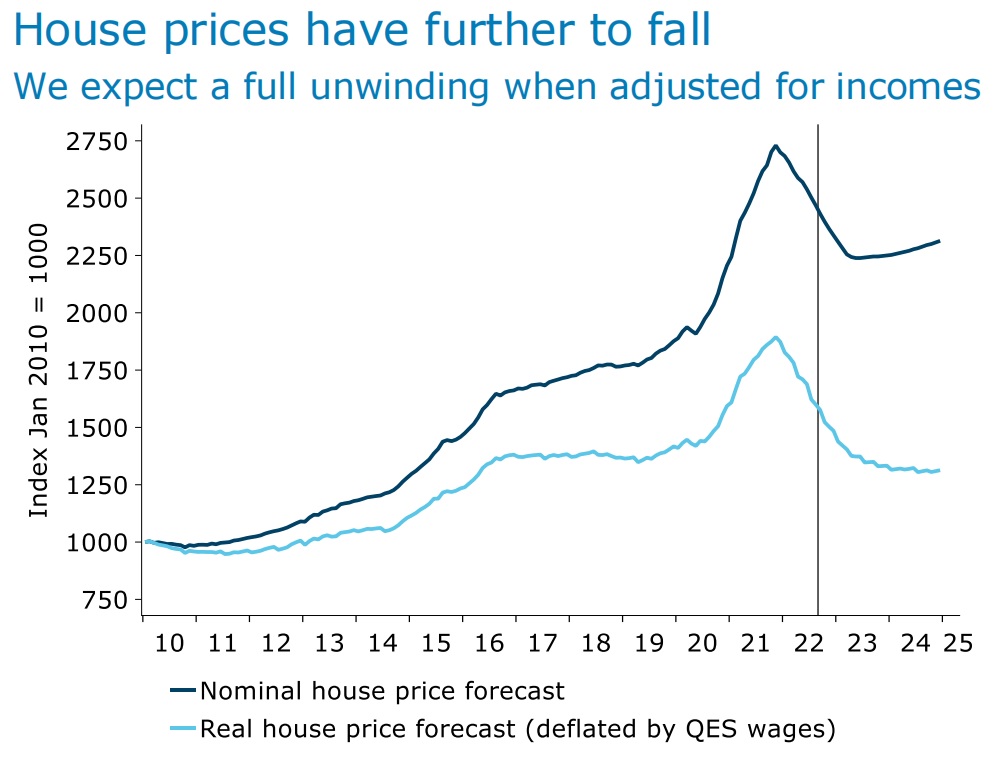
New housing supply is much higher than new demand, housing inventories are at a six-year high, affordability (as measured by house prices relative to incomes) still has a long way to go to get to half-respectable levels, and debt-servicing costs are still lifting.
"We see this culminating in around a 18% peak-to-trough decline in house prices, or 27% when deflated by [Quarterly Employment Survey] wage growth.
"In income adjusted terms, that’s a full unwinding of the pandemic stimulus / FOMO [fear of missing out] driven bump."
Whether or not New Zealand avoids recession remains a line ball call, the ANZ economists say.
"But it’s important to note that not all recessions are created equal.
"A recession that brings about a transition from the currently over-stretched economy towards sustainable expansion, while also avoiding a significant household income shock, may not be as bad as the R-word sounds, particularly from a long-run economic stability perspective.
And if it means squashing the current wage-price spiral before it necessitates even more aggressive action by the RBNZ, then it may be a cost worth paying.
"One way or another, the economy needs to find its way to a sustainable path. Price (and economic) stability is at stake, and so too is very hard-won central bank credibility. Hopefully a 5% OCR is enough to get the job done."
We welcome your comments below. If you are not already registered, please register to comment
Remember we welcome robust, respectful and insightful debate. We don't welcome abusive or defamatory comments and will de-register those repeatedly making such comments. Our current comment policy is here.