

Retail sales by volume have dropped for the third consecutive quarter, according to Stats NZ. The result was considerably worse than economists had expected.
The seasonally-adjusted 1.0% fall in volume of sales (these figures take out inflation) for the June quarter follows drops of 1.6% in March and 1.1% in December. Both the latter two figures have actually been revised down (IE the falls are bigger than earlier indicated) by Stats NZ.
But poor as these figures are, they would have been worse without a surge in motor vehicle sales (up 3.7%) as customers scrambled to beat the changes to the Clean Car Discount Scheme from July.
Sales volumes in the 'core' retail industries, excluding motor vehicles and fuel fell 1.8% on a seasonally-adjusted basis in the June quarter - following falls of 1.6% in March and 1.7% in December.
Comparing the June quarter volume figures with those for the same quarter in 2022 shows an annual fall for the all-industries figure of 3.5% and a fall of 5.1% for the 'core' industries.
Westpac senior economist Darren Gibbs said the retail figures highlighted that financial pressures are continuing to eat away at households’ purchasing power, with the value of total spending also declining despite very strong population growth and a recovering tourism sector. He said that excluding the pandemic period, per capita spending fell to its lowest level in four years.
"Spending volumes are dropping sharply as rising prices squeeze households’ finances," he said.
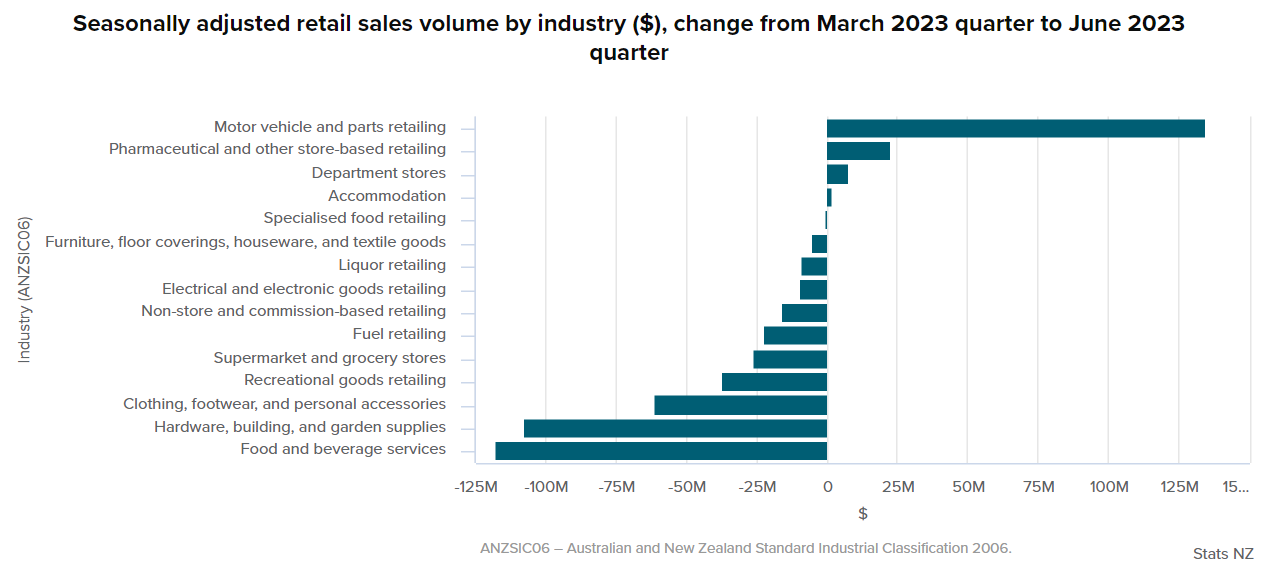
By industry, big contributions to the latest quarterly fall came from:
- food and beverage services – down 4.4%
- hardware, building, and garden supplies – down 4.8%
- clothing, footwear, and personal accessories – down 4.8%
- recreational goods retailing – down 4.8%
Eleven of the 15 industries had lower seasonally adjusted sales volumes in the June 2023 quarter compared with the March 2023 quarter.
Measuring the volumes of sales as against just the value removes the impact of inflation from sales data and therefore gives a clearer picture of levels of spending.
Other highlights in the latest quarterly figures were:
- total volume of seasonally adjusted retail sales was $25 billion, down 1.0%
- total value of seasonally adjusted retail sales was $30 billion, down 0.2 % ($60 million)
- total value of actual retail sales was $29 billion, up 2.5% ($725 million), compared with the June 2022 quarter
The latest retail sales figures would indicate a continuation and certainly, arguably, intensifying of the slowing in spending that the Reserve Bank (RBNZ) is looking for as it attempts to take heat out of inflation, which has been falling, but was at an annual rate of 6.0% as of the March quarter. And within this, domestic generated inflation was looking very 'sticky' at 6.6%, down only from 6.8% as of the March quarter.
The RBNZ has since October 2021 increased the Official Cash Rate at unprecedented speed, taking it from just 0.25% to the current 5.5%. This has led to mortgage rates now, in many instances, of over 7%. The intent of all this is to reduce spending and take the heat out of the economy. Clearly, spending is reducing.
Westpac's Gibbs said with around $15 billion of fixed mortgages repricing at higher interest rates each month, the pressure on households’ finances will continue to build.
"Unfortunately for households, as the Reserve Bank made clear last week, interest rates are likely to remain at or above current levels for some time yet, and certainly until inflation is much closer to returning to the midpoint of the 1-3% target range.
"While we had anticipated a soft result, today’s figures are weaker than we had expected. Nonetheless, after two quarters of contraction, we continue to estimate that the economy rebounded somewhat in the June quarter, led by what is likely to be a short-lived lift in export volumes. Even so, annual growth in the economy is very likely to have continued to slow in the June quarter and will almost certainly slow further in the September quarter."
ASB senior economist Kim Mundy said 2023 is shaping as a very challenging year for the retail sector.
The consumer backdrop is very muted "and spending has declined faster than we had anticipated" over the first half of the year.
The second half "is likely to be even more challenging for consumers and, by extension, the retail sector".
"Household savings buffers have been eroded, wage price inflation is cooling and by our estimate there is at least another 50bps of [Official Cash Rate] tightening to work its way through the system, despite our expectation that the RBNZ will leave the OCR on hold at 5.5% for the rest of this year," she said.
"As a result, there are few bright spots, but the earlier than expected turn in the housing market is the most notable. Nevertheless, at this early stage it looks like the housing market will turn gently and, on its own, is unlikely to offset the numerous headwinds facing the sector. At the very least, a per-capita consumption recession is likely to remain in play over the remainder of 2023."
We welcome your comments below. If you are not already registered, please register to comment
Remember we welcome robust, respectful and insightful debate. We don't welcome abusive or defamatory comments and will de-register those repeatedly making such comments. Our current comment policy is here.