
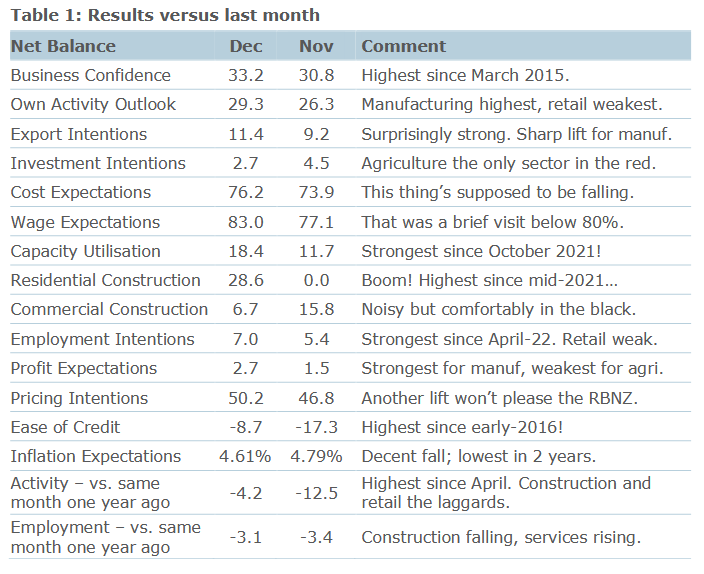
The last monthly ANZ Business Outlook Survey for the year paints a very mixed picture of rising business confidence, rising activity levels and falling inflation expectations.. but rising cost expectations and rising pricing intentions.
"The vast majority of indicators lifted. Inflation expectations took a decent step lower, but the proportion of firms expecting higher costs or intending to raise their prices both rose," ANZ chief economist Sharon Zollner said.
"Indeed, pricing intentions are the most reliable lead indicator for inflation of late, and they have stopped falling in recent months.
"If pricing intentions had continued on their previous downward trajectory they’d be rapidly approaching ‘normal’ ranges by now, but instead they’re currently looking a bit stuck at a level consistent with CPI inflation well above the [1% to 3%] target band.
"Specific numerical estimates of where firms’ own selling prices will be in three months’ time were slightly higher and in fact has been going sideways for six months. The data is clearly inconsistent with annual inflation anywhere near the 2% [inflation] target midpoint, and the stall in the downward trend is not encouraging."
Zollner said the Reserve Bank (RBNZ) has made it clear that they have "zero tolerance" for more delays in bringing inflation down.
"There’s a lot more data to come between now and the [RBNZ's] February OCR [Official Cash Rate] decision, but this survey read won’t be one of the [RBNZ Monetary Policy] Committee’s favourites."
Westpac senior economist Satish Ranchhod said the expectations of higher cost and intentions to increase prices were "worrying signs".
"Those continued cost and price pressures chime with comments we’ve heard from our own business contacts who have reported that operating cost pressures remain firm," Ranchhod said.
"In many cases, they’ve also told us it’s become harder to pass cost increases into output prices. We expect that continued pressure on operating costs will mean that domestic inflation eases only gradually over the year ahead.
"Overall, while confidence is up, we’re still left with a picture of limited momentum in economic activity and lingering inflation pressures."
In other results in the survey, business confidence continued its post election surge, hitting its highest level since March 2015. Business confidence rose 2 points to +33 and expected own activity rose 3 points to +29.
One standout feature in the survey results was a big surge in residential construction intentions, taking these to the highest level since mid-2021.
ANZ's Zollner said this was "startling, and suggests that dwelling consents (and before long, residential construction) are about to find a floor, so to speak".
The survey asks additional questions every three months, including what firms’ largest problems are.
"Finding skilled labour still rates as firms’ largest problem. However, the share of problems that are inflationary continues to decline, while the disinflationary problems of low turnover and competition are growing.
“We also ask firms every three months what is driving their investment decisions. Of those firms who are intending to increase their investment, far fewer are doing it to replace hard-to-find labour, and more are investing due to the economic outlook.
“Of those intending to invest less, wariness about the domestic economic outlook is still highest on the list," Zollner said.
She said the New Zealand economy has "certainly been through a very rough patch", as amply demonstrated by the much lower third quarter GDP outturn than expected, and significant downward revisions to past GDP as well.
"However, the ANZ Business Outlook survey suggests the outlook is improving – and the backward-looking questions suggest that experienced activity may also be past the worst.
"The rebound in residential construction intentions is particularly striking, suggesting consents may soon start lifting meaningfully. Things are clearly very weak on a per capita basis, but population growth of more than 2½% does put a floor under how far aggregate activity can fall.
“The RBNZ noted that the surge of workers had had a disinflationary impact on the labour market, but that the demand-side pressures were still playing out and could cause inflation to hold up longer than anticipated.
“The inflation indicators in the survey were mixed at best, which is not encouraging data for the inflation outlook.
“While GDP data showed the RBNZ has gotten a lot more traction than they knew last month, and that’s very important, it’s also important to remember that a recession was their plan, and that the question of how much pain is needed to get inflation all the way down to 2% isn’t in fact settled," Zollner said.
We welcome your comments below. If you are not already registered, please register to comment
Remember we welcome robust, respectful and insightful debate. We don't welcome abusive or defamatory comments and will de-register those repeatedly making such comments. Our current comment policy is here.