

Air New Zealand [AIR] is facing potential pre-tax losses across the current year and next year totalling over $500 million, according to Forsyth Barr analysts.
Forsyth Barr's head of research Andy Bowley and associate analyst Hugh Lockwood have estimated those losses in their latest report on Air New Zealand and in which they take a detailed look at the problems the airline - which was already loss-making - is facing as a result of the Middle East crisis.
Our national airline does 'hedge' its fuel costs, but is exposed to what's known as the 'crack spread'. Air New Zealand's jet fuel pricing is made up of two elements, Brent Crude (the underlying crude oil price) and this 'crack spread', which is the refinery margin (the difference between crude oil and the price of refined jet fuel).
The Forsyth Barr analysts say the airline's fuel bill has "increased materially" over the past three weeks.
"The lagged nature of its jet fuel contracts means cash costs have only modestly lifted to date but will likely increase materially into April. Our scenario analysis suggests that even the best-case outcome for FY26 [full-year 2026] is still significantly worse than the previous fuel cost guidance issued at the 1H26 result last month.
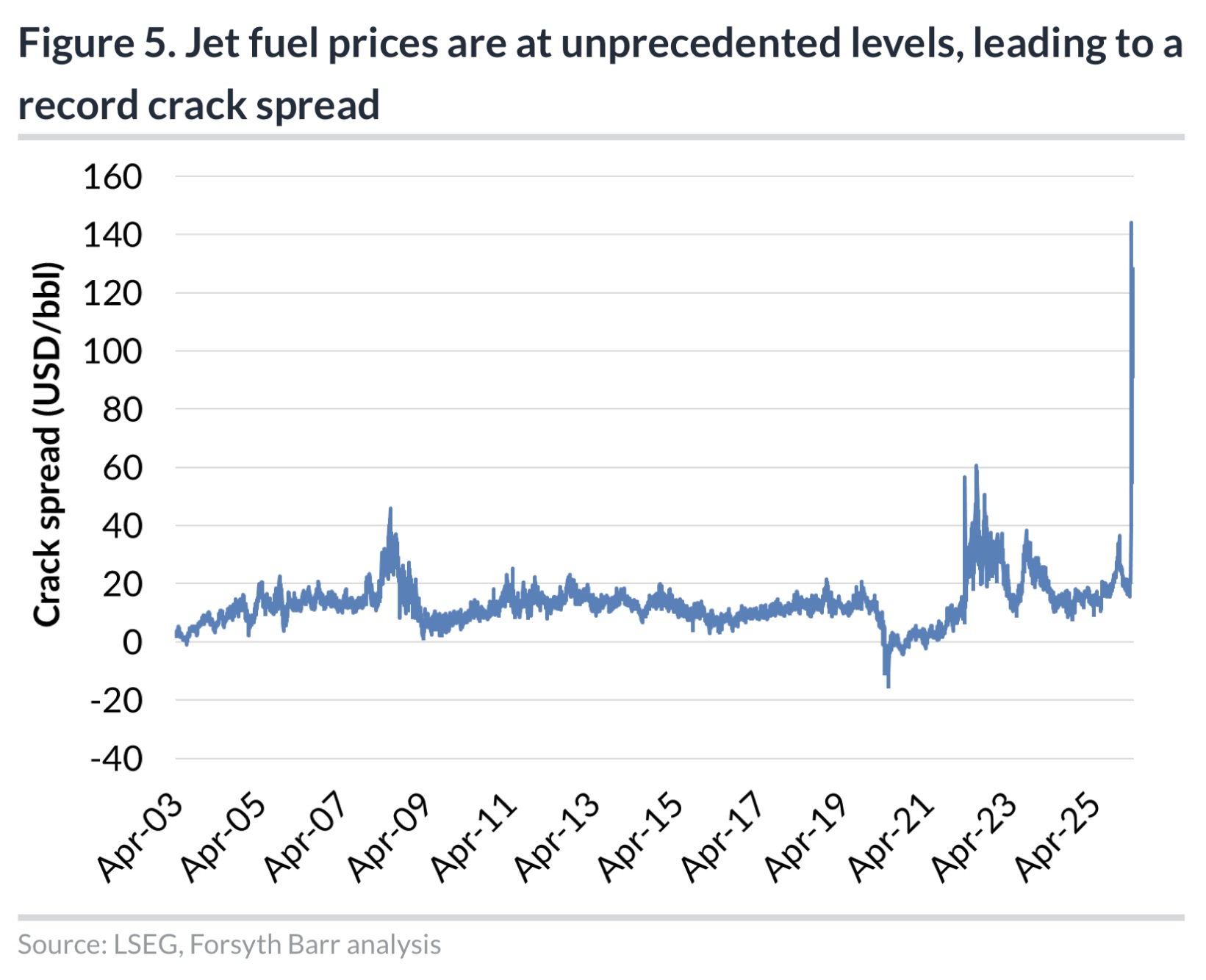
Air New Zealand recently reported an after-tax loss of $40 million (pre-tax loss $59 million) for the first half of the year (compared with a profit of $89 million for the first half of 2025) and warned that the second half results could be even a little worse. But it has now withdrawn this guidance. The company had already indicated it was undertaking a "strategic review".
Bowley and Lockwood estimate Air New Zealand's pre-tax loss for the year to June 30, 2026 will be $314 million with an 'underlying' after-tax loss of $226 million.
For financial year 2027 the estimate is a pre-tax loss of $206 million (underlying after tax loss of $148 million). The analysts see a return to modest profitability in 2028 with a pre-tax profit of $57 million ($41 million after-tax).
"The longer fuel prices stay higher, the bigger the losses [the airline] will be exposed to in FY26 and FY27," the analysts say.
They say Air New Zealand's balance sheet was "already beyond the top end" of its target gearing band - and they say this will be stretch much further.
However, they say the airline is is not exposed to debt covenants and should have ample near-term liquidity given the lagged impact of higher fuel costs and the propensity for brought-forward demand supporting current forward bookings.
"Moreover, balance sheet support may come in the form of capex flexibility ahead of a return to profitability, before the need for any additional capital."
The analysts have lowered their 12-month 'target' share price for Air New Zealand to 35c from 50c (price on NZX as of Thursday was 44.5c) and maintain an 'underperform' rating.
We welcome your comments below. If you are not already registered, please register to comment
Remember we welcome robust, respectful and insightful debate. We don't welcome abusive or defamatory comments and will de-register those repeatedly making such comments. Our current comment policy is here.