

Has the Financial Markets Authority (FMA), born 15 years ago to succeed the discredited Securities Commission, come full circle?
The FMA launched in 2011 under the oversight of Commerce Minister Simon Power and FMA Establishment Board Chairman, and high profile fund manager, Simon Botherway. It rose, phoenix like, out of the ashes of dozens of finance companies and the Securities Commission's failure to prevent that sector's near wipeout, which took the savings of hundreds of thousands of ma and pa retail investors with it.
Given that backdrop, the FMA's key initial task was to restore retail investors' confidence in the capital markets after, as Tony Molloy QC put it, finance company investors had been treated as prey.
With effervescent New Zealand Shareholders' Association founder Bruce Sheppard also on the Establishment Board, it did feel like there was a focus on retail investors. Inaugural FMA CEO Sean Hughes was accessible, made the right noises, and took the blame when the Ross Asset Management Ponzi scheme unravelled in 2012.
Hughes was succeed by Rob Everett in 2014. During Everett's tenure the FMA's responsibilities grew significantly including through the rollout of the Financial Markets Conduct Act. It also took on oversight responsibilities for the Financial Service Providers Register, something which quite reasonably perplexed Everett.
Conduct and culture issues of its own
From 2018 the FMA teamed up with the Reserve Bank to probe the conduct and culture of NZ banks, then life insurers, and also general insurers.
The irony now, of course, is that as New Zealand’s principal conduct regulator of financial market participants, the FMA has become embroiled in conduct and culture issues of its own. And in relation to its top brass no less.
Firstly there was an announcement last December that the Ministry of Business, Innovation & Employment was investigating matters raised about FMA Chairman Craig Stobo. Then in May we were told Stobo had resigned, following an independent review into his conduct finding "just cause" for him to be removed from the FMA board.
And this week news emerged that FMA CEO Samantha Barrass had gone on gardening leave.
"The FMA Board has recently become aware of cultural concerns at the FMA and is assessing the matters raised as a matter of urgency. Samantha Barrass is on a period of leave from today. During this time, board member Alastair Hercus will step into the role of interim Chief Executive," the FMA said in a statement attributed to its acting board Chairman Steven Bardy.
This follows worrying media reports, most recently from Stuff, highlighting concerns from current and former staff about bullying, psychological safety in the workplace, and the handling of staff complaints. It also comes soon after May's announcement that Barrass won't be seeking re-appointment when her five-year term ends next year.
Given this, there's now a strong sense the FMA needs to get its own house in order if it's to be a credible regulator of financial markets participants. The time is ripe for a review and reset.
Growth & priorities
The FMA has grown significantly since its formation, with major expansion in responsibilities. Just recently, for example, the FMA took over regulatory responsibility for the Credit Contracts and Consumer Finance Act from the Commerce Commission.
However, I do sometimes wonder about priorities. For example, last year the FMA raised concerns about the depletion of its litigation fund not long before it announced the appointment of a chief economist. Personally I was baffled as to why a financial markets conduct regulator needs an economist.
Another criticism is the FMA's seeming lack of interest in getting its hands dirty with cryptocurrencies, telling MPs crypto was "somewhat outside of our field of expertise." This didn't wash with former FMA lawyer Simon Papa. In 2024 Papa said;
That FMA had not developed expertise in cryptocurrencies, 10 years after they (and blockchain technology) emerged as the most significant innovations in the financial services sector in decades, was very disappointing. FMA has regulatory powers to act including through its ability to call financial products and services into the financial markets regulatory net. Sitting on the sidelines and wringing its hands in concern is not what FMA was set up to do.
Anecdotally you often here of FMA staff turnover. Typically this may be because there's more money on offer in the private sector. And for those eyeing well paid, high flying private sector roles, a stint as a game keeper can no doubt prove a useful step on the career ladder.
Given the penny pinching nature of NZ regulation, retaining staff against the backdrop of better pay on offer in the private sector is a big enough challenge. If you throw in a dysfunctional corporate culture as well, attracting and retaining good staff is going to get really problematic.
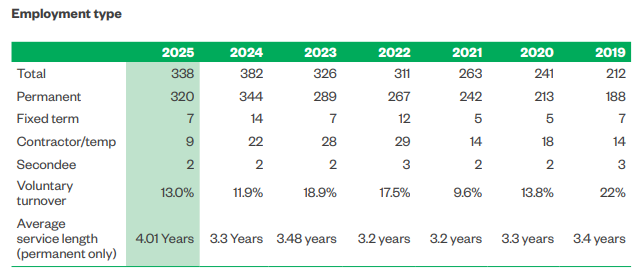
As of June 30 last year, the FMA had 328 staff. It had June 2025 year revenue of $74.208 million and expenses of $75.826 million.
In its last annual report the FMA said staff turnover had increased, with rolling voluntary turnover at 13% as at 30 June 2025, compared to 11.9% as at 30 June 2024. The FMA seeks feedback from those departing to understand their reasons for leaving, what it does well as an organisation, and where it can improve, the annual report said. Citing Official Information Act documents, Stuff reported 77 FMA employees left during the June 2025 year.
Fifteen years on from its launch it feels like the FMA's at a crossroads. To shore-up public confidence there's a need to get to the bottom of what has been going on within the FMA, fix any significant problems, and get on with it.
In an April 2011 press release, just before the FMA's launch, Power said the FMA was; "designed to restore the confidence of mum and dad investors in the financial markets by actively and consistently enforcing financial laws."
That seems to me like a pretty good focus for the FMA to return to. Get the internal culture right, avoid being too chummy with the big end of town, and get on with the job.
We welcome your comments below. If you are not already registered, please register to comment
Remember we welcome robust, respectful and insightful debate. We don't welcome abusive or defamatory comments and will de-register those repeatedly making such comments. Our current comment policy is here.