

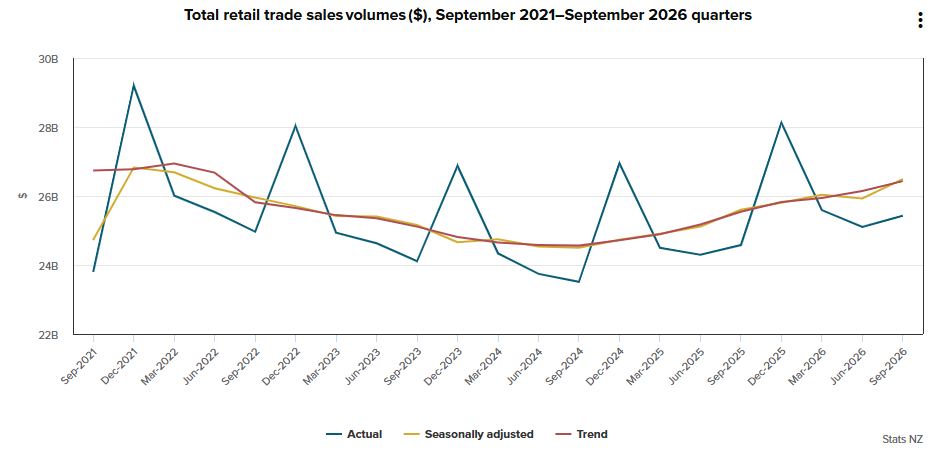
Seasonally adjusted retail sales rose by over half a billion dollars in the September quarter, turning around a decline in retail sales in the June quarter.
The latest retail trade survey from Statistics New Zealand shows total NZ retail sales volumes during the September quarter rose 2.2%, or $561 million, to $26 billion. Stats NZ adjusts sales volumes for price inflation and seasonal effects, while sales values are adjusted for seasonal effects only.
The total value of seasonally adjusted retail sales was up 2.4%, or $791 million, to $33 billion.
In the survey, sales volume measures the physical quantity of products sold, while sales value measures the total monetary amount generated from those sales.
Stats NZ measures sales and stock for businesses that provide household and personal goods and services, such as supermarkets, restaurants, cafes, hotels, petrol stations and car yards.
The total volume in retail sales for the September quarter came in well above predictions from bank economists. BNZ expected retail sales volume to rise 0.8% on a quarterly basis, while ANZ NZ pencilled in a 0.5% increase and ASB estimated a 0.3% quarterly gain.
The sharp increase in that headline figure also marks a turnaround from the fall in seasonally adjusted retail sales volumes reported in the June quarter, driven by the Middle East conflict.
Stats NZ’s economic indicators spokesperson Michelle Feyen said the increase in retail activity in the September quarter was the largest quarterly increase since the December 2021 quarter.
She said motor vehicle and parts retailing, pharmaceutical and other store-based retailing, and fuel retailing saw the largest increases across July, August and September.
Feyen noted that fuel retailing sales values were flat in the September quarter compared with the previous quarter.
“However, once adjusted for price movements, fuel sales had one of the largest increases of the industries measured,” she said.
The largest movements in retail sales volumes over the September quarter were:
- fuel retailing – up 9.5%
- pharmaceutical and other store-based retailing – up 6.4%
- motor vehicle and parts retailing – up 3.8%
- supermarket and grocery stores – up 1.7%
- food and beverage services – up 1.9%
The largest movements in retail sales values over the September quarter were:
- motor vehicle and parts retailing – up 5.9% or $252 million
- supermarket and grocery stores – up 2.4% or $170 million
- food and beverage services – up 2.7% or $113 million
- pharmaceutical and other store-based retailing – up 3.4% or $85 million
- accommodation – up 3.4% or $49 million
Stats NZ said 11 of the 15 retail industries it tracks had lower sales volumes in the September quarter compared with the June quarter. In comparison, 12 of the 15 industries had higher seasonally adjusted sales values in the three months to September compared to the prior quarter.
The total value of stock held at the end of September 2026 was $9.5 billion, up 3.6% or $329 million compared with September 2025.
Stats NZ said the largest retailing movements by industry on an annual basis were motor vehicle and parts retailing (rising 9.8% or $198 million) and fuel retailing (jumping 49% or $98 million).
'A firmness in spending appetites'
Westpac NZ senior economist Satish Ranchhod said the September quarter retail sales report showed a sharp recovery in spending.
“While the strong September quarter result is welcome news, we are taking it with a grain of salt. Much of the rise in spending was related to fuel spending, which was boosted by the fall in fuel prices over the September quarter, and fuel prices have stepped higher since then,” Ranchhod said.
“However, even excluding fuel, we have seen firmness in spending appetites. Core spending (excl. fuel and motor vehicles) was up 1.4% over the September quarter and is 4.7% higher than this time last year.”
Ranchhod said the September quarter retail survey reinforced the bank's expectations that the economy is moving into a stronger phase and showing a “firmness in spending appetites.”
“We expect that spending levels will continue to firm through the holiday season and 2027. However, that recovery is still likely to be gradual due to the combination of ongoing high inflation, a soft labour market and rising interest rates,” he said.
“We also expect the recovery will be uneven, with those regions with strong links to the agricultural and tourism sectors outperforming metro regions, like Auckland and Wellington.”
Stats NZ found all 16 regions had higher seasonally adjusted sales values in the September quarter compared with the June quarter. The three largest regional gains during July, August and September were in Auckland (up 2.5% or $314 million), Otago (up 3.7% or $73 million) and Canterbury (up 1.4% or $64 million).
Retail volume sales provide an idea of where gross domestic product (GDP) activity is heading, due to consumer spending making up a large part of economic activity and growth.
The latest GDP figures – for the June quarter – were released in mid-September, showing the NZ economy had grown by 0.2%. The size of the economy was $455 billion for the year ended June 2026.
The June quarter GDP was above the Reserve Bank’s projection that economic growth would be flat, while economists from NZ’s major banks had forecast lifts of 0.1% to 0.3% in GDP activity.
Ranchhod said Westpac NZ is forecasting GDP growth of 0.6% in the September quarter.
“Today’s result was above expectations. We’ll take a closer look at how our forecast for GDP growth is shaping up over the next couple of weeks as additional data on September quarter activity is released,” he said.
The GDP figures for the September quarter will be released on December 17.
We welcome your comments below. If you are not already registered, please register to comment
Remember we welcome robust, respectful and insightful debate. We don't welcome abusive or defamatory comments and will de-register those repeatedly making such comments. Our current comment policy is here.