
Cast your mind back to October 19, when New Zealanders waited with bated breath for New Zealand First Leader Winston Peters to get through his six-and-a-half-minute long speech, before finally announcing he’d decided to form a government with Labour.
Peters said too many people had come to view today’s capitalism “not as their friend, but as their foe”, and an “economic correction or slowdown” was looming.
Fast forward almost two months, Treasury’s projections for where the economy’s going will make you think Peters was talking about a different New Zealand back in October.
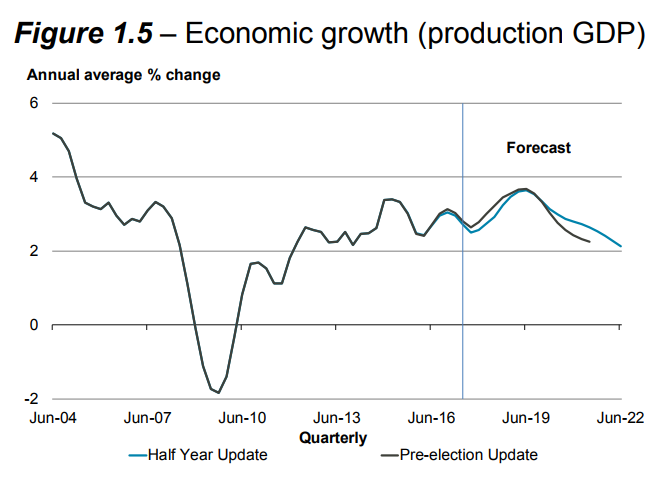
Its Half Year Economic and Fiscal Update is upbeat and doesn’t differ as much as expected from its Pre-Election Fiscal Update released in August.
Treasury sees annual GDP growth averaging at 2.9% over the next five years – a slight improvement from its pre-election forecast.
Yes, the Labour-led Government is going to spend more – channelling all of the money the previous government set aside for tax cuts into its families and tertiary education packages.
And yes, its capital spending on KiwiBuild and resuming contributions to the New Zealand Superannuation Fund will see its net capital spend come close to hitting the $5 billion mark over five years.
But Treasury’s rosy outlook for economic growth, buoyed by population growth, low interest rates, increased government spending, a positive international outlook and higher terms of trade, gives it confidence Labour will be able to follow through on its promise to reduce debt from 21.8% of GDP to 20% of GDP by 2022.
Extra tax revenue only $6.6b over four years
Nonetheless, the Leader of the Opposition, Bill English, hasn’t missed the opportunity to have a go at the Government for the incongruency between Treasury’s projections and the comments made by Peters in October.
English, during question time in Parliament on Thursday, asked: “Has the Prime Minister asked the Deputy Prime Minister whether he believes these [Treasury’s] forecasts given his public statements that the economy is headed for a downturn, if not a crash?”
Answering the question on behalf of the Prime Minster, Deputy Prime Minister Winston Peters said: “Yes the Prime Minister can confirm that – that it was a cause to be careful about into the future, not to spray money around on consumerism and on giving tax breaks to your mates. And in short, not to take from the needy to give to the greedy.”
Finance Minister Grant Robertson too gave assurances during question time that he was confident he would meet his 51 coalition commitments in the budget operating and capital allowances.
Yet Treasury only expects tax revenue to be $6.6 billion higher in the four years to 2020/21, than was forecast in August when it included the National-led Government’s proposed income tax cuts.
Only $0.7 billion of this tax revenue is expected to be “macroeconomic” driven.
Treasury’s projections ‘somewhat of a best-case scenario’
Politicking aside, bank economists believe Treasury has worn rose-tinted glasses, overplaying the amount of wiggle room the Government has to follow through on its spending commitments, while sticking to hitting its debt reduction target.
Westpac economists call Treasury’s forecasts “too optimistic”. ANZ economists say they “represent something of a best-case scenario”, while ASB economists coin them “bullish”.
At the heart of the matter, there’s consensus that the economy can’t growth as much as Treasury thinks it will.
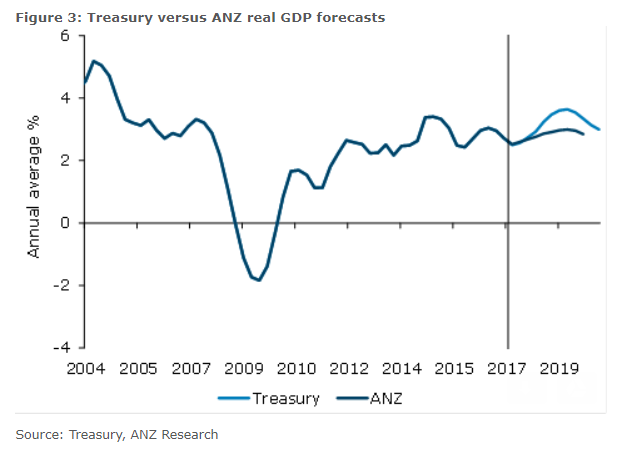
Westpac economists say: “Treasury is forecasting 3.6% GDP growth in the year to June 2019, compared to our own forecast of 2.8%.
“If GDP growth doesn’t accelerate to the extent that the Treasury is projecting, the risk is that the Government revenue will fall short, requiring Government to either rein in some of its spending plans, find additional sources of revenue, or abandon its commitment to reducing net debt so rapidly.”
ANZ economists go on to say Treasury’s growth projections hinge on two assumptions: “First, that despite clear capacity pressures right now, residential investment continues to grow strongly. Second, labour productivity growth picks up to average 1.1% per year over the next five years.
“We are a little sceptical on both fronts. In our view, while we are constructive about prospects going forward, this economy has already picked the low-hanging fruit.”
ASB economists also believe Treasury’s growth forecasts are more upbeat than theirs, as Treasury sees stronger inflation growth.
ANZ economists recognise the new government’s “more expansionary” fiscal stance, but ultimately only see a fiscal boost replacing other growth drivers, such as the housing market and construction, rather than driving the economy to above-trend growth.
We welcome your comments below. If you are not already registered, please register to comment
Remember we welcome robust, respectful and insightful debate. We don't welcome abusive or defamatory comments and will de-register those repeatedly making such comments. Our current comment policy is here.